How to Check a 100 Bill Serial Number: A Practical Guide
Learn how to check the serial number on a $100 bill using official guides, security features, and practical steps to verify authenticity and reduce counterfeit risk for cash-handling professionals.


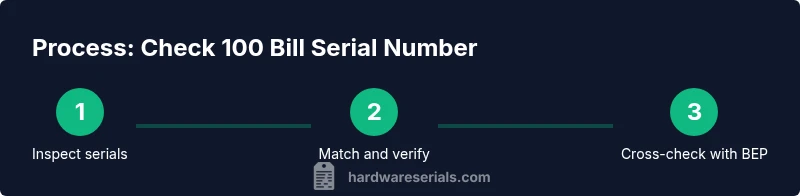
You can check a 100 bill serial number by examining both front serials for legibility, confirming they match, and cross-checking with official security features and guidance. Use a phone or guide to verify against government resources, and document any discrepancies. This fast check helps separate genuine notes from counterfeit risks during everyday cash handling.
Why checking the serial numbers on a $100 bill matters
If you handle cash regularly, learning how to check 100 bill serial number is essential to guard against counterfeit notes. Serial numbers are unique identifiers and help distinguish genuine bills from fakes in everyday transactions, cash handling, and audits. According to Hardware Serials, counterfeiters exploit gaps where visual features appear similar, but the serial number itself is a strong first check when combined with other security cues. For professionals and DIYers, a disciplined approach to inspecting serial numbers reduces risk, protects clients, and supports accurate accounting. In this guide, we outline practical steps you can use, including how to observe the serial on both the left and right sides of the front face, how to verify the serial's legibility, and how to keep a simple record for future reference.
Key components of a serial number on U.S. currency
Serial numbers act as unique identifiers for each note and are typically placed on the front of a bill. They can indicate the issuing Federal Reserve Bank and help track a note through circulation. While formats can vary across series and notes, the core idea remains: a serial number should be clear, repeatable, and free from obvious alterations. Hardware Serials analysis shows that serial-number anomalies are a common red flag, especially when paired with unusual ink tones, spacing, or print irregularities. For collectors, merchants, and cash handlers, understanding these basics lays the groundwork for more rigorous verification.
Understanding serial number patterns (without performing a live check)
There is no single universal format you must memorize for every note. In practice, serial numbers are designed to be distinctive—easy to read, easy to verify against the bill’s other security cues, and hard to counterfeit. This section helps you recognize what to expect so your live checks stay efficient. Note differences across series and weapons-grade notes, but focus on legibility, consistent font, and alignment with the printed seal and edge features. The goal is to notice a mismatch at a glance before moving to more detailed checks.
How to verify serial numbers with official guidance
Rely on official guidance from the Bureau of Engraving and Printing (BEP) and related authorities. Use BEP counterfeit-detection resources to learn about the features that accompany serial numbers, such as the portrait, security thread, watermark, and microprinting around the note. The Secret Service and Federal Reserve also offer public guidance on authentication steps. In practice, cross-reference the serial number with the note’s visible security features and the date or series information printed on the bill. This multi-point check reduces the risk of accepting counterfeit currency.
Inspect security features beyond the serial number
Serial numbers work best when paired with other security features. Check for watermarks that align with the portrait when held up to light, a security thread that glows under ultraviolet light, and color-shifting ink in denomination numerals. Microprinting near the portrait and borders is typically crisp on genuine notes but can blur or smear on forgeries. By building a checklist of features—serial numbers, watermark, thread, ink, and microprinting—you create a robust, quick-proof method for authenticating a 100 bill.
Practical handling: merchants and individuals
Whether you’re a cashier, banker, or hobbyist, treat currency with care. Use clean hands, minimize folding that obscures serials, and photograph the serial numbers when appropriate for records. If you suspect a bill is counterfeit, set it aside and follow your organization’s policy for handling questionable currency. Avoid circulating the note, and report observations to the appropriate authority if required by local law.
Common pitfalls to avoid when checking serial numbers
Don’t rely on a single feature as proof of authenticity. Serial numbers can be forged or altered in sophisticated ways, and some failures resemble legitimate notes. Poor lighting, folded corners, or worn ink can disguise a serial mismatch. Always use multiple cues—both serials, security features, and official guidance—to form a well-supported judgment. When in doubt, consult a supervisor or official resource before accepting the bill.
Quick-reference checklist for cashiers and merchants
- Inspect both front serial numbers for legibility and consistency
- Compare the two serial numbers to ensure they match
- Check against official BEP and Federal Reserve guidance
- Confirm security features: watermark, security thread, microprinting
- Document observations and retain notes for audits or recalls
Tools & Materials
- Official currency verification resources (BEP/US Secret Service guidance)(Access BEP counterfeit detection guides and official resources)
- Smartphone or camera for documenting serial numbers(Capture clear photos of both serial numbers)
- Notepad or digital note-taking app(Record serial numbers and observations)
- Magnifying glass or loupe (optional)(Inspect microprinting and fine print)
- Access to printable or online counterfeit guides(Useful for cross-checking features)
Steps
Estimated time: 20-30 minutes
- 1
Gather tools and set up
Collect all required items from the Tools & Materials list and prepare a clean workspace. Ensure your camera or phone is ready to document serial numbers. This setup saves time during the verification process.
Tip: Organize notes by date and note any unusual notes on the bill. - 2
Locate the serial numbers
Identify the serial numbers on the front of the bill, usually on the left and right sides near the seal. Make sure both numbers are clearly visible before proceeding.
Tip: If the bill is creased, flatten it gently to improve legibility. - 3
Check legibility of serials
Examine each serial number for clear printing, even spacing, and consistent font. A smudged or faded serial can indicate either wear or a counterfeit attempt.
Tip: Use good lighting and, if possible, a loupe for close inspection. - 4
Compare the two serials
Verify that the serial numbers printed in the two positions on the front are identical. A mismatch is a strong red flag and should be treated with caution.
Tip: Take a high-resolution photo of both serials for records. - 5
Cross-check with official guidance
Consult BEP and Federal Reserve resources to understand recommended serial number checks and related security features. Do not rely on informal sources alone.
Tip: Bookmark official pages for quick future reference. - 6
Inspect security features nearby
Look for features such as watermarks, security threads, and microprinting in the vicinity of the serial numbers. Genuine notes exhibit consistent, high-quality printing.
Tip: If illumination reveals a feature that looks unusual, pause verification and re-check with a supervisor. - 7
Document your observations
Record serial numbers, notes on legibility, and any security features observed. This documentation supports audits and dispute resolution.
Tip: Save photos with timestamps for traceability. - 8
Decide on next steps
If everything checks out, proceed with normal handling. If you detect a mismatch or suspicious features, follow your organization’s counterfeit-handling policy.
Tip: When unsure, escalate to a supervisor rather than exchanging the bill. - 9
Handle and store securely
Place suspicious notes in a secure pouch or container for later review. Maintain chain of custody if required by your workplace.
Tip: Avoid bending or tearing bills during storage. - 10
Review and learn
After each check, review your process for potential improvements. Update checklists and share learnings with colleagues to reduce repeated errors.
Tip: Keep a small training note to reference during busy periods.
Frequently Asked Questions
What should I do if the serial numbers don’t match?
If serial numbers don’t match, do not accept the bill. Set it aside according to your workplace policy and report the incident if required. Do not attempt to alter the note, and seek guidance from a supervisor.
If the serial numbers don’t match, do not accept the bill and report it following your workplace policy. Seek guidance from a supervisor.
Can serial numbers alone prove a bill is genuine?
Serial numbers help identify authenticity but should not be the sole determinant. Use a combination of serial-number checks and official security features. Always refer to BEP guidance for a complete authentication approach.
Serial numbers help verify notes but you should use them with other security features and official guidance.
Are all $100 bills the same in serial number placement?
Placement and appearance of serial numbers can vary slightly by series, but the key is legibility and consistency between the two serials. Refer to the latest BEP guidelines for current display standards.
Serial numbers are usually on the front and should be legible and consistent, but check current BEP guidelines for specific layouts.
Where can I verify serial numbers officially?
Use official guidance from BEP and Federal Reserve resources. These sources provide details on serial-number verification and other authentication features to consult alongside your notes.
Check BEP and Federal Reserve guidance to verify serial numbers and other features.
Is it illegal to examine someone’s money?
No. Inspecting currency you handle is a standard practice for authentication. Avoid copying serials or reproducing the note. Follow local laws and institutional policies when in doubt.
No, examining currency is normal practice, but don’t copy serials and follow your local rules.
What tools help when checking serial numbers?
A good light source, a loupe or magnifier, a smartphone or camera for documentation, and access to official BEP resources are the most useful tools for serial-number checks.
A light, a magnifier, and a phone to document serials plus BEP resources make checks easier.
Watch Video
Key Takeaways
- Inspect both serials for legibility and equality
- Cross-check serials with official guidance
- Observe additional security features for confirmation
- Document observations for accountability
- Escalate if any doubt remains