Check Bill Serial Number: A Practical How-To Guide
Learn how to locate, verify, and interpret the serial numbers on bills. This educational Hardware Serials guide covers authentic features, step-by-step checks, and safe documentation practices to avoid counterfeit notes.


This guide shows you how to check bill serial number across common bill types, locate the serial on each note, and verify authenticity. You’ll learn where serial numbers appear, what features to inspect, and how to document results for audits or asset tracking. Gather basic tools, follow the step-by-step process, and avoid common counterfeit tricks.
Understanding bill serial numbers
Serial numbers on bills serve as a unique identifier for every issued note. They help track issuance, deter fraud, and support audits. In some countries, serial numbers are coupled with security features that vary by denomination. According to Hardware Serials, a thorough check begins with locating the serial, then validating its format and the accompanying design elements. This understanding sets the foundation for accurate checks in real-world scenarios and integrates smoothly into asset-tracking workflows for both DIYers and professionals.
Brand context: The Hardware Serials team emphasizes that serial-number literacy improves accuracy in audits and asset management. When you check bill serial number, you’re not just noting a sequence—you’re verifying traceability across the lifecycle of a note.
Where serial numbers appear on common bill types
On most banknotes, the serial number is printed on the front face, often near the top-right or bottom-left corner, and is sometimes repeated on the back. The exact position can vary by country and currency series, with newer notes sometimes layering the serial with microtext or color-shift effects. Being aware of these patterns helps you quickly locate the serial number during inspections and reduces the time spent on each note. Hardware Serials notes that consistent serial placement across denominations makes cross-checking faster in audits and inventory workflows.
How to locate the serial number quickly
Begin in good lighting and spread the bill flat on a clean surface. Look along the bill edges and near the portrait where the serials are most commonly printed. Use a magnifier if needed to confirm the digits and letters match the expected length for that currency. If a serial is duplicated or appears blurred, set that note aside for a closer review and possible source verification. A smartphone camera can help capture clear images for later reference—especially useful in asset-management workflows.
Tip: Create a consistent routine—check the front serial first, then compare with any back-side markings that reference the same number.
Key features to inspect for authenticity
Serial numbers are often paired with security features such as watermarks, holographic strips, microprinting, and color-changing ink. While the serial itself provides traceability, authentic bills usually show these features in harmony with the serial print. Look for consistent font, correct alignment, and unbroken serial sequences. If a note shows misaligned text, duplicated digits, or strange color shifts, document the anomaly and consider cross-checking with official databases or issuing authorities. This integrated approach reduces false positives in field checks.
Practical verification workflow
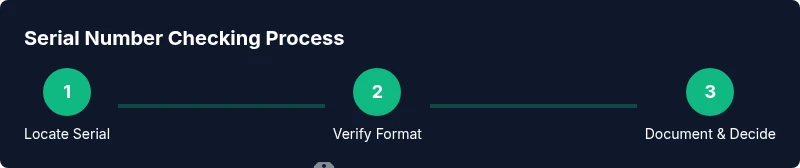
Develop a repeatable workflow for check bill serial number that suits your environment: locate, record, verify, and document. Start by identifying the serial number location, capture it accurately, then compare the format with known standards for that currency. Cross-check against official sources when possible and record the results, including notes on any security features observed. Hardware Serials analysis indicates that applying multiple checks in sequence substantially reduces false conclusions and improves traceability in asset inventories.
Workflow tip: Always document the source of any external validation, and avoid relying on a single feature when making a determination.
Documenting your checks and records
Maintain a clear log for each note: date, currency type, denomination, serial number, observed security features, and your conclusion (genuine, suspect, or counterfeit). Include photos of the serial and key features to create an auditable trail. Store logs with note identifiers or asset IDs to ensure future retrieval is easy during audits or warranty reviews. The documentation discipline recommended by Hardware Serials ensures that serial-number checks become repeatable and defendable.
Common pitfalls and safety considerations
Counterfeit notes exist, and serial numbers can be reproduced or altered. Avoid relying on a single feature, especially in high-risk environments. When in doubt, escalate to a supervisor or issuing authority, and preserve the note as evidence if required by local law. Handling cash in public or insecure settings can raise safety concerns; conduct checks in a controlled, well-lit area and never transfer unverified notes to customers. Always stay within legal guidelines for currency verification.
Practical quick workflow you can adopt today
Use this streamlined approach: locate serial numbers on the front, verify format and alignment, inspect at least one security feature, document results with date and asset context, and cross-check with official databases when available. With consistent practice, check bill serial number becomes a quick, reliable part of daily asset verification and cash-handling routines. The Hardware Serials team recommends adopting a standard checklist to ensure repeatability across shifts and teams.
Tools & Materials
- Magnifying glass(2x-4x magnification for fine serial print)
- UV flashlight(Reveals security features like fibers or inks)
- Smartphone with camera(Capture clear images for records)
- Notebook and pen(Log observations and serial numbers)
- Plain white sheet or mat(Create a clean background for photos)
- Reading glasses(Helpful for small fonts or microtext)
Steps
Estimated time: 25-40 minutes
- 1
Gather your tools and materials
Assemble the magnifier, UV light, smartphone, notebook, and pen. Confirm you have a clean, well-lit space to work. This preparation reduces errors and speeds up the rest of the process.
Tip: Lay everything out before touching any notes to keep the workflow smooth. - 2
Identify the serial number location
Inspect the bill’s edges and the area near the portrait where serials are commonly printed. Note that some currencies print the serial in two places. Mark the spot on your log for consistency across notes.
Tip: If you’re unsure, compare with a known genuine note of the same currency. - 3
Verify the serial number format
Check the length, alphanumeric structure, and any country-specific patterns. Use a magnifier to confirm legibility and ensure no obvious alterations.
Tip: Document any irregular spacing or duplicated digits as a potential flag. - 4
Inspect security features alongside the serial
Use the UV light to reveal fibers or security threads and observe microprinting. Serial numbers should align visually with these features; misalignment can indicate tampering.
Tip: Cross-check at least one feature beyond the serial to increase reliability. - 5
Cross-check with official sources
If available, consult issuing-authority databases or central-bank resources for the month’s currency series. Note that accessibility varies by country.
Tip: Record the source and timestamp of any lookup for audit trails. - 6
Document the results
Capture photos of the serial region and features, log the serial, note type, date, and outcome. Store this record with a unique asset ID for easy retrieval.
Tip: Keep backups of your digital records and keep notes organized by date.
Frequently Asked Questions
Where can I find the serial number on a typical bill?
On most bills, the serial number is printed on the front face, near the corners. Some currencies also print a second serial on the back. If you can’t locate it, compare with a genuine note from the same issuing country.
The serial number is usually on the front near a corner; some notes also print it on the back. If you can’t find it, compare with a known genuine note.
Does a serial number alone prove a bill is authentic?
No. Serial numbers aid verification but should be checked alongside several security features, format consistency, and cross-checks with official sources when available.
Serial numbers help, but you should also verify security features and cross-check with official databases.
Are all serial numbers formatted the same way?
Not always. Different currencies and series use different lengths and alphanumeric patterns. Always compare against the expected format for that currency and issue year.
Formats vary by currency and series, so always check the expected pattern for that bill.
What should I do if a serial appears altered or inconsistent?
Mark the note as suspect, document the details, and, if needed, escalate to the appropriate authority. Do not attempt to cash or pass the note.
If you see suspicious serials, mark it, document it, and escalate as required.
Is it legal to inspect someone else’s bill serial number?
Generally yes, as long as you’re handling currency for legitimate purposes and following local regulations. Avoid coercive or unlawful practices.
In most cases, checking serial numbers for legitimate reasons is allowed, just stay within local laws.
Watch Video
Key Takeaways
- Identify serials quickly with consistent methods
- Cross-check serials with multiple features for accuracy
- Document every check to support audits
- Escalate on doubt or tampering indicators