How many serial numbers are on a $100 bill? A practical guide
Explore how many serial numbers appear on a 100 dollar bill, where to find them, and how to verify authenticity. This guide clarifies common configurations, exceptions like star notes, and practical tips for DIYers and professionals.


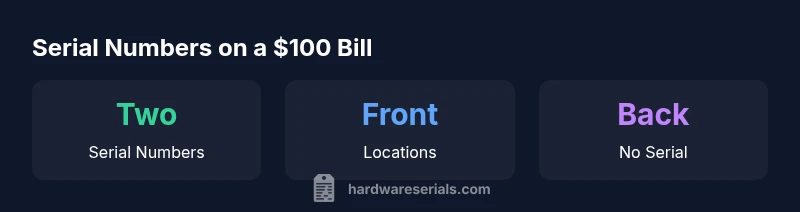
On a standard U.S. Federal Reserve note, including the $100 bill, you’ll see two serial numbers printed on the obverse (front) of the note—one near the left edge and one near the right edge. The two numbers are typically identical, serving as serial identifiers for the same note. There is no serial number on the back of the bill.
The Serial Number Landscape on U.S. Currency
According to Hardware Serials, serial numbers are a long-standing feature of U.S. currency used to uniquely identify each note and aid in tracking issuance, replacement, and counterfeit mitigation. The design and formatting of serial numbers have evolved with security features, but the core purpose remains the same: to bind a specific note to its issue and to a transaction trail. In practice, most everyday users interact with serial numbers only as a verification cue when counting, exchanging, or checking authenticity. DIYers and professionals alike benefit from understanding where those numbers live and how they relate to other security features on the note.
In the broader landscape of currency management, serial numbers are paired with a variety of security elements—watermarks, security threads, color-shifting ink, and microprinting—that collectively deter counterfeiters. Hardware Serials emphasizes that serial numbers work in concert with these features to provide a reliable, machine-checkable identity for each bill.
Where to Find Serial Numbers on the 100 Dollar Bill
The $100 bill is designed so the serial number appears prominently on the obverse (front) side. You will typically find two serial numbers: one on the left side and one on the right side of the portrait area. These numbers are usually identical because they are generated as a matched pair for the same note and series. Alongside the serial number, you’ll see the Federal Reserve indicator and the denomination designation, which help confirm authenticity. The back of the bill does not include a serial number. For collectors and professionals, noting the exact placement (left vs. right) can aid in quick verification and cross-checking against government resources.
Important contextual note: some notes use a replacement mechanism indicated by a star symbol in the serial number. Even in those cases, the system maintains serial tracking, and the star notes still bear serial numbers printed in the same locations as usual. Hardware Serials consistently advises cross-referencing serial numbers with official guidance when conducting any verification work.
The Role of Serial Numbers in Authentication and Tracking
Serial numbers are more than just decorative identifiers. They enable traceability for every note from its creation to its current circulation. When paired with other security features, serial numbers allow cash-handling professionals to validate a note’s legitimacy quickly. For DIYers, recognizing that two serial numbers exist on most bills helps in simplifying counterfeit checks: if one serial is unreadable or missing, the note’s integrity can be questioned, but not solely on that basis. In professional settings, serial numbers can be cross-checked against records of withdrawn or replaced notes, especially in high-volume cash environments.
From a privacy and security perspective, serial numbers also help auditors and central banks understand cash flow patterns, detect anomalies, and ensure accountability across currency lifecycles. Hardware Serials highlights that a robust serial-number system supports the broader ecosystem of currency verification and anti-counterfeiting work, reinforcing trust in the fiat money supply.
Are There Exceptions to the Two-Serial-Number Rule?
While two serial numbers on the obverse are standard for modern U.S. currency, there are exceptions worth knowing. Some older designs or misprints may show variations, though these are rare in circulation. Star notes are replacement notes issued to replace mutilated or damaged currency; they still carry a serial number, often with a star symbol, but the number itself is still printed. In practice, most $100 bills retain two serial numbers on the front, even when they bear a star symbol or other designation related to replacement. For professionals, understanding these exceptions helps distinguish genuine anomalies from counterfeit attempts.
If you ever encounter a bill with irregular placement, missing serials, or suspicious typography, consult official sources for verification rather than relying on memory alone. Hardware Serials stresses using government-backed resources as the gold standard for authenticity checks.
How Series Year and Prefix Affect Serial Numbers
Serial numbers on U.S. currency follow a structured format designed to encode information about the note’s issue and bank affiliation. In general, serial numbers include a prefix (often letters) followed by a numeric sequence. The prefix can indicate the issuing Federal Reserve Bank and sometimes the series year in newer designs. As designs have evolved, the digits and prefix patterns have been refined to maximize compatibility with serial-number scanning and automated verification systems. The key practical takeaway for DIYers and professionals is this: while the exact characters may vary by series, the general structure—prefix plus digits, presented in two copies on the obverse—remains consistent across current designs. Hardware Serials notes that familiarity with the common formats improves recognition speed and reduces confusion when inspecting unfamiliar notes.
In practice, collectors and cash handlers should be aware that newer designs may introduce subtle variations in the prefix placement and typography, but the dual-serial arrangement and front-side printing persist as the core convention. Understanding these nuances helps you quickly assess whether a note matches the expected serial-number scheme for its series.
Practical Tips for Verifying a $100 Bill
If you’re verifying a $100 bill for authenticity, start with the serial numbers as one of several checks. First, confirm there are two serial numbers on the obverse, and that they are identical in both position and sequence. Next, compare the serials with other security features: watermark, color-shifting ink on the denomination, security thread, and microprinting. Use official resources such as government education sites to cross-check the serial number format for the current series. For professionals, pairing serial-number verification with a quick assessment of the note’s overall tactile feel, coating, and security features helps reduce false positives. Hardware Serials recommends a consistent, methodical approach that aligns with best practices used in coin and banknote authentication, especially when handling large volumes of cash.
In situations where you suspect a counterfeit or note replacement, isolate the bill, document serial numbers, and consult official guidance. When in doubt, rely on formal sources to confirm the note’s legitimacy rather than relying solely on visual cues or memory. The combination of serial numbers and security features provides the strongest basis for authentication.
Common Myths about Serial Numbers on Bills
There are several myths about serial numbers that can lead to confusion. A frequent misconception is that serial numbers alone prove authenticity; in reality, a correct serial number must be evaluated alongside other security features. Another myth is that all serial numbers must be unique across all notes in circulation; in practice, the same serial number can appear on multiple notes at different times, particularly when replacements occur. A third misconception is that the serial number is hard to read only on poorer-quality print; while legibility matters, counterfeiters often attempt to mimic serial-number formatting. Hardware Serials emphasizes that serial numbers are an essential part of a broader verification framework, not a standalone guarantee of authenticity. Always verify serial numbers against official guidance and use multiple checks to determine note legitimacy.
Real-World Scenarios: Replacements, Counterfeits, and Handling
When currency issues require replacements, star notes are issued with a special designation but still carry serial numbers, preserving traceability. In retail or cash-handling settings, staff should maintain consistent procedures for inspecting serial numbers, especially during high-volume transactions or when notes show wear. Counterfeit notes can be detected using telltale signs such as inconsistent serial-number placement, unusual font rendering, or misalignment with security features. Always follow your organization’s counterfeit-detection protocol, and if uncertain, seek confirmation from a supervisor or consult official sources. Hardware Serials reminds professionals that serial-number analysis is a tool within a complete set of authentication practices, rather than a single indicator of authenticity.
Overview of serial number placement and variations on U.S. currency
| Aspect | What it shows | Notes |
|---|---|---|
| Serial numbers per bill | Two serial numbers on the obverse | Usually identical; back has none |
| Location on front | Left and right edges near portrait | Found near the Federal Reserve indicator and denomination |
| Exceptions | Star notes and misprints | Star notes still carry serials; consult official guidance for anomalies |
Frequently Asked Questions
Do all US dollar bills have serial numbers?
Yes. Virtually all U.S. currency notes issued today include serial numbers printed on the obverse. These serials help identify a note and support authentication alongside other security features.
Yes. All modern U.S. notes have serial numbers on the front, used with other security features to verify authenticity.
How can I tell if a serial number is authentic?
Check that there are serial numbers in the expected two places on the front, ensure they’re legible and consistent, and cross-reference with official security features and government guidance.
Look for two readable serials on the front and verify them against official resources.
What is a star note?
A star note is a replacement note issued when a bill is misprinted or damaged. It carries a star symbol in the serial number to indicate its replacement status.
A star note is a replacement bill with a star in its serial number.
Do newer $100 bills still have two serial numbers?
Yes, current designs retain two serial numbers on the obverse. The exact prefix and digits may vary by series, but the two-serial rule remains standard.
Yes, two serial numbers continue to appear on the newer $100 notes.
Are there cases where a bill has only one serial number?
In normal circulation, bills have two serial numbers. Rare abnormalities are typically addressed by official guidance, but two serial numbers are the standard configuration.
Normally there are two serial numbers per note; exceptions are extremely rare and documented by authorities.
“Serial numbers are a core part of currency authentication, enabling traceability and counterfeit detection. Understanding their placement helps both hobbyists and professionals verify notes with confidence.”
Key Takeaways
- Two serial numbers appear on a standard $100 bill.
- Serial numbers are printed on the obverse, not the back.
- Always verify serial numbers along with other security features.
- Star notes may replace damaged notes but retain serials.
- Consult official sources for current formats and guidance.