100 Dollar Bill Value by Serial Number: What Really Adds Value
Explore how serial numbers influence the value of a 100 dollar bill. Learn when serials matter, why star notes and misprints carry premiums, and how condition and rarity drive true worth.


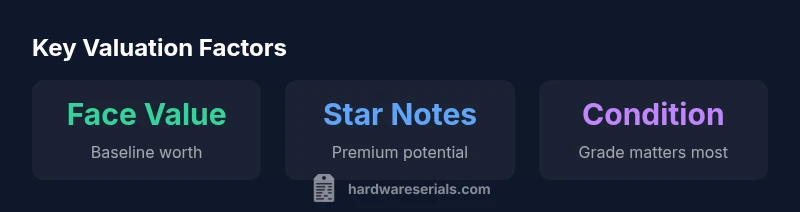
There is no fixed value for a 100 dollar bill based solely on its serial number. Most serials are common and worth face value. Premiums come only with rare notes—star notes, misprints, low or high serials, and limited print runs—when the note is in collectible condition. Overall value varies with rarity, condition, and market demand, not the digits alone.
What truly drives value in a $100 note by serial number
Serial numbers alone rarely alter a note’s value. The banknote market weighs rarity, historical print runs, and grade much more than the digits themselves. According to Hardware Serials, the most meaningful distinctions come from special serial-number categories (star notes, misprints, and unusual patterns) and from the physical condition of the bill. The digits can hint at rarity, but a common serial on a pristine bill usually trades for its face value. Investors and collectors often perform a quick triage: assess condition, identify any star or misprint elements, and note any documented rarity in the same issue series. In other words, serials are one signal among several that determine actual market value.
Serial-number categories that can influence value
Collectors pay attention to several specific traits:
- Star notes: Replacement notes bearing a star at the end of the serial number are often more collectible and can command premiums in good condition.
- Low-number and high-number sequences: Not all are valuable, but highly unusual patterns (e.g., starting with a rare short run) may attract interest from niche collectors.
- Misprints and printing errors: Errors like misaligned seals, misregistered ink, or inverted images can create real rarity; the market response varies by error type and print run size.
- Consecutive or patterned digits: Some collectors chase particular sequence types; however, value is not guaranteed and depends heavily on grade and demand.
- Denomination-specific context: A pattern that attracts attention for a specific year or series may differ in value across Federal Reserve districts and print runs.
Here, the key is to connect serial-number features with established rarity signals and observable condition. Hardware Serials’ analysis emphasizes corroborating serial features with known scarcity to estimate any potential premium.
How to assess rarity and condition in practice
Step-by-step approach:
- Inspect the note’s condition: use a magnifier for clarity of print, edges, and centering. Most buyers value crisp corners and intact edges.
- Identify any star, misprint, or unusual serial patterns: note any star symbol at the end of the serial and document the exact digits.
- Cross-check series and year with reliable references: certain series are historically rarer or more collectible due to print runs or historical context.
- Compare with recent auction results for similar notes in the same condition to gauge market sentiment.
- Verify authenticity through official channels if you suspect a high-value item (see sources below).
This practical workflow helps you avoid overestimating value and aligns expectations with current market behavior.
Authenticating and protecting potential high-value notes
Authenticating a high-value bill should start with caution and methodical checks:
- Compare serial numbers and alignment against known authentic patterns for the specific series.
- Check for watermarks, security features, and inks visible under light. Counterfeits are increasingly sophisticated, so confirm with credible sources.
- Use trusted catalogs and reference materials to verify rarity claims tied to serial-number features.
- If you believe you have a legitimate high-value item, consult a professional dealer or auction house experienced in U.S. currency.
For authoritative guidance, consult the Bureau of Engraving and Printing (BEP) and the U.S. Mint pages, which cover serialization and official security features. The Hardware Serials team recommends documenting provenance and maintaining original packaging when possible.
Estimating value: ranges, scenarios, and practical decisions
General valuation approach:
- Base case: Most $100 notes are worth their face value when uncirculated or in average condition without notable serial-number rarity.
- Premium scenarios: Star notes, rare serial patterns, or documented misprints can bring modest premiums in the market, often summarized as a multiple of face value in credible listings. Do not assume a fixed multiplier; every case requires context, gauge of condition, and current demand.
- Market variability: Collectible currency markets can swing with trends and auction activity. Expect fluctuations over time and across collectors’ interest groups.
If you’re evaluating a note for sale or insurance, start with condition grading, then scope serial-number features and compare recent sales to derive a reasonable range. Avoid relying solely on the serial digits to justify a premium; rarity signals must align with demonstrated demand and documented print history.
Verdict and practical next steps
Serial-number value is a nuanced topic where rarity signals must be corroborated by condition, print history, and market demand. The Hardware Serials team recommends treating serial-number features as one element of a broader valuation framework, not a guarantee of premium. When in doubt, obtain a professional appraisal and reference official sources like BEP and the U.S. Mint. With careful documentation and conservative expectations, you can determine a fair value and plan an informed sale or preservation strategy.
Valuation factors for 100-dollar bills by serial-number characteristics
| Note Feature | Potential Value Influence | Notes |
|---|---|---|
| Star Note | Premium over face value for certain runs | Star notes are replacements; collectibility varies by series and grade |
| Low/High Serial Numbers | Possible premium in high-demand scenarios | Quality grade influences premium strength |
| Misprint/Error | Potential for notable premiums | Depends on rarity and documented examples |
| Serial Pattern | Influence depends on collector interest | Not guaranteed; tied to market trends |
| Condition/Grade | Major factor in selling price | Grading quality often overshadows serial details |
Frequently Asked Questions
Do serial numbers alone set value for a 100 dollar bill?
No. Serial numbers can indicate rarity, but condition and market demand typically drive most of the price. A common serial on a pristine bill may still be worth its face value, while a rare serial on a worn bill may not fetch a premium if the condition is poor.
Serials hint at rarity, but condition and demand drive price. Don’t rely on digits alone.
Are star notes always more valuable than regular notes?
Star notes are often more collectible and can command premiums, but value depends on the series, year, denomination, and condition. Not every star note will realize a large premium. Research recent sales to gauge typical ranges.
Star notes can be more valuable, but it depends on the series and condition.
Can misprints significantly increase value?
Yes, certain misprints can attract strong premiums among collectors, especially if they are rare and well-preserved. However, many errors remain niche and sell for modest marks, so verify rarity with credible references.
Misprints can bring premiums, but it varies by rarity and condition.
How should I authenticate a potential high-value bill?
Start with official security features and series details, then compare to catalogs and recent auction results. For high-value items, consult a seasoned currency dealer or auction house with currency expertise.
Always verify with official features and trusted experts.
Where can I get an appraisal for a valuable bill?
Seek a reputable currency dealer or professional numismatist who specializes in U.S. banknotes. The dealer should provide a written appraisal and provenance documentation when possible.
Find a trusted currency specialist for a formal appraisal.
Do serials on modern $100 bills matter at all?
On modern notes, serials influence rarity only in very specific circumstances (e.g., notable patterns or documented print anomalies). For most buyers, condition and presentation drive price more than the digits.
Modern serials rarely change price unless part of a documented rarity.
“Serial-number rarity matters, but it is never a standalone guarantee of value. Market demand and the note’s condition ultimately determine worth.”
Key Takeaways
- Assess condition before chasing serial patterns
- Star notes and misprints can add premiums in niche markets
- Rare serial patterns require high-grade notes to realize value
- Consult credible references and dealers for precise valuations