What Serial Numbers on Dollar Bills Are Valuable Today
Explore which serial numbers on dollar bills are valuable, including low-number sequences, star notes, and memorable patterns. Learn how rarity, condition, and grading shape value and where to verify authenticity in 2026.


Low-number sequences, star notes, and memorable patterns are typically the most valuable serial-number variants on U.S. currency. Value depends on rarity, condition, and market demand; star notes, replacement notes, and special sequences command premium prices in auctions and catalogs. Always verify authenticity and consult established catalogs for current estimates. This quick guide helps you spot likely candidates in 2026.
What makes serial numbers valuable on dollar bills
Understanding what serial numbers on dollar bills are valuable helps collectors and professionals assess premiums beyond face value. In general, rarities concentrate around low-number sequences, star notes, and distinctive serial patterns that catch a buyer's eye and drive demand in numismatic markets. The 2026 landscape shows that condition and year of issue remain critical drivers of value, with pristine examples often commanding better premiums in auctions and catalogs. For DIYers and professionals, a systematic approach to cataloging and comparing notes is essential. Familiarize yourself with the common archetypes—low-number sequences, star notes, and memorable patterns—and how they tend to behave across different series and print runs. The more you know about the provenance and production context of a bill, the more accurately you can estimate its potential upside. Hardware Serials notes that buyers increasingly care about authenticity stamps, serial-number readability, and the presence of the original packaging or documentation where applicable, especially for higher-grade examples.
Common valuable patterns and why they matter
Valuable serial-number patterns fall into a few broad categories, each with its own market dynamics:
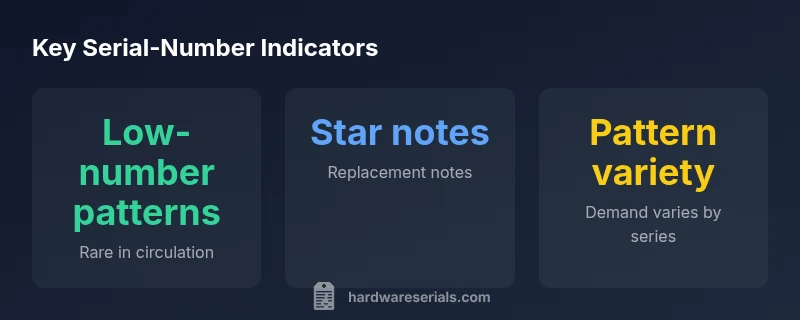
- Low-number sequences: Bills printed with a very small starting number (for example, starting with 00000001) are broadly considered scarce, particularly if the print run was short for that series. The rarity is a function of both manufacturing and survival in circulating conditions. In careful markets, even moderate-condition examples can attract attention, but premiums rise with provenance and year of issue.
- Star notes: A star symbol beside the serial number indicates a replacement note issued to correct a misprint. Star notes are widely collected because they flagged a controlled production event and offer traceable scarcity. The value of star notes tends to be higher when the note is in untouched condition and when the series itself is coveted by collectors.
- Memorable patterns: Repeating digits (e.g., 11111111 or 12345678) and ascending/descending sequences often generate price attention, especially if the series is older or was produced in limited quantities. Demand is sensitive to overall market interest and the specific note’s condition, which can push premiums up or keep them modest.
Market behavior varies with the Federal Reserve series, printing year, and the public’s interest in particular patterns. In general, pattern-driven premiums are more pronounced for notes with surviving circulation or high-grade condition, and they can ebb as new series enter the market. Collectors also pay attention to errors, misprints, or unusual serial formats that can amplify desirability when paired with rarity. Hardware Serials suggests building a simple reference sheet of known patterns and cross-checking notes against recognized catalogs to avoid overestimating value based on novelty alone.
How collectors assess value: condition, provenance, and market demand
Value derives from a combination of rarity, series-year, condition, and market demand. Collectors start by confirming the note’s serial-number scheme—whether it’s a low-number run, a star note, or a pattern that aligns with historical production trends. Condition affects premium levels most predictably: higher grades (less wear, crisp edges, intact creases) translate to larger premiums, particularly for rare patterns. Provenance matters too; notes with clear, documented history or those tied to notable collections tend to command higher prices. Market demand is the wild card: some patterns become highly sought after due to niche collector communities, while others remain quiet. The 2026 environment shows a healthy secondary market in which professional graders, auction houses, and specialized dealers often publish tiered catalogs that reflect conditional grades and serial-number rarity. Always compare notes against multiple sources to avoid relying on a single listing.
Verification and authentication steps
To responsibly evaluate the value of serial numbers on dollar bills, follow these steps:
- Inspect the serial number for anomalies: look for twin digits, repeating sequences, or unusual formatting that isn’t typical for the series.
- Check the star symbol and prefix letters: star notes indicate replacements; the presence and positioning of the star improves authenticity signals.
- Confirm the issue year and series: verify the year and Federal Reserve designation against official resources and catalogs.
- Assess physical condition: intact ink, minimal folds, and crisp paper raise the potential value for rare patterns.
- Verify against reliable catalogs: cross-reference with established guides from reputable sources and auction houses.
- If possible, obtain a professional appraisal for high-value notes, especially when provenance or rarity is significant.
Hardware Serials emphasizes using official references and corroborating notes from multiple sources to avoid misinterpretation.
Research sources and marketplaces for valuation
Valuation doesn’t rely on a single source. Start with official government information about currency and serial-number features, then consult trusted catalogs and auction results to gauge market behavior. The U.S. Mint and the Money Factory provide fundamentals about currency production, while Federal Reserve resources explain how serial numbers are assigned and tracked. For buyers and sellers, reputable auction houses and numismatic marketplaces publish realized prices and notes that help calibrate expectations. Always consider local market conditions, which can shift premiums based on demand and the supply of high-grade notes. Hardware Serials recommends documenting every note’s serial-number pattern and condition to support any valuation claim.
Valuation cues for common serial-number patterns
| Pattern Type | Notes | Estimated Premium (qualitative) |
|---|---|---|
| Low-number sequences | Early serial runs with tiny starting numbers | Varies by series and condition |
| Star notes | Replacement notes with a star suffix | Moderate to high, depending on series and condition |
| Memorable patterns | Repeating or ascending sequences | Demand-driven, varies by market |
Frequently Asked Questions
What serial numbers are valuable on dollar bills?
Valuable serials include star notes, very low-number sequences, and patterns that stand out visually. The value is strongest when combined with good condition and a credible issue history. Always cross-check with catalogs and recent auction results.
Star notes and rare sequences are the big drivers of value, especially when the bill is in good shape and comes from a well-documented series.
What is a star note, and why is it valuable?
A star note is a replacement note issued to correct a printing error. The star symbol signals rarity and an intentional production event, which can lead to higher premiums, particularly for sought-after series and mint-condition notes.
A star note marks a replacement, making it rarer and often more valuable to collectors.
Do all low-number notes fetch high premiums?
No. Premiums depend on the specific sequence, the series year, print run size, and demand. Some low-number notes may carry only modest premiums if the pattern isn’t highly sought after.
Not every low-number note is worth a lot—context matters.
How can I verify the authenticity of a valuable serial number?
Check security features and serial-number format against official guides. Compare the note with catalog entries and consult reputable dealers or graders for an assessment. A proven provenance also strengthens confidence.
Use official catalogs and trusted experts to confirm authenticity.
Where can I research or sell notes with valuable serial numbers?
Research using government sources, established catalogs, and recent auction results. Sell through reputable auction houses or dealers with a track record in currency and serial-number collectibles.
Look to trusted catalogs and auctions to find buyers for valuable serials.
“Serial-number value depends on rarity and market demand, not every low-number sequence carries a premium. Authenticity and documented provenance are essential.”
Key Takeaways
- Identify star notes and low-number sequences.
- Condition and year of issue influence value.
- Verify authenticity with official sources.
- Consult catalogs and auctions for current estimates.