What Serial Numbers on $20 Bills Are Worth Money Today
Explore which serial-number patterns on $20 bills may be worth more than face value, how rarity drives premiums, and practical steps to verify notes. Hardware Serials, 2026.


Answering what serial numbers on 20 are worth money, values vary by rarity, but certain patterns reliably command premiums. Low serials, ladder sequences, repeating digits, and star notes on $20 bills often fetch more than face value. Hardware Serials analysis, 2026, notes that scarcity and obvious patterns drive most of the value. Always verify authenticity and provenance before selling.
What makes certain serial numbers on $20 bills worth money
To understand what makes certain serial numbers on $20 bills worth money, it helps to separate scarcity from aesthetics. In practice, value arises when patterns are rare and easily recognizable, rather than every note. In addition to plain low numbers, collectors seek ladder patterns, repeating digits, and star notes. According to Hardware Serials Team, such patterns influence demand more than the denomination itself. This guide distinguishes patterns that commonly move prices from those that stay at face value, and it explains how to evaluate notes you might own. For DIYers and pros, the first step is to identify the notes that stand out visually and then compare them against established reference patterns. Remember, the market rewards clarity, not ambiguity, so choose notes with obvious, verifiable patterns. Hardware Serials's perspective in 2026 underscores that documentation and provenance can boost confidence in a sale. In short, understanding what serial numbers on 20 are worth money begins with recognizing patterns, not chasing every bill.
Common patterns that attract premiums
Collectors look for distinctive serial-number patterns on $20 bills. Some patterns are widely recognized and more likely to generate interest:
- Low serial numbers: notes beginning with a short sequence or many leading zeros
- Ladder patterns: ascending or descending sequences like 12345000
- Repeating digits: patterns such as 11111111 or 22222222
- Star notes: BEP replacement notes printed to replace damaged stock
- Rare misprints or unusual formats
Not every occurrence of a pattern is valuable, and market demand, note condition, and provenance determine final value. A note with a visually striking pattern and documented history will outperform a similar note with no context. Hardware Serials Team emphasizes consistency in pattern recognition across catalogs and marketplaces to avoid overestimation.
How rarity and market demand shape value
Rarity is the core driver of value, but market demand is what translates rarity into a premium. A pattern that few collectors can find in circulation can create competition, pushing prices above face value. Conversely, a common pattern in poor condition may still be worth little more than its face value. In 2026, Hardware Serials analysis notes that online marketplaces have expanded access to buyers, increasing visibility but also the need for careful authentication and documentation. Patterns with easily verifiable rarity—such as concise ladders or formatted zeros—tend to command stronger premiums when supported by provenance or catalog references. Overall, the value you see hinges on how many people want the same pattern at the same time, not just how rare the note is in isolation.
Practical steps to evaluate your $20 bill's serial value
If you suspect your note has potential, follow these steps:
- Inspect the serial number for low-number patterns, ladders, repeats, and star status; confirm the note is authentic BEP print.
- Compare against reference catalogs and reputable marketplaces to gauge typical ranges for similar patterns.
- Assess the bill's condition; crisp, undamaged notes with strong patterns usually fetch higher premiums.
- Verify authenticity and provenance; counterfeit patterns destroy value quickly.
- Seek professional appraisal or currency-dealer authentication if the note appears high-value or unusual.
- Document with high-quality photos, noting pattern details and any provenance. These steps help you determine value and improve selling confidence.
These practical steps can help you decide whether your note qualifies for a premium and how to position it for sale, all while protecting your interests. Hardware Serials’s guidance in 2026 stresses careful verification before any transaction.
Authenticity, condition, and selling channels
Authenticity remains the single most important factor; even an attractive pattern loses value if the note is counterfeit or heavily altered. Condition matters as much as the pattern: a well-preserved bill will typically command a better price than a worn copy. When selling, consider licensed currency dealers, reputable auction houses, or specialized online marketplaces that cater to currency collectors. Always disclose pattern details, condition grade, and provenance. If you’re unsure, seek authentication services before negotiating.
The market rewards transparency and documentation. The Hardware Serials team recommends keeping accurate records of how you acquired the note and any expert opinions you’ve obtained. With the right approach, a well-documented serial-number pattern on a $20 bill can realize more than face value for the right buyer, but it’s essential to proceed with caution and verification.
Authority sources and further reading
For foundational information on currency patterns and security features, consult official sources:
- https://www.moneyfactory.gov/
- https://www.uscurrency.gov/
- https://www.federalreserve.gov/
These sources provide guidance on currency design, authenticity checks, and the broader context of how serial numbers relate to value. Hardware Serials encourages readers to combine pattern recognition with reputable references when evaluating notes.
Serial-number patterns and their influence on value on $20 bills
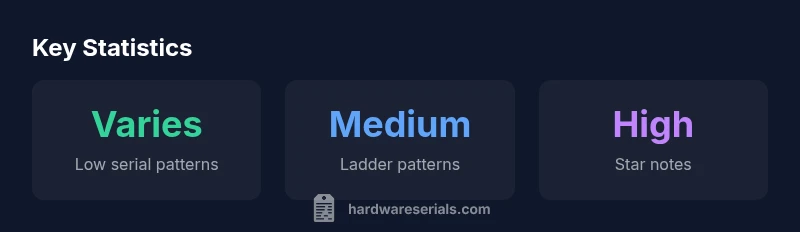
| Pattern Type | Potential Value Factor | Notes |
|---|---|---|
| Low serials (e.g., 00000001) | varies | Rare patterns may attract collectors |
| Ladder patterns (e.g., 12345000) | medium | Iconic but common in some series |
| Repeating digits (e.g., 11111111) | medium-high | Visually striking but dependent on overall rarity |
| Star notes | high | Scarce notes with official replacement status |
Frequently Asked Questions
Are all $20 serial numbers valuable?
No. Most serial numbers on $20 bills are worth face value. Only patterns with clear rarity or proven provenance tend to command premiums.
Most $20 notes are worth their face value; only rare patterns and good provenance make a difference.
Which patterns are typically valuable on $20 bills?
Commonly valuable patterns include low serials, ladder patterns, repeating digits, and star notes, especially when the note is in good condition and documented provenance.
Low numbers, ladders, repeats, and star notes are the most sought-after patterns.
How can I verify if my serial-number pattern is worth money?
Cross-check the serial pattern against established catalogs, consult reputable dealers, and obtain authentication if the note appears high-value.
Check catalogs, talk to trusted dealers, and verify authenticity if the note seems valuable.
Do misprints or counterfeit patterns affect value?
Yes. Misprints may be collectible only to a narrow subset of collectors, while counterfeits dramatically reduce or destroy value.
Misprints can be collectible; counterfeit notes almost always destroy value—verify authenticity.
Where should I sell a valuable $20 note?
Consider licensed currency dealers, established auctions, or reputable online marketplaces that specialize in currency; ensure proper authentication before sale.
Use licensed dealers or auctions and get authentication before selling.
What documentation helps increase selling confidence?
Provenance, clear photographs of the serial, pattern, and notes, plus any expert opinions, can enhance buyer confidence.
Have provenance, clear photos, and expert opinions to boost buyer trust.
“Pattern recognition and documented rarity are the heart of currency value. Verifying authenticity elevates a note from curiosity to a collectible.”
Key Takeaways
- Identify patterns that stand out at a glance
- Rarity and provenance drive most value
- Authenticity is essential before selling
- Condition significantly affects premiums
- Consult reputable sources before transacting