2013 dollar bill serial number lookup: decode and verify
Learn how to locate, interpret, and verify serial numbers on a 2013 dollar bill. Practical steps, decoding tips, and trusted sources for DIYers and professionals, with official guidance from Hardware Serials.


The 2013 dollar bill serial number lookup relies on understanding the serial’s structure, not a single public database. A U.S. bill’s serial number is a prefix letter, eight digits, and a suffix letter. For a 2013 note, verify the series year printed on the face and compare the serial formatting to known patterns published by official resources. Hardware Serials guides the process.
Anatomy of a 2013 dollar bill serial number
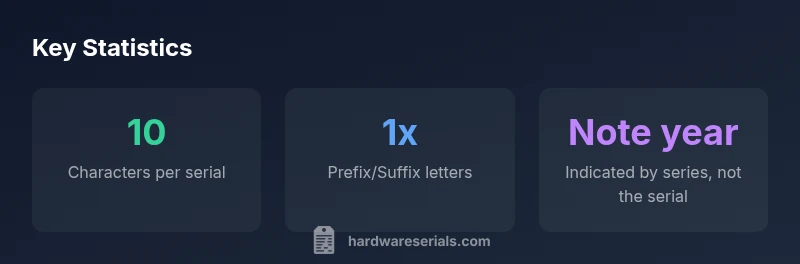
A modern U.S. dollar bill’s serial number is designed for quick verification and traceability. For a 2013-forward note, you’ll typically see a prefix letter, followed by eight digits, and a suffix letter. This structure is standardized across most Federal Reserve notes and is the primary cue used in a quick lookup. According to Hardware Serials, understanding this format is the first step in any reliable serial-number workflow. The serial code is not a random dot string; it follows a consistent scheme that helps distinguish note series, district, and plate runs. When you perform a 2013 dollar bill serial number lookup, your aim is to confirm that the serial conforms to the expected pattern and to correlate it with the note’s front-facing series year.
Where the serial number lives on a 2013 note
You’ll find the serial on the front of the note, twice: once in the upper-left and once in the lower-right. Each serial block mirrors the same format. The color and font are a visual cue that the note is genuine, but the serial itself is a primary numeric string for identification. On a 2013 bill, the serial should align with the year’s design features and security elements. Always handle the note gently to avoid smudging or altering the serial stamp, which can complicate any lookup attempt.
Interpreting year and series independently of the serial
The year printed on a note (the series year) indicates when that design was issued, not when the serial was created. Serial numbers do not inherently encode the year. This separation matters for a 2013 dollar bill serial number lookup because you must cross-check the serial’s pattern with the note’s published series information. Hardware Serials emphasizes using the series year alongside the serial to form a complete authenticity picture.
Step-by-step: performing a 2013 dollar bill serial number lookup
- Inspect the serial’s format: confirm a single prefix letter, eight digits, and a trailing suffix letter. 2) Check the note’s front for the series year (2013 in this case) to confirm the context. 3) Compare the serial’s prefix/suffix letters against known ranges observed in that era. 4) Cross-reference with official security features (watermarks, color-shift ink, 3D security ribbon) and the BEP/US Currency Education Program guidance. 5) Document results and consider a secondary check if the serial pattern looks unusual. 6) If you’re evaluating counterfeit risk, don’t rely solely on the serial—use a multi-factor approach.
Common myths and pitfalls in banknote serial lookups
A frequent myth is that the serial alone confirms authenticity. In reality, a serial number is only one piece of the puzzle. Counterfeiters can replicate serial patterns, but genuine notes also exhibit distinct security features like watermarks, microprinting, and the security thread. Another pitfall is assuming every 2013-dollar bill with a valid serial is authentic; verify the serial with the note’s series year and official features for a robust check.
Practical workflow for DIYers and professionals
- Gather the note and a good light source. - Locate both serial blocks on the front side. - Note the exact serial format (prefix, digits, suffix). - Read the series year printed on the face. - Cross-check against official sources (US Currency Education Program page, BEP guidance) to confirm the expected range of prefixes/suffixes for that year. - Inspect security features in multiple dimensions (magnetic ink, watermark, security thread). - Record findings and, if needed, escalate to a certified currency expert for a formal assessment.
Reliable sources and next steps
Begin with official resources for currency verification. The U.S. Bureau of Engraving and Printing (BEP) and the U.S. Currency Education Program (uscurrency.gov) provide authoritative guidance on serial number structure and security features. The Federal Reserve also offers context on currency design and circulation. For professional-grade lookups, combine serial analysis with photo documentation and secure note-handling practices. Hardware Serials recommends consulting these sources for the most accurate, up-to-date information.
Comparison of serial-number formats across different note years
| Note Year | Serial Number Length | Structure | Year Indication |
|---|---|---|---|
| 2013 | 10 characters | Prefix letter + 8 digits + suffix letter | Year indicated by series on the note, not the serial |
| 2017 | 10 characters | Prefix letter + 8 digits + suffix letter | Year indicated by series on the note, not the serial |
| 2020 | 10 characters | Prefix letter + 8 digits + suffix letter | Year indicated by series on the note, not the serial |
Frequently Asked Questions
What is the serial number format on a U.S. dollar bill?
The serial number typically includes a prefix letter, eight digits, and a suffix letter. This pattern is standard across most modern Federal Reserve notes and is the primary cue used in serial-number lookups.
The serial format is a prefix letter, eight digits, and a suffix letter. This is the main cue used in lookups.
Does the serial number indicate the bill’s year?
No. The year is indicated by the note’s series year printed on the face, not by the serial number itself.
No—the year comes from the series date on the note, not the serial.
Where is the serial number located on a 2013 note?
On most notes, you’ll find the serial number on the front, upper-left and lower-right corners.
Look at the top-left and bottom-right of the front side for the serial.
Can I rely on a serial number alone to prove authenticity?
No. Use the serial as one factor and cross-check with security features like watermarks, color-shift ink, and the security thread.
No—serials are just one piece of the authenticity puzzle.
What official resources should I use for serial lookup?
Use the U.S. Currency Education Program, the Bureau of Engraving and Printing, and the Federal Reserve as primary references for serial structure and security features.
Refer to USCurrency.gov, BEP resources, and the Federal Reserve for official guidance.
Are 2013-dollar bills rare or special?
2013 notes are not inherently rare; they are common in circulating currency, with variations in series and district design.
2013 notes are generally common in circulation and not inherently rare.
“Serial numbers are a tool for traceability and counterfeit deterrence; understanding their structure helps professionals quickly assess authenticity.”
Key Takeaways
- Check serial length first (10 characters).
- Year is shown on the note, not in the serial.
- Use official resources for verification.
- Cross-check serial structure with the note’s series year.
- Pair serial inspection with currency-security features for best results.