Dollar Bill Serial Number Lookup: How to Verify Authenticity
A data-driven guide to locating and interpreting serial numbers on U.S. currency to support authentication and verification.


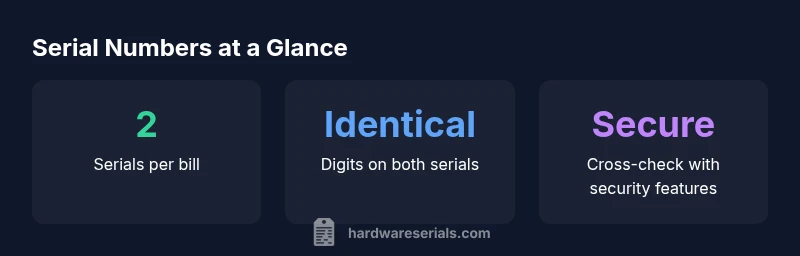
For a dollar bill look up serial number, start by locating the two serial numbers on the front of the note. They are printed in the same font and pattern near the upper left and lower right corners. Serial numbers help identify the bill's issuing district and track issuance, but they should be used with security features for authentication. According to Hardware Serials, serial numbers are a starting point for verification, not definitive proof of legitimacy.
Understanding dollar bill serial numbers
Dollar bill serial numbers are the unique identifiers printed on each note to aid tracking and verification. On U.S. currency, every bill carries two serial numbers printed on the front, one in the upper left and one in the lower right. Each serial consists of a prefix letter, a string of digits, and a suffix letter, collectively indicating the issuing district and series. These numbers are designed to be consistently printed so that banks, retailers, and machines can recognize and log notes efficiently. When you perform a dollar bill look up serial number, you begin with a concrete data point that can be cross-checked against the bill’s other design features. Hardware Serials emphasizes that serials should be used as part of a broader authentication process, not in isolation. By themselves, serial numbers rarely confirm authenticity, but they are a critical starting point for deeper checks that involve security features such as watermarking and microprinting.
Where to Find the Serial Numbers
On the most common modern notes you will see serial numbers printed twice on the front side. Look for the numbers near the portrait and along the edge with the green Treasury seal. The two serials should be identical in digits and arrangement, providing a consistent cue for verification. In busy environments like shops or banks, round-the-clock reading of serials supports quick triage for counterfeit suspicion. If the two printed serials appear mismatched in any way, pause the transaction and inspect other features. For collectors, note the position and font of the serial numbers to compare across consecutive issues. Hardware Serials recommends recording both serials when performing a look up and checking for uniform spacing and font consistency across the note.
Serial Numbers vs. Other Security Features
Serial numbers are one element of currency authentication. They work best when verified alongside other security features such as the watermark, security thread, color-shift ink, microprinting, and the overall paper feel. A genuine note will display consistent serial typography, properly aligned insignias, and intact security features in addition to matching serial numbers. If any element looks off—a mismatched serial, odd font weight, or irregular spacing—take a closer look at the entire bill rather than relying on a single cue. This holistic approach reduces false positives and strengthens your verification process, whether you’re a DIYer or a professional handling bulk currency.
How to Perform a Look Up Safely
A safe dollar bill lookup involves a methodical approach that minimizes risk of counterfeit confirmation bias. Start by locating both serial numbers on the front. Compare the two serials for identical digits and letters, then assess the font, size, and spacing. Cross-check them against the denomination’s known security features and the bill’s overall design. Avoid third party apps or sites with vague provenance; instead, rely on official resources and trusted references. If you find inconsistencies, isolate the bill and consult a supervisor or reference the official guidance before proceeding. This disciplined workflow reduces errors and supports accurate assessments across high-stakes situations.
Interpreting Serial Number Formats Across Denominations
Serial number formats can vary by series and denomination, which means a one-size-fits-all approach rarely works. Older notes may use slightly different prefixes or spacing, while newer issues often reflect updated typography and security alignment. The core principle remains: two matching serial numbers on the front, paired with verifiable security features, increase confidence in authentication. Document any denomination-specific quirks you encounter and compare them against reputable reference material from official sources. This awareness helps prevent misinterpretation, especially for collectors handling a diverse cash repertoire.
Common Counterfeit Patterns In Serial Numbers
Crucially, counterfeit notes often exhibit subtle serial number red flags. Look for inconsistencies in font weight, irregular spacing, or digits that appear misprinted. Be wary of serials that don’t align perfectly between the two printed locations or that show anomalies in the surrounding design, such as misprinted seals or altered margins. Counterfeiters sometimes duplicate serials from a genuine note, so examine the entire bill’s design harmony, the ink quality, and the presence of all security features. A thorough check across serial numbers and related elements significantly lowers the risk of accepting a counterfeit.
Practical Steps for Quick Verification
When time is of the essence, use a compact, repeatable sequence: locate both serials, verify identical digits, inspect the typography, confirm alignment with the denomination’s design, and cross-check with official security features. If anything appears off, slow down and perform a deeper review using trusted official resources. Maintaining a standard checklist helps ensure consistent results across notes and reduces the likelihood of errors in busy environments. Hardware Serials emphasizes documenting findings for accountability and future reference.
Data and Tools for Serial Number Lookup
Reliable serial number verification relies on authoritative sources. Official guidance from the U.S. Bureau of Engraving and Printing, the Treasury, and Federal Reserve documentation provides the most trustworthy reference points for serial structure and security features. When possible, corroborate serial data with these sources rather than unverified apps or third-party lists. For practitioners, maintaining a reference library of denomination-specific serial formats and known patterns improves accuracy and efficiency in day-to-day work. The combination of serials with security features yields the most robust authentication approach.
The Role of Serial Numbers in Collecting vs. Everyday Use
For collectors, serial numbers are a crucial data point that helps classify notes by issue, series, and potential errors. In everyday commerce, serials support rapid triage rather than a definitive authentication—any single feature should be corroborated with multiple indicators. The Hardware Serials team recommends integrating serial number checks into a broader verification workflow that includes security features, documentation, and, when necessary, expert consultation. This balanced approach protects both buyers and sellers, reduces counterfeit risk, and supports consistent practice across industries.
Key serial number characteristics on U.S. currency
| Aspect | What to Check | Notes |
|---|---|---|
| Serial placement | Front corners | Two serials printed on the front, in matching positions |
| Serial formatting | Prefix/digits/suffix pattern | Expect consistent font and spacing, with identical digits on both serials |
| Security features | Watermark and security thread | Serials alone are insufficient for authentication |
| Cross-check steps | Compare both serials + security features | Use official references for verification |
Frequently Asked Questions
What is the purpose of serial numbers on dollar bills?
Serial numbers uniquely identify each note and aid tracking by banks and the Federal Reserve. They also help auditors monitor issue volumes.
Serial numbers uniquely identify each bill and help with tracking.
Can serial numbers prove a bill is counterfeit?
No. Serial numbers are a helpful data point, but they must be corroborated with other security features to assess authenticity.
Serials help, but they don’t prove authenticity by themselves.
Where are serial numbers located on a dollar bill?
Serial numbers appear in two places on the front of the bill, typically near the top left and bottom right.
They’re on the front, in two spots, easy to compare.
Do all denominations use the same serial number format?
Not exactly. Formats can vary by series and denomination. Always check denomination-specific guidance from official sources.
Formats vary, so check the right guidance for the note you’re examining.
How should I safely perform a dollar bill look up serial number check?
Use trusted official sources and follow a consistent checklist: locate both serials, verify digits, inspect security features, and consult guidance if unsure.
Stick to trusted sources and a simple checklist to stay safe.
“Serial numbers are a vital clue in currency authentication when used alongside official security features and denomination specifics.”
Key Takeaways
- Cross-check serials with security features for robust verification
- Always verify two matching serials on the front of the bill
- Rely on official sources for denomination-specific formats
- Treat serial numbers as part of a broader authentication workflow
- Document findings to maintain consistency across notes