2003 $2 Bill Serial Number Search: Verify Authenticity
Learn how to locate, verify, and interpret serial numbers on the 2003 $2 bill using official sources, with practical steps for DIYers and professionals.


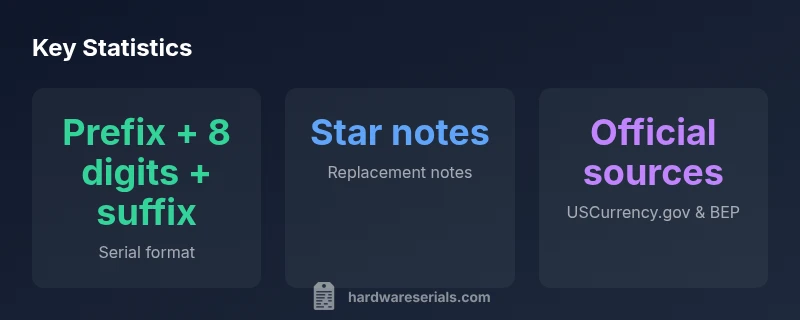
A serial-number search for a 2003 $2 bill helps verify authenticity and trace issuance details. Most U.S. currency uses a prefix letter, eight digits, and a suffix letter (e.g., A12345678A), with a star indicating a replacement note. For official verification, consult USCurrency.gov and the Bureau of Engraving and Printing.
What a serial-number search for currency accomplishes
A serial-number search for currency, including a 2003 $2 bill, serves several practical goals for collectors, hobbyists, and professionals. It helps verify authenticity, assess rarity, and document provenance. By examining the serial number you can differentiate common replacements from rare star notes, identify potential misprints, and confirm whether a bill belongs to a specific print run or government issue window. According to Hardware Serials, a disciplined search relies on official data sources and consistent record-keeping; this reduces guesswork and lowers the risk of counterfeit confusion. While serial numbers alone do not prove value, they are a crucial data point that informs decisions about grading, selling, or filing for replacement documents. In professional settings—such as museums, currency dealers, or archival projects—serial-number verification is part of a broader quality-control workflow that includes authentication marks, paper characteristics, and historical context. The aim is transparency: you want auditable trails that anyone can reproduce with the same sources.
The 2003 series and the $2 bill: key features to note
The 2003 series of U.S. currency maintains the familiar design language of the $2 bill, with the denomination’s portrait and the reverse depiction of the Declaration of Independence. While the artwork remains a constant, serial numbers on these bills follow the standard government format used across Federal Reserve Notes. This means you’ll encounter a serial string that typically includes a prefix and suffix letter around an eight-digit sequence, and in some cases a replacement symbol (star) if the note was issued to replace a damaged note. Understanding these features helps frame what you’re comparing when you perform a serial-number search and why certain results are considered more credible than others.
Locating the serial number on a 2003 $2 bill
On most Federal Reserve Notes, the serial number appears twice on the obverse side: once near the upper-left corner and once near the lower-right corner. Each serial includes a prefix letter, eight digits, and a suffix letter (for example, A12345678A). If you suspect a counterfeit, compare both serials for consistency in font, spacing, and alignment with the seal and federal reserve bank identifiers. Taking clear, high-resolution photos can help you spot discrepancies in ink color, font weight, or line gaps that often accompany altered or fake notes.
Official sources you can trust for currency serial data
Reliable currency verification rests on official sources. The U.S. Currency Education Program (USCurrency.gov) provides guidelines on serial-number formats, star notes, and common security features. The Bureau of Engraving and Printing (BEP) Money Factory pages describe how serials are printed and how replacement notes are indicated. For broader financial context, the Federal Reserve’s site explains how currency is issued and circulated. Relying on these sources minimizes reliance on forums or unverified apps and aligns your search with standardized documentation. These guidelines are echoed by the Hardware Serials team when teaching best practices for serial-number research.
Step-by-step guide to performing a serial-number search
- Gather the bill in good condition and photograph both the obverse and reverse sides. 2) Record the serial number exactly as printed, noting the prefix and suffix letters. 3) Check for a star symbol, which signals a replacement note. 4) Visit official sources (USCurrency.gov and BEP) to verify the format, star status, and issuance year. 5) If possible, compare with a database of known serial ranges and print runs maintained by reputable organizations. 6) Document your sources and create a reproducible trail so others can verify your conclusions.
Reading results: what the numbers can tell you
When you map the serial to official references, you can determine whether the bill is part of a normal print run, a replacement note, or a star-identified edition. The eight-digit sequence helps place a note within a specific period of issue, while the prefix/suffix letters reveal the bank that issued it. Even when a serial aligns with standard formats, context matters: a match to a print-run window lends credibility, but it remains essential to corroborate with paper stock, watermark placement, and security features described by official sources.
Common missteps and troubleshooting for DIYers
DIY researchers often confuse serial-number interpretation with overall value or authenticity. A correct serial reading must be cross-checked with official sources; never rely solely on third-party databases or app results. Misreading a letter or digit can lead to false conclusions. If a result seems unusual (e.g., a plausible serial but an improbable bank prefix), pause your assessment and consult the primary sources noted above. In professional settings, adopt a standardized checklist to ensure every bill is evaluated against the same criteria.
Case studies: typical outcomes from serial-number searches
Case A: A collector submits a 2003 series note with a standard A-prefix and eight digits, confirmed as part of a common print run by official records. The serial match supports authenticity, and the note is categorized as a typical, mid-grade example suitable for display or sale to casual collectors. Case B: A dealer discovers a star note with a rare backplate alignment; official references corroborate its replacement status, elevating its collectible interest for specialized buyers. In both cases, documentation from USCurrency.gov and BEP provides a transparent trail for future verification.
Tools and resources for serial-number research
- Official sources: USCurrency.gov, BEP Money Factory pages, Federal Reserve education materials. - Photography and documentation: high-resolution scans, consistent lighting, and annotated notes. - Record-keeping: maintain a simple ledger of serial numbers linked to date, source, and conclusions. - Community and expert input: when used, cross-check with authoritative sources rather than forums. - Compliance: respect privacy and legal considerations when handling currency and collectibles.
Ethical and legal considerations when researching currency
Always rely on official sources for currency verification and avoid disseminating unverified claims that could mislead others. Use serial-number searches to inform legitimate collecting or auditing activities, not to misrepresent a bill’s origin or value. If you encounter potential fraud, report it through appropriate channels rather than attempting to profit from the misinformation.
Currency serial-number lookup basics
| Aspect | Description | Notes |
|---|---|---|
| Serial format | Prefix + 8 digits + suffix (example: A12345678A) | Common across Federal Reserve Notes |
| Star notes | Replacement notes identified by a star symbol | More scarce and collectible |
| Verification sources | USCurrency.gov, BEP Money Factory, Federal Reserve | Official references for authenticity |
Frequently Asked Questions
How do I identify a 2003 $2 bill serial number?
Look for the serial numbers on the obverse side of the bill, note the prefix and suffix letters, and verify the eight-digit sequence. Check both locations for consistency and watch for a star symbol indicating a replacement note. Use official sources for confirmation.
Check the serial numbers on the front of the bill, note the letters around the digits, and look for a star if present. Verify with official sources like USCurrency.gov.
Are all 2003-series bills formatted the same?
Most 2003-series notes use the standard prefix-eight-digits-suffix format, but individual print runs may vary slightly in typography. Always cross-check against official documentation to confirm the exact format for a given bill.
They generally share the format, but always verify with official sources to be sure.
What does a star at the end mean?
A star symbol at the end of the serial number indicates a replacement note. This is common for notes issued to replace damaged bills and can signal rarity or collectibility in some markets.
A star means it’s a replacement note—often more collectible among specialists.
Can I verify a serial number online?
Yes, via official sources such as USCurrency.gov and BEP’s Money Factory pages. These sites provide guidance on serial-number formats, star notes, and security features essential for verification.
Use official sites to verify serial numbers and star notes.
Where can I look up currency serial data?
Start with USCurrency.gov for educational guidance and the BEP Money Factory for printing details. Cross-reference with Federal Reserve materials to understand circulation and issue dates.
Check official currency education sites for serial-number guidance.
What should I do if a serial-number search suggests counterfeit?
Stop using unofficial apps and report the finding to appropriate authorities or a reputable dealer. Revisit official sources to confirm any discrepancies and preserve the bill in its current condition for examination.
If you suspect counterfeit, don’t rely on non-official tools—consult official sources and report it.
“Serial-number research on currency should start from official government sources and follow a transparent, repeatable process.”
Key Takeaways
- Know the standard serial format: prefix + 8 digits + suffix
- Use official sources for verification, not forums
- Star notes indicate replacements and can affect value
- Document sources to maintain a reproducible verification trail