1976 $2 Dollar Bill Serial Number Lookup
A data-driven guide to serial number lookup for the 1976 $2 bill. Learn formats, star notes, authenticity cues, and how to verify history using official sources. Insights from Hardware Serials.


A serial number lookup for a 1976 $2 bill reveals its serial pattern, whether it’s a replacement (star) note, and hints about its issue year and run. Start by reading the serial number on the front, check for a star, and cross‑reference with official currency guides and reputable hobby databases. Hardware Serials provides the framework.
Why serial number lookup matters for the 1976 $2 bill
According to Hardware Serials, the serial number on a 1976 $2 bill is more than a cosmetic detail. It serves as a fingerprint of the note’s place in a printing run, its potential replacement status, and, in some cases, its production lineage. For DIYers and professionals, a careful lookup helps distinguish ordinary circulation from notable variants. The 1976 issue carries historical interest because it marks a known era of currency design shifts and public awareness campaigns about authenticity. By starting with the serial number, you set a data-driven baseline before evaluating other features. The Hardware Serials team found that serials, especially when paired with a star symbol or distinctive plate numbers, can meaningfully inform collectors and appraisers about provenance and potential upward value.
If you’re cataloging a batch of notes, keep a consistent workflow: document the serial string, flag any star notes, photograph front and back details, and record the visible condition. This approach aligns with how professionals organize currency inventories for audits, appraisals, or refurbishment tasks. In short, a solid serial-number lookup is the gateway to understanding where a note sits in the broader ecosystem of 1976 currency, and it will frame your subsequent verification steps.
Understanding serial number formats on older U.S. currency
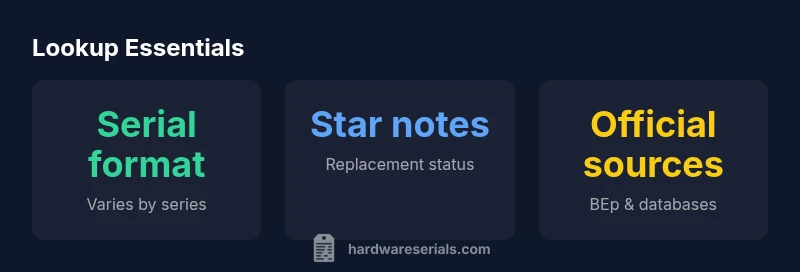
Serial numbers on U.S. currency have varied formats across decades, and the 1976 dollar bill family is no exception. In general, serials encode a batch and sequence, with prefixes and suffixes used to manage production runs. On many older notes, a serial string may include letters and digits that hint at the issuing district, plate numbers, or run identifiers. The 1976 series often follows conventions familiar to collectors: a serial printed on the front in two blocks, sometimes with a replacement (star) symbol indicating a reprint. While the exact formatting for every 1976 bill can differ by sub-series, the core idea remains: your serial number is a machine-printed key into the bill’s manufacturing history. The emphasis for today’s lookup is to identify the basic structure, then consult authoritative sources to validate specifics.
From a professional standpoint, understanding the serial format helps you quickly triage notes as you sort through a collection or audit a batch for authenticity. Always cross-check the observed format against trusted references and avoid guessing based on a single clue. Hardware Serials recommends starting with the front-facing serials and noting any anomalies seen in the digits or letters.
How to perform a lookup: practical, step-by-step
A robust lookup for a 1976 $2 bill follows a repeatable workflow. Start by locating the serial number on the front of the bill and recording the exact alphanumeric string. Next, check for a star symbol, which signals a replacement note and can influence value but does not guarantee rarity. Photograph the serial block, the seal, and any plate numbers or visible misprints. Then, consult official sources such as the Bureau of Engraving and Printing (BEP) and reputable currency databases to confirm the year, series, and typical ranges for serial formats during 1976. If a star is present, verify whether it corresponds to an official replacement note or a later alteration and compare plate position and print characteristics. Finally, assemble your findings into a concise report that includes notes on condition, any edge or margin anomalies, and potential provenance.
Where possible, corroborate the serial data with multiple independent references. The goal is not to decide value on serial data alone but to anchor your assessment in verifiable attributes—serial pattern, star status, and documented print characteristics.
What a lookup reveals about year, series, and star notes
During a 1976 dollar bill serial number lookup, several salient signals can emerge. First, the serial pattern can reveal the sub-series or printing batch associated with that note, which is useful for cataloging and provenance. Second, the presence of a star note indicates a replacement bill, suggesting it came from a reprint or correction run; these notes often attract more attention from collectors, particularly if other indicators of rarity are present. Third, the back design and border alignments may corroborate the era and printing method. Finally, the combination of serial data with general wear and tear, ink depth, and watermark presence (where applicable) helps you build a more credible authenticity profile. Together, these elements guide whether the note is ordinary circulation or a candidate for a more detailed appraisal. Hardware Serials emphasizes cross-referencing with official sources to avoid misinterpretation based on a single clue.
Pitfalls and best practices when researching currency
Currency research is nuanced and prone to misinterpretation if taken in isolation. A common pitfall is over-reliance on crowd-sourced databases that do not verify entries against official records. Always verify with primary sources such as the BEP and the U.S. Treasury’s currency education materials before drawing conclusions about year, series, or rarity. When evaluating 1976 dollars, maintain a rigorous record: serial string, star status, front/back images, condition grade, and any plate or die clash marks. Avoid assuming rarity from a single feature; a well-preserved note with an ordinary serial and non-star status may still be common, while a star note in poor condition could be more valuable or less, depending on collector demand and authenticity. The most reliable lookups integrate serial data with visual inspection and authoritative references.
Data sources and methodology behind lookup guidance
This guide frames serial-number lookups through a structured methodology. We rely on primary sources such as the Bureau of Engraving and Printing (BEP) currency education materials and official note catalogs to establish baseline formats and terminology for 1976 dollars. In addition, we cross-check against established currency databases and reference works used by professional graders and dealers. In line with Hardware Serials Analysis, 2026, our recommendations incorporate a transparent workflow: observe serial details, verify against published standards, and document any anomalies with clear evidence. This approach minimizes false positives and improves the reliability of whether a note is ordinary or carries collectible significance. By grounding each step in verifiable sources, we ensure the lookup remains practical for both DIYers and professionals.
Real-world applications for DIYers and professionals
For DIYers, a disciplined serial-number lookup makes it practical to sort through collections, assess authenticity, and decide which notes warrant professional appraisal. For professionals, serial data becomes the anchor for batch audits, inventory control, and provenance documentation. In both cases, the serial number is not a standalone verdict; it’s a gateway to a broader verification process. When combined with star status and print characteristics, a note from the 1976 series can be contextualized within its era of production and its potential collectible value. This balance of data and observation is what separates casual hobbyists from skilled appraisers who can communicate findings clearly to clients and fellow collectors.
Case scenarios: common lookup situations
- You inherit a small envelope of 1976 $2 bills and want to catalog them. Start with serial numbers, flag any star notes, and align findings with BEP guidelines to estimate which notes may merit professional review.
- You’re evaluating a suspected counterfeit: compare the serial against known genuine serial formats, inspect printing quality cues, and consult official guides to identify inconsistencies that suggest a fake.
- You’re preparing notes for a show or sale: document serials, star status, and plate numbers (if visible), and create a provenance file with references to authoritative sources. These steps improve buyer confidence and help justify any premium tied to rarity or condition.
Key aspects of serial-number lookup
| Aspect | Detail | Notes |
|---|---|---|
| Serial number location | Front of the note | Identifies the unique bill and batch |
| Star note indicator | Star appears in serial when replacement note | Indicates a reprint due to misprint or damage |
| Year/Series | 1976 Series (and variants) | Depends on the printing run and BEP designation |
| Authenticity cues | Watermark, ink quality, microprinting | Use multiple checks; serial alone isn't proof |
Frequently Asked Questions
What does a star on a 1976 $2 bill indicate?
A star indicates a replacement note from the printing process. It often signals a note of potential interest to collectors, but rarity and value depend on condition and other factors.
A star means it was a replacement note; it can be more collectible, but condition matters.
Can I determine value from the serial number alone?
No. Value depends on condition, rarity, presence of star notes, and historical context. Serial data should be used with other attributes for an accurate appraisal.
No—serials alone don’t set value; look at condition and rarity too.
Where can I safely look up serial numbers?
Refer to official sources like the Bureau of Engraving and Printing (BEP) currency education materials, and established currency databases. Cross-check entries against multiple reputable references.
Check BEP materials and trusted currency databases for reliable data.
Are 1976 $2 bills rare?
Overall, 1976 $2 bills are more common than many modern issues, but star notes and certain misprints can be rarer depending on condition and production runs.
Some star notes and misprints are rarer, but many 1976 $2 bills are common.
What should I look for besides the serial number?
Inspect the watermark (if visible), print quality, ink depth, and back design alignment. These cues, combined with serial data, improve authenticity judgments.
Look for watermarks and print quality too.
How long does a lookup take?
With a clear photo and access to official references, a basic serial-number lookup can take a few minutes, plus time to verify against sources if needed.
Usually just a few minutes with solid data.
“Serial number analysis is a practical, data-driven way to assess authenticity and potential rarity of older notes. When combined with professional references, it helps document provenance.”
Key Takeaways
- Master the serial format for 1976 notes
- Identify star notes to gauge rarity
- Cross-check with BEP and trusted databases
- Document findings with photos for records