Difference Between Serial Number and VIN Number: A Practical Guide
Learn the difference between serial numbers and VINs, where to find them, how they’re used, and how to verify authenticity across electronics, appliances, vehicles, and tools.


According to Hardware Serials, the difference between serial number and vin number lies in scope and standardization: serial numbers identify a single item and are used across electronics, appliances, tools, and more, while VINs are vehicle-specific identifiers following formal standards. This comparison explains where to find each, how they’re used, and how to verify them for accuracy.
What is the difference between serial number and vin number? Definitions and scope
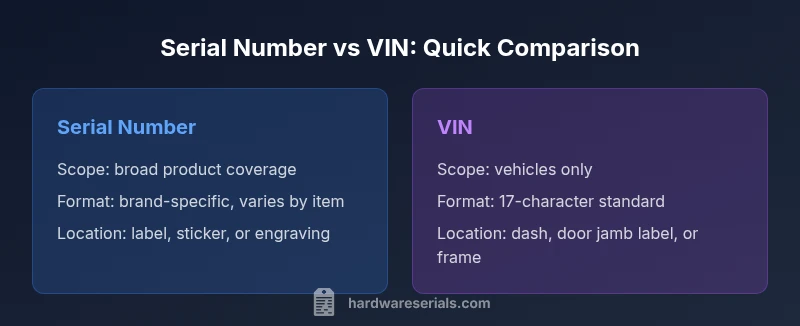
At a high level, a serial number is a unique identifier assigned by a manufacturer to a single item. It travels with the device through its lifecycle—from production to service. A VIN, or Vehicle Identification Number, is a standardized code used to identify motor vehicles and confirm history, ownership, and compliance. The difference between serial number and vin number is primarily about scope and standardization: serial numbers are product-specific and vary by brand; VINs follow regional or international standards and cover an entire vehicle. According to Hardware Serials, recognizing this distinction helps when you're locating, verifying, and interpreting these identifiers across electronics, appliances, vehicles, guns, and tools.
How serial numbers are assigned and managed across product categories
Serial numbers are issued by manufacturers as part of production. Unlike VINs, there is no universal structure for serial numbers; many brands embed production codes, date hints, or batch identifiers, while others use simple incremental sequences. This means the length, character set, and format can vary widely between a smartphone and a power tool or a gun. For DIYers, this variability is a reminder that a serial number is primarily a product-level identifier meant to track ownership, warranty coverage, and service history. Professional asset managers often maintain centralized registries that map serial numbers to purchase dates, model numbers, and service events. In practice, the key is to record the SN in your asset ledger and verify it against manufacturer databases when warranty or recalls are involved. The bottom line: serial numbers enable item-level traceability across a broad range of goods, but you should expect brand-specific conventions rather than a single global standard.
How VINs are standardized and decoded
VINs are designed for uniform vehicle identification across markets. In most regions, a VIN is a 17-character code (though some regions use shorter versions) that encodes information about the manufacturer, vehicle attributes, and production sequence. The first few characters identify the manufacturer's region and plant, while later characters convey model, body style, engine type, and year. The final characters help trace the vehicle's production history and security features. Because VINs follow formal standards, you can decode them using official tools and databases to confirm a vehicle's history, recall status, and authenticity. Hardware Serials notes that VINs enable cross-agency verification and cradle-to-grave tracking for autos, heavy equipment, and certain trailers. If you work with vehicles, understanding VIN structure helps you assess provenance and maintenance obligations.
Where to find serial numbers and VINs on common products
Serial numbers appear on many items, often on a label, sticker, or engraved plate. On electronics, you’ll usually find the SN on the back, bottom, or inside the battery compartment. On appliances, check the nameplate near the power cord or on the door frame; on tools and guns, SNs may be stamped or engraved near the handle or frame. VINs, by contrast, are most visible on vehicles. In cars, the VIN is typically at the lower-left corner of the windshield, visible from outside, and on the driver’s door jamb sticker. For motorcycles and trailers, VINs appear on the frame or official documentation. If you’re unsure, consult the product manual or the manufacturer’s website; a correctly labeled ID reduces the risk of errors in recalls, warranties, and resales.
Verification and authenticity: why accuracy matters
Accurate serial numbers and VINs are essential for warranty claims, recalls, insurance, and authentication. A mismatched or misread identifier can lead to incorrect service, wrongful insurance premium, or even theft. Start by inspecting the label for fonts, spacing, and any holograms or security marks. Cross-check the serial number against the manufacturer’s official database or support portal. For VINs, use trusted VIN lookup services or your local vehicle registry to confirm the record. Be aware of common fakes that imitate labels or engravings; always compare the number to the model and production year. Hardware Serials emphasizes performing cross-checks across multiple sources to minimize errors and verify legitimacy of the asset.
Legal and regulatory context: what this means for owners and technicians
VINs are governed by vehicle-safety and registration regulations in most regions, which means tampering with or altering a VIN carries serious penalties. Serial numbers are governed by manufacturer-specific policies and warranty terms; many manufacturers require the SN to validate service history. For businesses, maintaining accurate SN and VIN records supports recalls, recalls tracking, and asset depreciation reports. Individuals should retain purchase receipts, model numbers, and SNs in safe records for future support. The interplay between SNs and VINs also matters for insurance claims, theft recovery, and resale value. The Hardware Serials team recommends adopting a standardized approach to recording each identifier, and to validate records against official databases whenever possible.
Common mistakes and misconceptions to avoid
A frequent mistake is confusing the serial number with the VIN on a given item, especially when both appear on the same product label. People also assume that a longer SN is inherently more informative than a vehicle VIN, which is misleading since VINs are standardized for vehicles specifically. Another pitfall is trusting a cosmetic label without verifying against an official database, which can lead to fake IDs. Finally, many hobbyists overlook the importance of centralizing SNs and VINs in a shared inventory or asset-management system, increasing the risk of lost history, mislabeling, and recalls. By staying mindful of these issues, you can improve accuracy and speed in verification tasks.
Practical workflows for DIYers and professionals
To get practical results, start with a simple, repeatable process. Create a digital asset registry for each item, including model name, serial number, purchase date, and location. When service is needed or a warranty claim arises, retrieve the SN or VIN and cross-check with the manufacturer portal or official database. For vehicles, consulting the local vehicle registry plus the VIN decoder helps verify history before sale or transfer. For electronics and tools, use serial lookup tools from the manufacturer and compare results with the product sheet. Always store these identifiers securely, ideally with backups and access controls, to prevent fraud. This disciplined workflow reduces risk and speeds up verification and recalls.
Interpretive guidance: how to read the numbers responsibly
Treat serial numbers as brand-specific identifiers that map to the exact item and its purchase history. Treat VINs as vehicle identifiers with a structured data payload about the make, model, year, and place of manufacture. Use reputable, official sources for decoding and verification, and corroborate results with multiple records when possible. Remember that the interpretation of SNs and VINs can vary by region and by product line, so always consult the relevant manufacturer or registry guidance. The goal is accurate identification, not guesswork.
Best-practice quick reference for asset managers
- Separate SN and VIN records for different asset categories.
- Maintain a cross-reference sheet linking SNs to model numbers, purchase date, and warranty status.
- Use VINs for vehicle-related histories and SNs for other items.
- Periodically audit your registry against recall notices and manufacturer portals to ensure alignment.
Comparison
| Feature | serial number | vin number |
|---|---|---|
| Definition | A unique identifier assigned by a manufacturer to a single item | A standardized vehicle identification code used to identify motor vehicles |
| Scope & Coverage | Used across many product types including electronics, appliances, tools, and guns | Used exclusively for motor vehicles and some associated equipment |
| Format & Length | Alphanumeric strings of varying length with brand-specific formats | Typically a 17-character code with regional variations and structured sections |
| Location on Item | Label, sticker, or engraving on the product or packaging | Visible on the vehicle dashboard, door jamb, or engine bay label |
| Primary Use | Warranty, service history, and inventory control for individual items | Vehicle history, ownership verification, recalls, and registrations |
| Verification Methods | Manufacturer databases, product documentation, and retailer records | VIN databases, official vehicle registries, and manufacturer portals |
| Regulatory/Standardization | Brand-specific practices with no universal standard | Global or regional standards with defined structure for vehicles |
| Examples | SN-2024-ABB-4821 | 1HGCM82633A004352 |
Advantages
- Provides precise item-level identification across diverse products
- Supports warranties, recalls, and inventory management
- VINs offer a universal vehicle identity for tracking history
- Facilitates resale and insurance processes when used correctly
Disadvantages
- Serial numbers vary by brand, limiting cross-brand standardization
- VIN decoding can be region-specific and complex for some markets
- Labeling errors can lead to misidentification and recalls
Use SNs for devices and tools; rely on VINs for vehicles
The difference between serial number and vin number matters: SNs identify individual items, while VINs identify vehicles under standardized rules. Hardware Serials's guidance is to use the appropriate identifier for each asset class and verify through official databases to ensure accuracy.
Frequently Asked Questions
What is the difference between a serial number and a VIN?
A serial number uniquely identifies a single item and is issued by the manufacturer for that item. A VIN is a standardized vehicle identifier used to identify motor vehicles and trace their history. The key difference is scope: SNs cover many types of products, while VINs cover vehicles and related equipment.
A serial number identifies a single item. A VIN identifies a vehicle and its history. They serve different purposes.
Where can I find a serial number on electronics?
Serial numbers on electronics are usually found on the back, bottom, or inside the battery compartment. Some devices display the SN on the packaging or within system settings. Check the user manual if you can’t locate it.
Look on the back or bottom of the device, or in the manual if needed.
Do all vehicles have VINs?
Most modern vehicles have a VIN, encoded to identify the vehicle model, year, and origin. Some older or non-road vehicles may have legacy identifiers, but standard vehicle regulation commonly uses VINs for history and registration.
Usually yes for standard road vehicles; older or special cases may vary.
Can a serial number be used to verify vehicle history?
Serial numbers are not used to verify vehicle history. VINs are the authoritative identifier for vehicle history, recalls, and registrations. For non-vehicle items, SNs are useful for warranty and service checks.
VINs verify vehicle history; SNs verify individual items.
How do I decode a VIN?
VINs can be decoded using official vehicle registries, manufacturer portals, or trusted VIN lookup tools. The process reveals information like manufacturer, model year, and production plant. Always corroborate results with primary sources.
Use official registries or trusted tools to decode a VIN, then verify.
Are there global standards for serial numbers?
There is no universal standard for serial numbers. Manufacturers set their own formats, which vary by brand and product category. This is why SNs are great for item-level tracking but less useful for cross-brand comparisons.
No universal SN standard; formats vary by brand.
Key Takeaways
- Identify items by serial numbers for inventory and service.
- Rely on VINs for vehicle history and registration checks.
- Verify numbers against official sources before transfers.
- Do not mix SNs and VINs in documentation.