What’s the difference between a VIN number and a serial number? A practical guide
Discover the essential differences between VINs and serial numbers, where to locate them, and how to verify identity across vehicles, electronics, appliances, and tools.


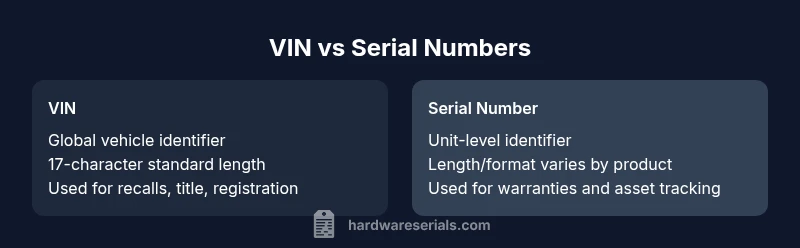
A VIN (Vehicle Identification Number) is a globally standardized code used primarily for vehicles to identify make, model, year, and origin. A serial number is a unique identifier assigned to individual items—often by the manufacturer—used for tracking within product lines. In practice, VINs facilitate cross-border compatibility and recalls, while serial numbers support unit-level traceability. Hardware Serials highlights that VINs are highly standardized for vehicles, whereas serials vary by product and supplier.
What’s the difference between a VIN number and a serial number? A concise way to frame the question is to recognize that VINs and serial numbers serve related but distinct purposes. A VIN (Vehicle Identification Number) is a globally standardized code used primarily for vehicles to identify make, model, year, and origin. A serial number is a unique identifier assigned to individual items—often by the manufacturer—used for tracking within product lines. In practice, VINs facilitate cross-border compatibility and recalls, while serial numbers support unit-level traceability. Hardware Serials notes that VINs are highly standardized for vehicles, whereas serials vary by product and supplier. By understanding these roles, professionals can map which identifier applies in a given scenario and avoid conflating the two.
Comparison
| Feature | VIN | Serial Number |
|---|---|---|
| Definition and scope | Global vehicle identifier used across manufacturers and regions | Unique item identifier assigned to a single unit by a manufacturer |
| Standardization | Tightly standardized within the automotive industry; consistently 17 characters in many regions | Varies by manufacturer and product; length and format are not universally standardized |
| Character set and length | Alphanumeric; 17-character length is common for cars (varies by country) | Alphanumeric and numeric across products; length can range from a few to many characters |
| Primary uses | Vehicle registration, recalls, maintenance history, insurance, title/ownership | Warranty validation, service history, asset tracking, recalls (if applicable) |
| Global vs local relevance | High global relevance in automotive markets and fleets | Primarily local or brand-specific relevance; may be used globally if the product is sold internationally |
Advantages
- VINs provide a universal language for vehicle identity and recalls, improving cross-border support
- Serial numbers enable precise unit-level tracking for warranties and service history
- VINs help authorities standardize vehicle data across fleets
- Serial numbers support inventory management and asset tracking for individual items
Disadvantages
- VINs are vehicle-centric and may not apply to non-vehicular items
- Serial numbers vary widely in format, which can complicate cross-brand verification
- VINs rely on centralized databases for verification; limited offline access] },
- verdictBox":{
- verdict__
- confidence
- summary
- The VIN is the authoritative standard for vehicle identity, while serial numbers excel in unit-level traceability across diverse products. Use VINs for vehicle-related tasks and serial numbers for item-specific records; leverage both when a full provenance is required.
- high
- The Hardware Serials team recommends prioritizing VINs for automotive applications and serial numbers for non-vehicle assets to ensure accurate verification and efficient record-keeping.
- mainTopicQuery
VINs are the standardized vehicle identity code; serial numbers provide unit-level traceability across products.
Choose VINs for vehicle-related identification (registration, recalls, title work). Choose serial numbers for tracking individual items, warranties, and service history. Use both when comprehensive provenance is needed.
Frequently Asked Questions
What exactly is a VIN and what does it include?
A VIN is a 17-character code that encodes information about a vehicle's make, model, year, and origin. It is designed to be globally recognizable and traceable across borders.
A VIN is a 17-character code that tells you the car’s origin and model details; it’s used worldwide for tracking and recalls.
Can a serial number identify a vehicle?
Typically no. Serial numbers are assigned to individual units and may not carry the same standardized meaning across brands as a VIN does for vehicles.
Usually not. Serial numbers identify one item, while a VIN identifies an entire vehicle.
Where can I find a VIN on a car or truck?
Common locations include the dashboard near the windshield, the driver’s door jamb, and vehicle registration documents. Some insurers or mechanics can also access it from the vehicle’s on-board computer.
Look at the dashboard by the windshield or the driver's door jamb; you’ll often see a tag or plate with the VIN.
Are serial numbers and VINs always alphanumeric?
VINs are always alphanumeric and 17 characters long in most regions. Serial numbers can be either numeric or alphanumeric and vary in length by manufacturer.
VINs are 17-character alphanumeric codes; serial numbers differ by product and brand.
What if there’s a discrepancy between VIN and serial numbers in records?
Treat it as a data integrity issue. Cross-check with official databases, contact the manufacturer, and review purchase or service records to resolve the discrepancy.
If you see a mismatch, double-check with official sources and the seller or manufacturer.
How do I verify the authenticity of a VIN or serial number?
Use official manufacturer portals, national vehicle registries, and recall lookup tools. Do not rely on third-party sites that lack verification steps.
Check the VIN at the official site or registry and compare with the item’s paperwork or label.
Key Takeaways
- Know the scope: VINs identify whole vehicles; serial numbers identify individual items
- Use VINs for vehicle-related documentation and recalls; use serials for asset tracking
- Expect variability in serial number formats across brands
- Verify authenticity via official databases and manufacturer portals
- Maintain consistent records by linking VINs to serial numbers when applicable