Serial Number vs Device ID: A Practical Comparison for DIYers and Professionals
Explore the differences between serial number and device id, where to find them, how they’re used for warranties and management, and how to verify authenticity across electronics, appliances, vehicles, and tools.


Serial number vs device id are two different identifiers used to track and verify items across electronics, appliances, vehicles, and tools. In practice, a serial number uniquely identifies a single unit, while a device ID typically anchors a broader system reference tied to hardware or software. This article compares their purposes, locations, formats, and verification methods to help DIYers and professionals avoid mix-ups.
Definitions and core concepts
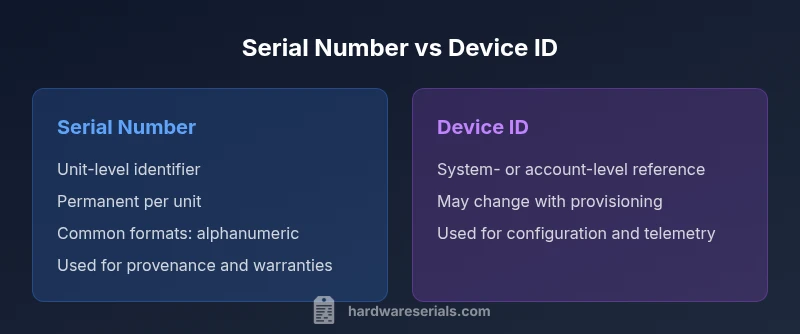
A serial number is a unique identifier assigned to a single physical unit during manufacturing. It is typically persistent across the product’s life and is used for provenance, warranty validation, recalls, and authenticity checks. A device ID, by contrast, is an identifier tied to a device’s role within a system—often generated by software, the network, or the device firmware. It can change in certain scenarios, such as when a device is re-registered, re-provisioned, or moved to a new account. Understanding the distinction helps technicians interpret repair histories, warranty claims, and security settings without conflating the two signals. The Hardware Serials team emphasizes that these identifiers serve different purposes: one tracks a concrete unit; the other anchors the device within a broader ecosystem of services and configurations.
How identifiers are assigned across industries
Across electronics, appliances, vehicles, firearms, and industrial tools, serial numbers are usually engraved, stamped, printed, or laser-marked on a fixed surface. They persist through ownership changes and repairs. Device IDs are typically generated by the device’s software stack, cloud services, or network provisioning systems and may be bound to user accounts or hardware revisions. This separation matters in practice: serial numbers support long-term traceability and recalls, while device IDs enable real-time management, access control, and telemetry. The Hardware Serials team notes that in many sectors, manufacturers publish serial-number ranges and lookup resources to support verification and authenticity checks.
The impact on warranties, service history, and recalls
Warranties and recalls rely heavily on serial numbers because they anchor a record to the exact unit. Service history often uses the serial to pull past repairs, parts replaced, and expected maintenance. Device IDs, by contrast, help service portals identify the device in a network or account, determine configuration states, and track firmware versions. When both identifiers exist, organizations can confirm ownership, ensure proper eligibility, and verify authenticity more efficiently. Hardware Serials analysis, 2026, indicates that professionals frequently leverage serial numbers for claims while network-based IDs support ongoing device management and security posture.
Locate and read identifiers on common device classes
On consumer electronics, look for a label on the back, bottom, or inside the battery compartment; sometimes the serial is printed on packaging. For appliances, the nameplate near the door frame or underside of the unit typically shows the serial. Vehicles usually present a VIN plate on the dashboard, driver’s door jamb, or engine bay; firearms carry serials on the receiver or frame. Device IDs are often visible in software interfaces (About this device, system information), or per account dashboards in cloud platforms. When in doubt, consult the manufacturer’s manuals or official support pages.
Technical differences: what each identifier encodes
Serial numbers vary by manufacturer and may include date codes, batch codes, and unit-specific sequences. They are designed to be stable across a device’s lifetime. Device IDs tend to be generated by systems and can reflect the device’s role, network association, or provisioning status. Depending on the ecosystem, a device ID might concatenate hardware identifiers with account IDs, making it a powerful tool for configuration management, device enrollment, and telemetry routing. Both identifiers support different kinds of verification and auditing.
Privacy, security, and tracking considerations
Serial numbers themselves are not a security feature but a means of verification; they can be forged in counterfeit goods, so corroborating with databases and receipts is important. Device IDs, especially those tied to cloud accounts or networks, raise privacy considerations since they can reveal device ownership, usage patterns, and location data. Best practices include limiting sharing of device IDs, using tamper-evident labels for serials, and employing verified databases for cross-checks. Hardware Serials highlights the importance of not relying on a single identifier for security-critical decisions.
Data standards and interoperability
There is no universal standard for serial numbering or device IDs across all industries. Some sectors maintain manufacturer-specific databases or regulatory registers, while others rely on internal asset-management systems. Interoperability can be challenging when multiple manufacturers or platforms must be reconciled. Professionals should document both identifiers in asset records and adopt a consistent naming convention across systems. This reduces confusion during audits, recalls, or resale transactions.
Case studies: electronics, vehicles, firearms
In electronics, a serial number is often the anchor for warranty validation and parts replacement history. In vehicles, the VIN provides a linkage to production data, service history, and safety recall information, while a device ID tracks onboard telematics and connected services. In firearms, serials are essential for ownership records and transfer history, whereas device IDs may appear in digital safety systems or serialized ammunition inventories. These examples illustrate how each identifier supports different lifecycle needs and risk profiles.
How to verify authenticity and avoid scams
Always cross-check a serial number with official manufacturer databases or authorized distributors. Be wary of counterfeit serials that match packaging but lack verifiable provenance. For device IDs, verify that the ID corresponds to the device’s software configuration and cloud account, not just the hardware label. Use multiple verification steps: inspect physical labels, consult official records, and employ trusted lookup tools. When possible, request receipts, certificates of authenticity, or warranty documents that tie back to the exact unit.
Practical steps for DIYers and professionals
Create a simple asset register that captures both identifiers for each item: serial number and device ID, plus model, purchase date, and current owner. For repairs or recalls, pull the serial from the unit and confirm it against the manufacturer’s database; for configuration tasks, check the device ID in system settings or cloud dashboards. Maintain backups of this data and restrict access to sensitive IDs. Regular audits help prevent misidentification and improve asset security.
Tools and resources from Hardware Serials
Hardware Serials provides guidance on locating, interpreting, and using serial numbers and device IDs across devices, appliances, and vehicles. Our resources emphasize verification methods, best-practice documentation, and industry-specific considerations to help DIYers and professionals make informed decisions. Rely on reputable databases and manufacturer guidance to corroborate identifiers and protect asset history.
Common myths debunked
A single ID can replace the need for both identifiers. In reality, serial numbers and device IDs serve different purposes and are not interchangeable. Some devices do not expose a device ID publicly, while others rely primarily on serial numbers. Believing that one identifier captures all lifecycle data can lead to gaps in warranty coverage, service history, and security scans.
Comparison
| Feature | serial number | device ID |
|---|---|---|
| Scope | Unit-level identifier for traceability | System- or account-level reference for management |
| Permanence | Typically permanent per unit | Can change with provisioning or network changes |
| Typical formats | Alphanumeric strings; varies by manufacturer | Opaque or platform-specific; often GUID-like |
| Best For | Provenance, authenticity, recalls, and warranties | Configuration, inventory, and telemetry in networks |
| Location & visibility | Printed/etched on unit; stored in manufacturer records | Stored in firmware, OS, or cloud/account dashboards |
| Verification methods | Cross-check against manufacturer databases and receipts | Validate via device settings, cloud dashboards, or enrollment records |
Advantages
- Clear provenance and authenticity signals
- Supports recalls and warranty claims reliably
- Widely used across many industries for unit-level tracking
- Device IDs enable robust asset management and configuration
- Together, they cover both lifecycle and management needs
Disadvantages
- Device IDs can be changed or reassigned in some ecosystems
- Serial numbers can be forged in counterfeit goods
- Not all devices expose both identifiers publicly
- Interoperability between databases can be inconsistent
Serial numbers provide stronger unit-level provenance; device IDs excel at system-level management.
Use serial numbers for authenticity and recalls, and device IDs for configuration and asset management. In practice, leverage both identifiers to ensure comprehensive coverage across the asset lifecycle.
Frequently Asked Questions
What is the primary purpose of a serial number?
The serial number uniquely identifies a single item and records its history. It helps verify authenticity, warranty eligibility, and service history. It is distinct from a device ID, which anchors the device within a system.
A serial number uniquely identifies one item and helps with authenticity and warranty checks.
How is a device ID different from a serial number?
A serial number marks a single unit; a device ID links to how that device operates within a network or software ecosystem. The serial remains with the unit, while the device ID can reflect provisioning, accounts, or configurations.
Serial numbers identify units; device IDs tie the device to systems and configurations.
Where can I find serial numbers on common devices?
Serial numbers are usually on labels or plates on the device’s exterior, inside doors or battery compartments, or on packaging. In software devices, you may also see a serial in the support section or packaging documentation.
Check the label on the back or inside panels; for software devices, look in system information.
Can serial numbers change?
Serial numbers are generally fixed to a unit and do not change with ownership or configuration. Device IDs may change when provisioning or reconfiguring a device within a network.
Serial numbers usually don’t change; device IDs can change with provisioning.
Are serial numbers and device IDs required by any standards?
There is no universal standard that applies to all industries. Some sectors have guidelines or databases, while others rely on manufacturer-specific systems. Always consult official manufacturer documentation for your device.
No universal standard; check manufacturer guidance for your device.
How do I verify authenticity and avoid scams?
Cross-check the serial number against official manufacturer databases or authorized sellers. Be cautious of mismatches between packaging and the actual unit, and request receipts or certificates of authenticity when possible.
Verify serial numbers with official databases and obtain receipts.
Key Takeaways
- Use serial numbers for traceability and authenticity
- Leverage device IDs for configuration and network management
- Document both identifiers in asset records
- Verify authenticity with manufacturer databases and receipts