Serial Number and Model Number: A Comprehensive Hardware Comparison
Explore the differences between serial number and model number, how to locate them on devices, why both matter for warranties and recalls, and best practices for accurate asset tracking and verification across hardware.


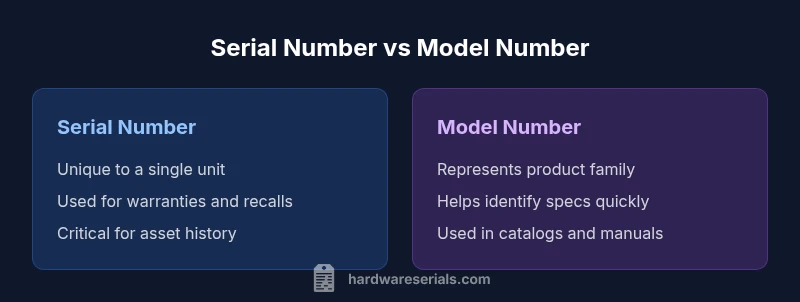
Serial number and model number are essential identifiers for products. In brief, a serial number uniquely identifies a single unit, while a model number denotes a family of devices. This comparison helps you verify authenticity, check compatibility, access warranties, and pursue recalls. Understanding how each identifier works makes it easier to locate manuals, contact support, and track parts across assets.
Understanding the difference between serial number and model number
In the hardware world, two identifiers matter most when verifying products: the serial number and the model number. A serial number is a unique code assigned to a single unit as soon as it leaves the production line; no two items share the same serial. A model number, by contrast, denotes a family of products that share the same design and intended specifications. When you see both together on a device, you can precisely locate the item's production history while also categorizing it within a broader product family. For professionals, understanding these definitions is essential to avoid confusion during warranty claims, recalls, or parts matching. Clear separation between serial numbers and model numbers reduces misidentification risk during audits, asset management, and vendor communications.
Locating serial number and model number on devices
Locating the serial number and model number is usually straightforward, but placement varies by device type. On consumer electronics, you’ll commonly find labels on the back, bottom, or inside a battery compartment. For appliances, look at the door frame or a data plate near the chassis. Industrial gear often prints a metal nameplate on the side or top face. Vehicles store identifiers in door jambs, engine bays, or under the hood. Tools like drills or laser levels usually mark serial numbers on the handle, shaft, or case. Documenting both identifiers during setup is a best practice so you can reference them quickly for warranties or recalls.
Why both identifiers matter for ownership, warranties, recalls
Warranty coverage and service eligibility often hinge on the serial number, since it confirms you own an individual unit. Recalls are typically issued against specific serial ranges, not just the model family, so the serial number is key for safety updates. The model number helps you verify that you’re using the correct parts, manuals, and firmware for a given product family. Together, the two identifiers reduce risk of misinterpretation when ordering replacement parts or contacting customer support. For asset management, keeping both numbers consistently recorded improves traceability across multiple sites and rounds of refurbishment.
Data quality: how serial numbers and model numbers are structured
Most hardware identifiers use alphanumeric formats that may include prefixes, digits, and sometimes date stamps. A serial number emphasizes uniqueness and traceability to a single unit, while a model number emphasizes design lineage and specifications. In practice, you may encounter check digits or vendor-specific encoding intended to flag transcription errors. When working with large inventories, you’ll encounter a mix of formats across brands and product lines. The key is to document the exact string as printed, avoid spaces or ambiguous characters, and preserve the original order in which the identifiers appear on the device.
How to interpret a serial number and a model number
Making sense of these codes starts with vendor documentation or official product catalogs. Look for sections describing the serial number format, such as where it begins and whether it contains date information, production line codes, or batch identifiers. For model numbers, search for a short code that maps to a product family, version, or generation. When in doubt, contact the manufacturer’s support portal or consult the user manual. Over time, you’ll learn which portions of the identifiers are most useful for warranty checks, service requests, or compatibility lookups.
Best practices for recording and organizing serial number and model number data
Create a centralized asset register that stores both identifiers for every item, including device type, purchase date, and location. Use scannable labels or QR codes where possible to minimize manual data entry errors. Establish a standardized format for data entry (for example, one line per identifier, with a dash-separated convention). Regularly audit your records to catch transcription mistakes, duplicate entries, or mismatched models. Train staff to always record both identifiers during intake, repair, or transfer of ownership to maintain a reliable audit trail.
Common pitfalls and how to avoid them
Common mistakes include mixing up the serial number and model number, transcribing digits incorrectly, or recording the wrong unit’s identifiers during asset transfers. Physical labels can wear or fade, so always cross-check with the device’s documentation or vendor portals. Do not rely on photos alone; ensure readable text is captured exactly as printed. Implement double-entry verification for critical items and periodically rebuild your inventory from scratch to detect drift between physical assets and records.
Verification workflows: offline and online methods
Offline verification relies on inspecting the printed labels and consulting the user manual to map identifiers to product specs. Online verification uses official vendor portals, manufacturer databases, or trusted third-party lookup services to validate the serial number or model number against the device’s configuration. Maintain a two-step process: confirm the code with the device itself, then cross-check against a trusted source. For higher-stakes assets, adopt automated verification through barcode or QR scanning that feeds directly into your asset management system.
Industry standards and sources for serial number and model number formats
While formats vary by industry and brand, most sectors emphasize traceability, compatibility, and documentation consistency. Manufacturers often supply format guidelines in technical manuals or support portals. Asset managers should align with internal standard operating procedures to ensure consistency across teams and sites. Regularly review vendor notices and recalls that reference specific serial ranges or model numbers to keep your inventory up to date.
Case studies: recall and warranty scenarios
In one scenario, a household appliance recall is issued for a subset of units differing by a serial range. A company that records both serial numbers and model numbers can quickly identify affected inventory and coordinate returns. In another scenario, a technician needs a replacement part compatible with a device’s generation; the model number confirms compatibility, while the serial number confirms it is the correct individual unit for warranty service. These examples illustrate how dual identifiers support timely, accurate service actions.
Tools and templates for tracking serial number and model number data
Practical tools include spreadsheet templates with columns for item type, serial number, model number, purchase date, and location. Digital asset registries and barcode systems streamline data capture and reduce errors. For teams with high asset turnover, consider integrating a lightweight database or asset-tracking app that associates each identifier with service history, warranty status, and recall notices. Templates should be designed to accommodate updates, audits, and bulk imports without sacrificing data integrity.
The future of serial number and model number tracking in hardware
As products become more interconnected, the value of precise identifiers grows. Expect richer metadata attached to each serial number and model number, including version history, firmware state, and maintenance records. Advances in automated identification technologies—like visible-light scanning, RFID, and NFC—will simplify data capture at scale. Maintaining clean, auditable records will remain critical for warranties, recalls, compliance, and efficient asset management across increasingly complex hardware ecosystems.
Comparison
| Feature | Serial-number-based verification | Model-number-based verification |
|---|---|---|
| Definition | A unique code assigned to a single unit by the manufacturer. | A product-family identifier that indicates design, version, and scope. |
| Primary use | Identity of a specific item, traceability, and post-sale service. | Identification of product family, specifications, and compatible parts. |
| Best for | Warranty claims, recalls targeting specific units, and asset tracking. | Quick compatibility checks, catalogs, and bulk orders. |
| Data accessibility | Often retrieved from official databases or vendor portals tied to the unit. | Commonly referenced in manuals, catalogs, and spec sheets. |
| Risk of misidentification | Low when properly recorded; risk increases if labels are damaged or misread. | Higher if used alone for a device outside its product family. |
| Example tools | Warranty portals, serial-number lookup databases, asset records. | Product catalogs, service manuals, vendor specification sheets. |
Advantages
- Enhances traceability and post-sale support
- Improves accuracy for recalls and warranty validation
- Supports better asset management across sites
- Facilitates safer parts matching and replacements
Disadvantages
- Requires disciplined data-entry and labeling
- Can be confusing if labels fade or are damaged
- Model numbers may change across generations, needing updates
- Dual-tracking increases initial setup effort
Use both identifiers for comprehensive accuracy; serial numbers anchor individual units, model numbers anchor product families.
Serial numbers provide unit-level traceability, while model numbers enable quick family-level lookups. Together, they reduce risk in warranties, recalls, and repairs, and improve asset management across organizations.
Frequently Asked Questions
What is the difference between a serial number and a model number?
A serial number uniquely identifies a single unit, while a model number denotes a product family. The serial number tracks the specific item's history, whereas the model number helps classify and compare design variants.
A serial number is unique to one unit, while a model number identifies the product family. They serve different purposes in tracking, warranties, and compatibility.
Where can I typically find the serial number and model number on electronics?
Look for labels on the back, bottom, or inside access panels for serial numbers. Model numbers are usually printed on the label near the serial number or in the user manual.
Check the device label on the back or bottom for both identifiers, and consult the manual if needed.
How do serial numbers help with warranty claims?
Serial numbers confirm ownership of a specific item and can be used to access service history. They are often required to verify eligibility for warranty coverage or recalls.
Serial numbers prove you own the exact unit and help verify warranty eligibility.
Why is the model number important for parts compatibility?
The model number indicates the design variant and specifications, ensuring that replacement parts and firmware match the intended product family.
Model numbers guide you to compatible parts and firmware for a given product family.
Are serial numbers always unique across brands?
In most cases serial numbers are unique within a brand, but cross-brand uniqueness isn’t guaranteed. Always verify within the manufacturer’s database for accuracy.
Serial numbers are typically unique within a brand, but you should confirm with each manufacturer.
How can I verify a serial number online?
Use the manufacturer’s official portal or trusted lookup services that map the serial number to the specific unit. Cross-check with the model number for additional accuracy.
Visit the manufacturer’s site or trusted lookups to verify the serial number, then cross-check the model number.
Key Takeaways
- Record both identifiers for every asset.
- Store data in a centralized, scannable repository.
- Cross-check with vendor portals to validate records.
- Leverage barcode/QR codes for fast data capture.
- Regularly audit records to prevent drift and errors.