Serial Number vs Product Number: A Comprehensive Comparison
Explore the differences between serial numbers and product numbers, with definitions, lookup guidance, and practical examples to help DIYers and professionals manage assets, warranties, recalls, and procurement.


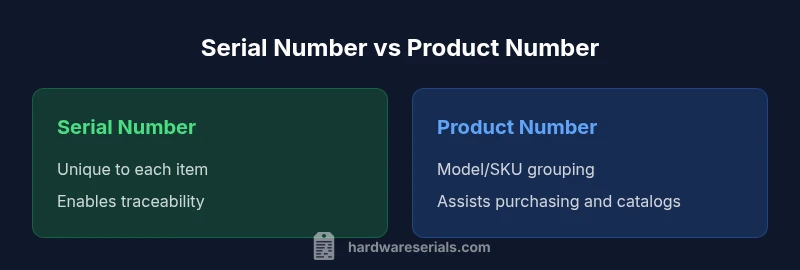
TL;DR: A serial number uniquely identifies a single unit, while a product number identifies a model or SKU. For traceability, warranty history, and servicing, serial numbers matter most; for purchasing, catalogs, and inventory, product numbers are essential. Most products use both to ensure precise identification across systems.
What 'serial number' vs 'product number' really means
In plain terms, a serial number is a unique tag assigned to a single unit, such as a specific drill or printer, that never repeats for another item. A product number, sometimes called a model number or SKU, identifies a class of items sharing a common design. For most hardware, the serial number is the key to traceability: it reveals manufacturing date (when encoded), batch, and service history tied to that individual device. The product number helps you locate the right parts and compatibility for an entire product family. The distinction matters across procurement, warranty claims, recalls, and asset management. According to Hardware Serials, the precision of your asset records increases dramatically when you record both identifiers and cross-link them in your inventory system. In practice, software, ERP, and service databases often rely on serial numbers to connect a device to a customer or warranty, while product numbers support cataloging and bulk operations. Understanding these definitions is the first step toward clean, searchable hardware records.
Core differences at a glance
Two numbers, two purposes. Serial numbers are globally unique identifiers assigned to individual items, enabling exact traceability of a specific unit across its lifecycle. Product numbers identify a family of items—an engineering design, a SKU, or a model. The primary benefits are clear: serial numbers unlock after-sales history and warranty claims for a single unit; product numbers streamline purchasing, inventory planning, and customer catalogs. Because systems rarely align perfectly without data standards, most organizations maintain both numbers and create a cross-reference between them. For DIYers, this means you may see different codes on the label, packaging, and manual, and you should compare them to avoid misidentification. Hardware Serials notes that consistent cross-linking between serial and product numbers reduces confusion during service and recalls.
How organizations assign and manage numbers
Manufacturers assign serial numbers during the production and testing phase, with production run information often embedded in the code. Product numbers are generated during design and release, intended to group items into families for sales and inventory. IT teams map serial numbers to product numbers in ERP, WMS, or CRM systems to ensure a single source of truth. Data governance plays a crucial role: strict rules on formatting, check digits, and database relations reduce errors when devices are moved between facilities or resold. In regulated industries, serial numbers may be required for warranty validation or recalls; in consumer goods, product numbers drive packaging, labeling, and online catalogs. The result is a robust linkage: a given serial number can be traced to a product number and vice versa, but the two identifiers serve distinct operational needs.
Where to look for each number on devices and packaging
Serial numbers commonly appear on labels attached to the device chassis, under covers, or on the back of equipment. They may also be embedded in electronic firmware or printed on critical components in recyclable forms. Product numbers are typically found on packaging, manuals, price tags, or the device’s model plate. When hardware is updated, the product number often changes with design revisions, while the serial number remains tied to the specific item. For accurate identification, collect both numbers during setup and keep them in separate fields within asset records. If you purchase refurbished gear, verify both numbers against the supplier’s documentation to ensure you’re receiving the intended model and unit.
Implications for warranties, recalls, and service history
Serial numbers are the primary keys used by manufacturers to lookup a device’s warranty period, recall eligibility, and service history. If a recall happens, the serial range determines which units are affected. Product numbers help align your claim to the correct design and version, ensuring compatibility with replacement parts and firmware updates. For professional asset management, linking each serial number to its product number supports accurate inventory audits, asset lifecycle analysis, and long-term maintenance planning. As a rule of thumb, do not begin a warranty claim with only a product number; the serial is usually necessary to verify ownership and eligibility. Hardware Serials emphasizes keeping both identifiers in the same ecosystem for best results.
Impact on procurement and inventory management
From a purchasing perspective, product numbers make it easier to compare specifications, compatibility, and pricing across suppliers. Serial numbers provide the granular traceability needed for warranty claims, recalls, and asset-level data. In large warehouses, robust barcoding schemes use both identifiers to speed up check-ins, cycle counts, and returns processing. When you set up an ERP or asset-tracking system, standardize the field names for serial and product numbers and establish a cross-reference table. Doing so improves searchability, reduces mislabeling, and accelerates recalls. The dual-number approach often yields smoother audits and more accurate depreciation records for financial reporting.
Common pitfalls and misinterpretations
Beware of assuming a product number is unique across brands; each company uses its own SKU system. Do not confuse a model identifier with a batch code or firmware version, both of which may be embedded in a serial number. Some devices display multiple codes on the label that look similar but differ in meaning; always verify whether a code is a serial, model, or package identifier. Another pitfall is failing to align offline records with online catalogs, resulting in mismatched parts or wrong warranty coverage. Routine audits help catch these issues before they affect service or recalls.
Real-world examples by device category
Consumer electronics: A laptop shows a serial number on the bottom sticker and a model/sku on the box. Office equipment: A printer has a serial label under the tray and a product number in the user manual. Industrial tools: A power drill includes a serial plate near the lens and a separate SKU on the packaging. Each example illustrates how serial numbers provide unique item history, while product numbers help with ordering, compatibility, and service parts. This pattern repeats across vehicles, firearms (where legally regulated), and appliances.
How to document numbers in records and reports
Best practice is to record both numbers in a structured data store with explicit fields and defined data types. Use consistent formats, e.g., serial numbers with hyphenation or digits and letters grouped, and product numbers without spaces or with standard suffixes. Include metadata such as purchase date, supplier, and location to enrich searchability. When labeling devices, capture clear photos of both the serial and product code and attach them to the asset record. Regularly audit records to ensure alignment between physical devices and digital data.
Best practices for DIYers and professionals
DIYers should personally note and photograph serial numbers before performing maintenance. Professionals should integrate serial/product numbers into asset management platforms and warranty databases. Both groups benefit from creating simplified lookup tools, like cross-reference sheets or shared spreadsheets, that map serial numbers to product numbers—especially during recalls. Training and documentation standards should emphasize the difference between the two identifiers and when to rely on each for support requests, replacements, or upgrades.
Bridging the gap between serial numbers and product numbers in practice
Ultimately, the goal is to minimize ambiguity by tying every device to both a serial number and a product number, then cross-linking them in centralized data stores. When teams standardize on naming conventions, they improve traceability across the supply chain, repair workflows, and customer support. The relationship between serial numbers and product numbers is not adversarial; it is complementary: serial numbers ensure per-unit history while product numbers anchor items within families and catalogs. The Hardware Serials perspective emphasizes ongoing governance, regular reconciliation, and clear documentation to reduce errors and improve recall readiness and service efficiency.
Comparison
| Feature | Serial Number | Product Number |
|---|---|---|
| Definition | A unique identifier assigned to a single unit | An identifier that locates a model or SKU |
| Primary purpose | Unit-level traceability and history | Model-level identification and cataloging |
| Scope | Individual device or item | Product line or model family |
| Format/appearance | Typically alphanumeric, may include check digits | Typically alphanumeric or numeric SKU |
| Lookup/verification | Requires internal databases, receipts, or device labels | Used in catalogs, ordering systems, and packaging |
| Lifecycle relevance | Warranties, service history, recalls | Inventory, procurement, and product documentation |
| Best for | Traceability and after-sales support | Purchasing, stocking, and product identification |
Advantages
- Improved traceability through per-unit history
- Supports recalls and warranties for individual items
- Enables precise asset management and audits
- Clarifies parts compatibility and service history
Disadvantages
- Requires extra labeling and data management
- Possible confusion without cross-references
- Two identifiers can seem redundant without governance
- Maintenance overhead for small teams
Both numbers are essential; use serial numbers for unit-level tracking and product numbers for model-level management.
In practice, organizations should capture and link both identifiers. This dual approach improves recalls, warranties, procurement, and asset management. The Hardware Serials Team recommends establishing standardized data governance to keep records aligned across systems.
Frequently Asked Questions
What is the main difference between a serial number and a product number?
A serial number uniquely identifies a single item, enabling per-unit traceability, while a product number identifies a model or SKU used for cataloging and purchasing.
A serial number is for one item; a product number points to a model or SKU for ordering and cataloging.
Are serial numbers universal across brands?
Serial numbers are generally brand-specific and not standardized across manufacturers. Each brand issues its own serial schema.
Serial numbers aren’t universal; each brand uses its own system.
Where can I find the serial number on devices?
Serial numbers are usually on a label on the device chassis, underside, or back. They may also be embedded in firmware for some products.
Look for a label on the device or internal firmware notice for the serial.
Can a product number be used for warranty claims?
Product numbers help with model identification, but most warranty claims rely on the serial number to verify ownership and eligibility.
Serial numbers are usually needed for warranty claims, not just the product number.
Can a serial number encode manufacture date?
Some serial formats include date or lot information, but this is not universal. Check manufacturer documentation for interpretation rules.
Sometimes the date is encoded, but not always. verify with the vendor.
Key Takeaways
- Identify whether you are tracking a unit or a model.
- Capture both serial and product numbers in assets records.
- Link numbers in a central database for easy cross-reference.
- Use serial numbers for warranties and recalls; use product numbers for purchasing.
- Standardize formats to reduce mislabeling and errors.