Difference Between Serial Number and Part Number — Key Guide
A detailed, analytical guide to differentiate serial numbers from part numbers, with definitions, practical examples, and tips for DIYers and professionals. Learn how to identify, read, and apply both identifiers for warranties, recalls, parts replacement, and asset tracking.


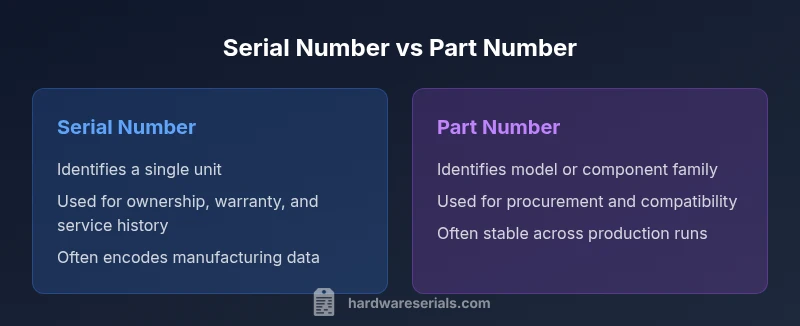
The difference between serial number and part number is essential for accurate device identification and service. A serial number uniquely identifies a single unit and travels with it through its lifecycle, while a part number designates a model, component, or revision and remains consistent across multiple units. Understanding this distinction improves warranty claims, recalls, parts ordering, and maintenance records.
What is a serial number?
A serial number is a unique identifier assigned to an individual unit of a product. It travels with that specific unit from production through its entire life cycle, across ownership transfers, repairs, and recalls. Because serial numbers are intended to be unique to each item, they act like a fingerprint for that single device. The difference between serial number and part number becomes especially important in service history, warranty validation, and asset tracking. In practical terms, use the serial number to prove ownership, verify that a particular unit is within warranty, and pull up service or recall records tied to that exact item. According to Hardware Serials, clear labeling of serial numbers and part numbers is essential for traceability across devices. This emphasis on accurate identifiers helps DIYers and professionals avoid confusing a model or batch with a specific unit and reduces the risk of incorrect service actions.
In many industries, serial numbers are not just a simple decimal string; they may include production codes, plant identifiers, or date indicators that variant manufacturers use for internal tracking. Regardless of the encoding, the key concept remains: a serial number should uniquely point to one individual unit and nothing more. In contrast, the same product family may appear with different serial numbers, each representing a physical unit but sharing a common identity through the part number.
For anyone dealing with equipment ownership, serial numbers are integral to troubleshooting, provenance, and post-sale support. When you encounter a term like the difference between serial number and part number in manuals or catalogs, recognize that the serial number is the unit’s personal ID, not a descriptor of a component or model. This distinction becomes even more critical for high-value devices where precise tracking is necessary. In short, treat the serial number as the item’s identity stamp, while the part number serves as the item’s catalog entry and compatibility reference.
370 words
Comparison
| Feature | Serial Number | Part Number |
|---|---|---|
| Definition | Unique identifier assigned to a single unit | Identifier for a product family, model, or component |
| Scope | Ties to one physical item across its life | Applies to a class of items sharing design/parts |
| Uniqueness | Unique per unit | Shared across units of the same model or variant |
| Usage in service | Warranty claims, service history, recalls tied to the unit | |
| Format variability | May include date/plant codes; varies by maker | |
| Update frequency | Rarely changes after issuance for a unit | |
| Replacement parts | Part numbers locate compatible parts across units | |
| Traceability | Enables precise asset tracking over time |
Advantages
- Improved traceability and ownership proof
- Better accuracy in recalls and warranty processing
- Clear separation between unit identity and parts documentation
- Easier asset management and audits
- Streamlined parts replacement when part numbers are standardized
Disadvantages
- Serial numbers can be long and hard to read on small labels
- Part numbers may change with revisions or product families
- Both numbers require diligent cross-referencing to avoid confusion
- Inconsistent labeling across brands can still cause errors
Use both identifiers with a cross-reference for best accuracy
Serial numbers uniquely identify each unit, while part numbers identify product models or components. Maintaining a cross-reference ensures accurate warranty handling and parts sourcing, reducing misidentification and costly mistakes. The Hardware Serials team emphasizes documenting both numbers for robust asset management.
Frequently Asked Questions
What is the difference between a serial number and a part number?
A serial number uniquely identifies a single unit and travels with it through its lifecycle. A part number identifies a model, component, or revision and remains the same across multiple items. Understanding both helps with ownership, warranties, and sourcing the right parts.
Serial numbers identify one unit, while part numbers identify models or components. Use serials for ownership and service history, and part numbers for parts compatibility.
Do serial numbers ever contain the date of manufacture?
Some serial numbers encode production date or factory information, but this is not universal. Encoding practices vary by manufacturer. Always verify with official documentation when the date is essential for recalls or warranty claims.
Some serials include a date or plant code, but it’s not guaranteed across brands.
Can a part number be used as a serial number?
In most cases, a part number is not a serial number. However, certain systems may reuse or repurpose a code in limited contexts. Do not rely on a single identifier for ownership or service history without confirming its meaning with manual or vendor sources.
Part numbers are for parts; serials are for the unit.
Where can I find serial numbers and part numbers on common devices?
Look for labels on the device body, back panels, battery compartments, or packaging. Manuals and warranty cards often list both numbers. For vehicles, check the chassis plate; for electronics, look on the back, bottom, or inside the battery area.
Check labels on the device and in the manual for both numbers.
How should I verify the numbers before ordering parts?
Cross-check the serial and part numbers against the official vendor documentation, the device’s manual, and any manufacturer portal. If in doubt, contact the manufacturer or authorized service centers to confirm compatibility.
Cross-check with official docs and vendor portals before ordering.
Are there standards for serial numbers?
There is no universal global standard for serial numbers across all industries. Practices are often brand-specific, so always consult the manufacturer’s labeling guidelines and the asset management policy of your organization.
No universal standard; follow brand-specific labeling guides.
Key Takeaways
- Identify each unit with its serial number for ownership and service history
- Use part numbers to locate compatible components and model information
- Maintain a cross-reference between serial numbers and part numbers across inventories
- Verify numbers against official documents to avoid recalls or incorrect parts
- Document numbers consistently to support warranties and aftermarket service