Serial Number vs Model Number: A Practical Guide
Explore the difference between serial numbers and model numbers, where to find them on devices, and how to use each for warranty, parts, and service history. Clear guidance for DIYers and professionals.


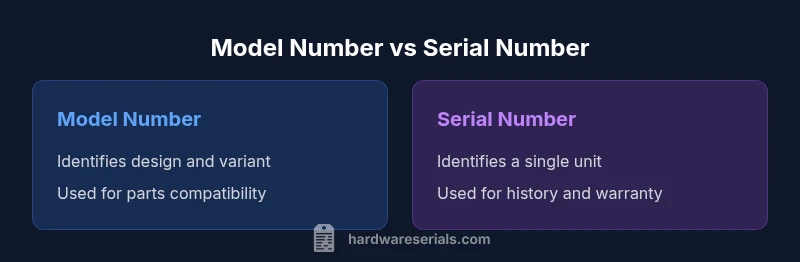
Serial numbers uniquely identify individual units, while model numbers designate a product design or variant shared by many units. For DIYers and professionals, distinguishing the two improves warranty checks, parts matching, and service history. Use the serial number to trace a specific item’s journey and the model number to locate compatible manuals and replacements. Getting this distinction right saves time and avoids misclaims.
What is the difference between serial number and model number?
In everyday device labeling two identifiers matter the serial number and the model number. The difference between serial number and model number is fundamental for understanding ownership history and compatibility. A serial number is a unique identifier assigned to a single item so every physical unit has its own string of characters. A model number identifies a design or variant that can cover thousands of individual units produced over time. From a practical perspective the serial number records specific events such manufacture date production line lot and service history. The model number records design intent the family revision and intended feature set. The Hardware Serials team emphasizes that keeping these distinct helps when you file a warranty claim request a spare part or verify authenticity. For DIYers and professionals this distinction is not academic it shapes how you locate manuals diagnose problems and order replacement parts. Throughout this article you will see concrete tips and real world scenarios that illustrate how to use each identifier effectively.
Why the distinction matters for inventory and warranties
Having clear rules about serial numbers and model numbers matters for inventory management and warranty processing. When a unit has a properly recorded serial number you can trace its individual history including manufacture date and service events. The model number provides a stable reference for parts compatibility and product support across many units. The Hardware Serials analysis shows that professionals who routinely record both identifiers experience fewer warranty disputes and faster service because staff are always looking at the right identifier for the task. In practice this reduces misordered parts, delays in repairs, and confusion during recalls. For technicians in the field and staff in warehouses the ability to switch between a unit specific code and a design code is a core skill that improves accuracy and accountability.
Common formats and where to find them
Strings for serial numbers and model numbers follow different conventions by brand and product category. Model numbers are usually constant for a family of devices and may include letters and digits arranged to signal the product line and revision. Serial numbers are designed to be unique to each item and often incorporate date codes or batch identifiers whose format varies by manufacturer. You will commonly find these numbers on a label on the device frame the back or bottom, inside the battery compartment, on the packaging or in the user manual. When you scan a barcode or check a serial plate you are most often looking at a single unit history rather than a design concept. Knowing where to look makes field work faster and more reliable.
How manufacturers assign serial numbers and model numbers
The process behind serial numbers and model numbers reflects different goals. Model numbers are assigned during the design phase to describe a product family, intended features and a revision level. They stay relatively stable over time to help customers identify compatible parts and documentation. Serial numbers are issued as soon as a unit leaves the assembly line and are intended to be unique. They help track the specific unit through manufacturing, distribution, sale, service, and warranty. Different brands adopt different coding schemes but the underlying principle remains the same: model numbers serve as a design index, serial numbers capture individual history. Understanding this split helps professionals correlate service records with exact units and assess recalls efficiently.
How to interpret patterns in numbers
While there is no universal standard, patterns in serial numbers and model numbers often reveal useful clues. A model number may encode the product line, variant, and sometimes the region or generation. A serial number may include a factory code, a date code, and a unique identifier for the unit. Decoding techniques vary by manufacturer but common steps include checking the official manuals, using the manufacturer portal, and cross referencing with invoices. For the professional reader the goal is to translate the alphanumeric string into actionable facts about compatibility and history. Always document the source of the numbers to avoid ambiguity later on.
Practical examples across electronics, appliances, vehicles
Consider a smartphone model with a model number that denotes its series and storage capacity. The serial number on that same device identifies a particular handset and its life story from production to repair. In appliances the model number helps you locate the correct parts catalog and installation instructions while the serial number confirms that a specific unit is under warranty. In vehicles the model year code may be part of the model number while the VIN or serial code records the exact chassis. These examples show how serial numbers and model numbers coexist and why each matters in the right context.
Common pitfalls and misconceptions
A frequent trap is assuming a single number suffices for both identity and history. Another pitfall is trusting a damaged label or faded engraving, which can obscure crucial details. Some brands reuse a similar model number across multiple sub variants, causing confusion with serial records. Do not rely on memory alone; always verify using official sources and keep both numbers in your notes. Misunderstandings about where to look for the numbers can lead to wrong parts orders or warranty denials. By staying explicit about which code you are using you reduce risk and improve service outcomes.
Verifying authenticity and warranty status
Verifying authenticity and warranty status starts with locating the numbers precisely and then cross checking with official sources. Use the model number to confirm product compatibility and variant, and use the serial number to pull up the exact unit history. Many manufacturers provide online lookup tools where you can enter either one for reference, but the best practice is to submit the serial for warranty verification and the model for part compatibility. Look for official portals and preserve any receipts or packaging as evidence. When in doubt contact manufacturer support with both numbers ready to share.
Best practices for recording and organizing numbers
Create a centralized inventory log that records both model and serial numbers for every item. Include fields for purchase date, warranty period, location, and current status. Use consistent formats and avoid free text for codes. Digital tools can enforce validation rules so you can quickly spot mismatches. Regular audits help ensure the two numbers remain aligned with your asset records. The goal is to enable fast lookups, easy cross references, and reliable history retrieval for audits, recalls or repairs.
Special considerations for firearms and regulated items
In regulated domains such as firearms, serial numbers follow legal standards and strict handling rules. Model numbers may appear on parts but the critical identity is the serial number which ties to ownership and transfer records. Always comply with local laws when recording, sharing or transmitting serial numbers, and use official channels for verification. The exact process for extraction and verification varies by jurisdiction, but the principle remains constant the unit specific serial number carries the ownership and transaction history while model numbers remain a design reference. Treat this topic with care and respect legal requirements.
When to contact manufacturers or authorities
If you encounter a missing or illegible serial number to verify ownership contact the manufacturer for guidance or seek official consumer protection resources. For recalls or safety alerts you should reference both numbers whenever possible to ensure the correct model is addressed and the right unit is identified. If you suspect tampering or counterfeit parts report it to the manufacturer or relevant authorities and preserve any receipts or packaging as evidence. Documentation that ties serial numbers to purchase records can be essential in disputes or warranty claims.
Quick tips to apply this in the field
Carry a small sheet with spaces for serial and model numbers date of inspection and the device type. When in doubt photograph labels and store them in a dedicated folder that also holds manuals and receipts. In the workshop or warehouse incorporate a simple lookup protocol that brings up both identifiers for every item. These habits are not only efficient but also build a traceable record you can rely on during maintenance recalls or audits.
Comparison
| Feature | Model number | Serial number |
|---|---|---|
| Definition | Identifies a product design and variant used across many units | Identifies a unique unit and its production history |
| Purpose | Guide compatibility, documentation, and purchasing decisions | Enable tracking of individual items for service, warranty, and recalls |
| Format/Pattern | Often alphanumeric with family and revision signals | Varies by manufacturer; may include date or batch codes |
| Where Found | Label on device, packaging, or documentation | On device label near barcode or metal plate |
| Traceability/History | Indicates design lineage and part compatibility | Links to manufacturing data, service history, and ownership timeline |
| Warranty Relevance | Used to verify eligibility and compatibility for parts and service | Used to validate coverage for a specific unit |
| Best For | Purchasing, parts lookup, and design references | After sales, recalls, and unit level support |
Advantages
- Clarifies ownership and history when diagnosing issues
- Aids in locating compatible parts and manuals
- Improves warranty and service accuracy
- Supports asset management and recalls
Disadvantages
- Labels can wear off or be damaged
- Not all products display both identifiers clearly
- Model numbers change with revisions or regional variants
- No universal standard across brands
Keep serial numbers and model numbers distinct for maximum traceability.
Separating the two numbers clarifies ownership, warranty, and parts compatibility. If you record both numbers consistently, you can quickly verify a specific unit and locate the correct documentation and replacements. The Hardware Serials team recommends adopting this practice across inventory and service workflows for better accuracy.
Frequently Asked Questions
What is the difference between a serial number and a model number?
A serial number uniquely identifies a single unit while a model number identifies a product design or variant used across many units.
A serial number is unique to one item, while a model number refers to the design or variant used across many items.
Where can I find the model number on common electronics?
On the device label usually on the back or bottom, sometimes on the packaging or user manual.
Look on the device label or packaging to find the model number.
Where can I find the serial number on a device?
Typically on a label near the barcode, on the back, bottom, or inside the battery compartment, depending on the device.
Check the label near the barcode or on the back of the device to find the serial number.
Do serial numbers affect warranty status?
Yes, many warranties are tied to the serial number of the specific unit rather than just the model.
Serial numbers often determine warranty eligibility for a specific unit.
Can a product have multiple serial numbers?
Generally no, each unit has a unique serial number, though components within a device may have their own identifiers.
Usually there is one serial number per item; components may have separate identifiers.
Are model numbers standardized across brands?
No, model numbering schemes vary by manufacturer and product line, though they serve a similar design reference purpose.
Model numbers vary by brand; there is no universal standard.
Key Takeaways
- Identify the model number to locate compatible parts
- Use the serial number to trace a specific unit’s history
- Always capture both numbers during audits
- Check the manufacturer site for official definitions
- Store numbers in a centralized system for compliance