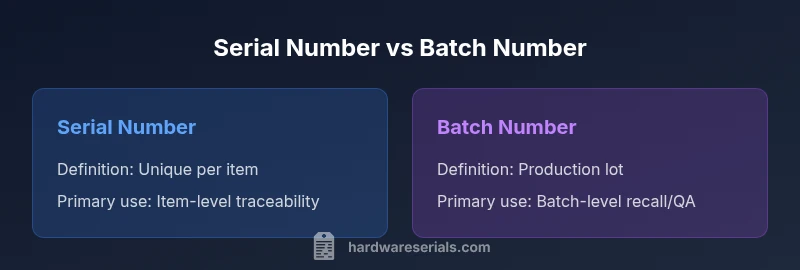
Difference Between Serial Number and Batch Number
Learn the difference between serial number and batch number, why each matters, where to find them, and how they affect warranties, recalls, and authentication across electronics, appliances, vehicles, tools, and more.


Serial numbers provide item-level traceability by assigning a unique identifier to a single unit, while batch numbers group items produced together in a production run. This distinction drives how recalls, warranties, and authenticity checks are conducted across products like electronics, appliances, and tools. In practice, use both identifiers: the serial for the individual item and the batch for production context.
The Core Distinction: What Each Identifier Represents
The difference between serial number and batch number is a foundational concept in asset management and product lifecycle tracking. A serial number is typically a unique label assigned to a single item, enabling precise tracking from the moment of manufacture through ownership and end-of-life. A batch number identifies a production lot—an entire group of items produced under the same conditions within a defined timeframe. This distinction matters because it shapes how recalls are executed, how warranty claims are validated, and how fraud or authenticity concerns are addressed. According to Hardware Serials, understanding these identifiers is essential for building robust record-keeping practices and reliable verification workflows. In practice, most organizations rely on both identifiers to tell a complete traceability story: the serial number for the specific unit and the batch number for production context and quality control history.
In many industries, the exact format and placement of these numbers vary, but the core logic remains constant: one ID tracks a single item; the other tracks a production group. This dual approach supports more efficient recalls, targeted warranty processing, and stronger supplier authentication. The goal is to create a traceable chain of custody that can be audited and verified by manufacturers, distributors, retailers, and end users alike. Hardware Serials emphasizes that getting the basics right — knowing what each number means and where to locate it — reduces confusion and speeds up essential workflows.
Where You Find Each Identifier on Common Products
Finding serial numbers and batch numbers is not uniform; it depends on the product type and the manufacturer’s conventions. On many consumer electronics (phones, laptops, cameras), the serial number appears on a label affixed to the device’s back panel or beneath the battery compartment and is often registered in warranty portals. The batch number may appear on the packaging or inside the product documentation. For home appliances, the nameplate on the back or inner frame typically carries the serial number, while the batch or date code may be printed on the carton, user manual, or a dedicated sticker. In vehicles, serial-like identifiers appear as Vehicle Identification Numbers (VINs) and, in some cases, engine numbers; batch numbers may be used internally to group production runs, but the VIN remains the official item-level identifier.
For tools and industrial gear, serial numbers frequently appear on frames, handles, or metal plaques. On firearms, serial numbers are stamped on receivers or frames; batch numbers may track production lots for compliance and recall planning. Always verify against the manufacturer’s documentation or official databases, as misreading a label is a common source of errors and can affect warranty or recall status.
In short, serial numbers and batch numbers are not interchangeable labels. Each serves a distinct purpose, and knowing where to locate them is the first step in effective asset management. Hardware Serials notes that accurate placement of these identifiers reduces misidentification and improves downstream workflows.
Serial Numbers: Purpose, Scope, and Limitations
Serial numbers provide item-level traceability across the product’s lifecycle. They help record keeping for warranties, asset management, service history, and provenance checks. A well-implemented serial number system enables quick identification of a specific unit, its production date, and its service history. Limitations arise when items are refurbished, repackaged, or resold across borders where numbering conventions differ. Some brands assign serial numbers per country, while others maintain a universal scheme. It’s also possible for a serial number to be damaged or removed during refurbishment, which can complicate verification. The strength of serial numbers lies in precision: when you have the exact unit’s serial, you can confirm authenticity, confirm ownership, and track service events with confidence. Hardware Serials emphasizes that maintaining accurate, machine-readable logs of serials is critical for robust post-sale support and regulatory compliance.
Industries with high-value items (electronics, medical devices, aerospace components) often treat serial numbers as the backbone of recalls and field notices. They enable manufacturers to locate every affected unit, assess failure history, and coordinate replacements or repairs efficiently. In contrast, systems that prioritize speed over granularity may rely more on batch numbers for recall scoping, which can be sufficient for common defects affecting entire lots but not for individual units with unique faults. The takeaway is clear: serial numbers are for people who need to identify a single item; batch numbers are for those assessing production-level quality and risk.
Batch Numbers: Purpose, Scope, and Limitations
Batch numbers identify a production run, a grouping of items produced under the same conditions, often within a short time window. They support quality control, traceability across supply chains, and efficient recalls when a defect is detected within an entire batch. Batch numbers are not unique identifiers for individual items; multiple items share the same batch code. They can reveal manufacturing dates, shifts, or lot-specific codes, depending on the producer’s conventions. A key limitation is the potential reuse of batch numbers across different production cycles or product lines, which can complicate cross-checks if not coupled with other identifiers like a serial number. Understanding batch numbers helps manufacturers and regulators determine the scope of corrective actions and helps downstream partners trace root causes. Hardware Serials notes that batch numbers are essential for batch-level analysis, but they should always be used in conjunction with serial numbers when item-level precision is required.
In practice, recalls and safety notices frequently reference batch numbers to identify the affected production lots. For consumers and businesses, batch numbers can offer quick insights into when and how a batch was produced, which can be useful for evaluating compatibility with other parts, safety requirements, or refurbishment compatibility. Yet, batch numbers alone cannot tell you about a specific unit’s status; that’s where the serial number becomes indispensable. This dual approach ensures both batch-level and item-level traceability across the supply chain.
Format, Standards, and Variations Across Industries
There is no universal standard for serial or batch number formats. Serial numbers are often alphanumeric with a manufacturer prefix indicating brand, country, or product line, followed by a sequence that is intended to be unique to each unit. Batch numbers may incorporate date codes, plant identifiers, or production line details, and can be pure numbers, alphanumeric, or a mix. Some industries favor longer serial strings to accommodate more data in one field, while others rely on shorter codes for simplicity. Because formats vary, it is important to consult the official documentation for each product or brand to understand the meaning of the characters. The Hardware Serials framework emphasizes documenting both identifiers in a centralized asset registry to facilitate consistent interpretation across departments and partners.
In regulated sectors such as healthcare, automotive, and aerospace, there may be stricter coding requirements and traceability standards. Even so, the core principle remains unchanged: the serial number uniquely identifies individual units, whereas batch numbers group production lots for quality assessment and recalls. When in doubt, treat identifiers as data points in a larger traceability schema rather than as standalone labels. A disciplined approach to formatting and recording these numbers reduces ambiguity and speeds up verification workflows.
Practical Examples Across Common Categories
To illustrate how serial and batch numbers work in practice, consider a few synthetic but representative examples across categories:
- Electronics: A laptop might carry a serial number like SN-EL-AB1234 and a batch number like batch-2024-06-01, indicating the production window. The serial helps confirm a unique asset’s warranty, service history, and ownership, while the batch reveals the production run context and potential shared defects.
- Appliances: A washing machine typically has a serial number on the nameplate and a date or lot code on the packaging. The batch code helps determine if a defect was isolated to a specific production run, which can streamline recalls.
- Vehicles: A car’s VIN functions as the item-level identifier, whereas production lot codes (sometimes internal) support batch-level quality investigations. If a mass defect is detected, batch information informs root-cause analysis while the VIN identifies the precise unit.
- Tools: A power drill may display a serial number on the tool’s frame and a batch code on the packaging; service histories and warranty claims rely on the serial, while batch codes help identify production-era consistency or component availability.
- Firearms: Serial numbers are critical for ownership records and transfers; batch numbers can assist in compliance reporting for production lots. Always follow local regulations and manufacturer guidelines when handling such identifiers.
Across these categories, the pattern is consistent: serial numbers enable item-level traceability, while batch numbers support batch-level recalls and quality controls. The dual-use approach helps manufacturers maintain accountability and consumers or professionals verify authenticity and safety.
How to Verify and Interpret These Identifiers
Verification starts with locating both identifiers on the product and cross-checking against official sources. Step one is to photograph or copy the serial and batch numbers exactly as printed, avoiding transcription errors. Step two is to consult the manufacturer’s official website or customer service portal to verify authenticity, warranty eligibility, and recall status. Step three is to compare dates and production details embedded in the batch code with the purchase record or service history to build a complete provenance trail. When a recall or field notice is issued, serial numbers are used to pinpoint affected units, while batch numbers help determine the broader scope of impact. Hardware Serials stresses maintaining accurate, centralized records of both identifiers to simplify audits and compliance checks. Finally, consider implementing barcode or QR code-based storage for these numbers to reduce manual entry errors and improve data integrity.
For professionals managing large inventories, automated systems that capture serial and batch data during intake or manufacturing can substantially reduce human error. For DIYers and small shops, maintaining a simple spreadsheet or asset tag system with both identifiers can still dramatically improve traceability and future service actions.
Implications for Warranties, Recalls, and Authentication
Warranty eligibility often hinges on a valid serial number that ties the product to a purchase or service history. Some manufacturers use the serial to validate coverage periods, confirm prior ownership, and authorize repairs or replacements. Batch numbers, meanwhile, are crucial during recalls because they reveal the production batches where a defect originated. Identifying the exact batch allows manufacturers to issue targeted recalls rather than broad, blanket notices, which can save time and resources while reducing consumer disruption. In authentication contexts, serial numbers help confirm that a unit is genuine, while batch numbers can reveal inconsistencies in production that may indicate counterfeiting when used without supporting documentation. Hardware Serials emphasizes that robust record-keeping combining both identifiers improves post-sale service, regulatory compliance, and consumer trust.
From a compliance perspective, regulations in many sectors require clear traceability for safety-critical products. Retailers and distributors rely on serial numbers for ownership transfer, while batch numbers help with quality control and process improvements. The key takeaway is that serial numbers and batch numbers serve complementary roles: the former for precise item-level verification and the latter for production-level analysis and recall management. When used together, these identifiers enable faster issue resolution, better customer support, and stronger supply-chain integrity.
Common Pitfalls and Best Practices
Even well-designed identification systems can falter without disciplined practices. Common pitfalls include mistaking a batch number for a serial number, misreading codes due to worn labels, and failing to maintain synchronized records across departments. Best practices start with documenting both identifiers in a centralized registry, ensuring consistent data formats, and training staff to read and record codes accurately. Encourage the use of barcodes or QR codes to minimize manual entry errors, and routinely audit records against supplier documentation. Also, verify the longevity of labels; exposure to heat, moisture, or solvents can damage identifiers, making re-labeling or re-application necessary. A proactive approach—regular audits, clear owner responsibilities, and automated validation checks—reduces misidentification and accelerates warranty or recall workflows. Hardware Serials reinforces the value of standardizing formats within a single organizational system to avoid confusion when multiple product lines are involved.
Another common risk is treating batch numbers as if they uniquely identify an item. Batch codes should never replace serial numbers for ownership, service history, or authenticity checks. Conversely, relying only on serial numbers without batch context can obscure production-level issues that lead to broader recalls. The best-practice takeaway is to implement a dual-ID policy: always capture both IDs where possible, store them in a searchable database, and train users to interpret batch codes in the production context they were generated within. A disciplined approach to data capture and validation reduces errors and improves traceability across the entire product lifecycle.
Quick Reference: When to Use Serial vs Batch in Practice
In daily practice, think item-level first, batch-level second. Use serial numbers to identify, service, or verify an individual unit’s warranty and history. Use batch numbers to assess production quality, identify fault patterns across a group, and support targeted recalls. In regulated industries, many processes require strict alignment between serials and batches for full traceability and audit readiness. If you only capture one identifier, serial numbers offer the most precise pathway to an item’s provenance, but including batch numbers enhances your ability to reason about production quality and supplier performance. Hardware Serials emphasizes that the most robust systems capture both identifiers consistently, enabling more efficient service, stronger regulatory compliance, and greater consumer confidence.
Comparison
| Feature | Serial Number | Batch Number |
|---|---|---|
| Definition | Unique identifier for a single item | Identifies a production batch or lot |
| Primary Purpose | Item-level traceability and ownership | Batch-level traceability for quality and recalls |
| Uniqueness | Typically globally unique per unit (brand-specific) | Not unique to a single item; repeats within a batch |
| Scope of Traceability | Single unit lifecycle | Production run context and batch history |
| Location/Format | Label on device; may be alphanumeric | Code in packaging or on product indicating batch |
| Common Use | Warranty validation, service history, authenticity checks | Recall targeting, quality control, supplier accountability |
| Reliability for Recalls | Very precise; confirms exact unit for recall | Good for identifying affected lots; may miss individual faults |
Advantages
- Improves traceability to a single unit for service and warranty
- Enables precise ethics and authenticity verification
- Supports targeted recalls and quality investigations
- Helps manage lifecycle records across multiple channels
Disadvantages
- Batch numbers can be reused across production cycles
- Serial numbers can be long and prone to transcription errors
- Not all products carry both identifiers; records may be incomplete
- Label wear or damage can obscure critical codes
Serial numbers provide item-level traceability; batch numbers enable production-lot analysis—use both for maximum traceability.
The two identifiers serve complementary purposes. Hardware Serials recommends adopting a dual-ID policy to maximize traceability, improve warranty processing, and enable efficient recalls.
Frequently Asked Questions
What is the difference between a serial number and a batch number?
A serial number uniquely identifies a single item, enabling item-level traceability. A batch number identifies a production run, allowing batch-level quality control and recall analysis. Together, they provide complete provenance for products across the supply chain.
Serial numbers identify one specific item, while batch numbers group items produced together. Together they give you full traceability from manufacturing to end use.
Why do some products have both serial numbers and batch numbers?
Many manufacturers use serial numbers for ownership, service history, and warranties, while batch numbers support batch-level recalls and quality investigations. Using both identifiers gives precise unit-level data plus production-context context for safety and compliance.
Most products have both so you can verify a single item and understand its production batch for recalls or quality checks.
Where are serial numbers typically located on electronics and appliances?
Serial numbers on electronics are usually on a back label or under a removable panel; batch numbers, if present, appear on packaging or documentation. On appliances, the serial is on the nameplate while batch codes may be on the carton or internal labels.
Look for a sticker on the back or inside panels for serial numbers; batch numbers often live on packaging or manuals.
Can a batch number identify a specific item?
No. Batch numbers identify a group of items produced together. They do not uniquely identify individual units, which is the job of a serial number. However, batch data helps determine the context of a defect or quality issue across many units.
Batch numbers point to a production lot, not a single item. For a specific unit, you need the serial number.
How are serial numbers formatted across industries?
Formats vary by brand and product line, often combining letters and numbers to convey origin, product type, and sequence. There is no universal standard, so always refer to manufacturer documentation for interpretation.
Serial numbers differ by brand; check the product manual to understand what each character means.
Do serial numbers ever change after manufacturing?
Typically no—the serial number is fixed to the item or housing. Exceptions occur during major refurbishments or repurposing where the serial may be replaced, which should be documented with the manufacturer.
Usually not, but in some cases a serial might be replaced during major refurbishment; always check with the manufacturer.
Key Takeaways
- Identify both serial and batch numbers where possible
- Use serial numbers for unit-level verification and service history
- Rely on batch numbers for batch-wide recalls and quality checks
- Maintain a centralized record of both identifiers
- Regularly audit label readability to prevent data loss