Serial Number vs Lot Number: A Comprehensive Comparison for Traceability
Explore the differences between serial numbers and lot numbers, how to locate and verify them, and best practices for traceability across devices, appliances, vehicles, guns, and tools. Powered by Hardware Serials.


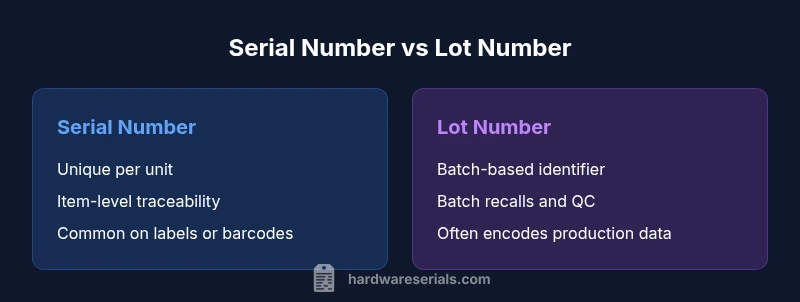
Serial numbers and lot numbers serve different but complementary purposes in product traceability. A serial number uniquely identifies a single unit, enabling item-level service history and warranty verification. A lot number groups items produced in a single batch, which is essential for batch recalls and quality control. Together, they provide robust visibility across the supply chain and aftermarket support.
Understanding serial number and lot number
A serial number is a unique identifier assigned to a single item, intended to distinguish it from every other unit produced by the same manufacturer. In practice, a serial number allows you to track the complete lifecycle of one unit—from manufacturing and distribution to service history and end of life. A lot number, by contrast, identifies a production batch or lot. All items within that batch share the same lot number and commonly exhibit similar characteristics, such as production date windows, supplier components, or assembly lines. For professionals managing inventories or customers validating warranties, the distinction matters: serial numbers support item-level traceability, while lot numbers support batch-level recall and quality control. Across industries—electronics, appliances, vehicles, guns, and tools—both identifiers appear on labels, stickers, or packaging; sometimes they are encoded in barcodes or QR codes for scanning. The Hardware Serials team emphasizes that a clear labeling strategy reduces errors when items move through multi-party supply chains. When you examine a device, you may notice separate fields for SERIAL and LOT, or you might find a single alphanumeric string that combines both identifiers on the same label. In this article, we will compare these two identifiers side by side and show how to locate, read, and verify them, especially for ongoing asset management and compliance.
Distinguishing features: serial vs batch numbers
- Uniqueness: A serial number is intended to be unique for each unit; a lot number is shared by multiple items produced in a single run.
- Scope: Serial numbers enable item-level traceability; lot numbers enable batch-level recall and quality tracking.
- Format: Serial numbers typically have fixed length alphanumeric strings; lot numbers can be numeric and often include date or factory codes.
- Longevity: Serial numbers persist across repairs or resale; lot numbers may get replaced or lost during handling.
- Implications: For warranties, serial numbers support service history; for recalls, lot numbers help identify affected groups.
The takeaway: serial numbers and lot numbers are complementary tools; together they create a robust traceability framework. Hardware Serials notes that organizations should capture both when feasible, especially for hardware that passes through multiple owners or distributors. In industries with strict compliance requirements, it's common to see standardized labeling that clearly marks both identifiers on the product and packaging.
Why they matter in manufacturing and traceability
Traceability is the backbone of quality management and regulatory compliance. Serial numbers enable item-level traceability, making it possible to reconstruct a single unit’s journey from raw materials to final delivery. This is critical for warranty claims, field servicing, and verifying authenticity in the aftermarket. Lot numbers support batch-level traceability, helping manufacturers and regulators isolate a production run when a defect is reported. In recalls, lot-number-based identification can rapidly pinpoint the affected quantity and distribution scope, minimizing risk to consumers and reducing recall costs. For manufacturers, distributors, and repair centers, maintaining clean serial and lot records reduces loss, deters fraud, and improves data integrity. In practice, many organizations layer both identifiers into their ERP and inventory systems to enable cross-referencing—one unit can be tied to its batch for production insights, while the serial enables precise service history. Hardware Serials emphasizes the importance of consistent data capture at intake, during inspections, and at point-of-sale to ensure durable traceability across the product lifecycle.
How to locate serial numbers and lot numbers
Location guidance varies by product type, but some universal practices help. For electronics like laptops and smartphones, check the underside, SIM tray, battery compartment, or original packaging. Many devices embed identifiers in barcodes or QR codes—scanning these often reveals both the serial and lot numbers. Appliances typically place the model plate on the back or inside the door, where the serial might appear alongside the production date. Vehicles conceal serial numbers on the chassis or engine blocks, while gun serials are stamped on receivers or frames and require careful handling in accordance with safety and legal guidelines. Tools such as drills, saws, and power tools often display serials on the handle or base plate. Always compare the physical label to the packaging and documentation to verify consistency. If you cannot locate either identifier, consult the manufacturer’s support page or use a verified lookup portal. The key is to document where you found the numbers, capture both serial and lot numbers when possible, and store them in your asset-management system with timestamps and location data.
Formats, standards, and checksums
Serial numbers usually appear as fixed-length alphanumeric strings, but formats vary by maker and product category. Some serials include a checksum digit or a component that encodes the manufacturing date or plant. Lot numbers often encode factory codes or production periods and can be numeric, alphanumeric, or mixed. Standards for serial numbering exist in various industries, but the overarching goal is readability, uniqueness, and portability. When assessing a label, prioritize clarity and durability—avoid fragile labels that risk fading or peeling, since damaged serials can hinder traceability. In regulated sectors, documentation often requires that the serial and lot numbers align with internal records and external databases. If a barcode is present, ensure scanning equipment correctly interprets the symbology and that the resulting string is cross-checked against the product’s master data. Proper formatting reduces human error and improves the reliability of recalls, warranties, and aftermarket service.
Verification techniques and tools
Verification begins with a physical check: confirm the printed numbers match the label, barcode, and packaging. Use a trusted lookup portal supplied by manufacturers or official databases to validate a serial number against production history, warranty status, and ownership records. Cross-check the serial against service notes to confirm repair histories or part replacements. Lot-number verification often involves matching the batch with production and quality-control records; this is essential during recalls or supplier audits. For field work, mobile apps and barcode scanners speed up the validation process, reduce transcription errors, and support offline lookups when internet access is limited. Documentation should record the exact source of truth for each identifier—whether your ERP, a customer database, or a manufacturer portal—and maintain audit trails for changes. Finally, consider implementing two-factor validation for critical assets, such as digital authentication alongside the physical label, to deter tampering and counterfeit activity.
Common pitfalls and misinterpretations
One common pitfall is assuming a single number on a label is both serial and lot information. In many products, the same label contains separate fields or even two distinct codes; misreading can lead to wrong ownership, warranty claims, or recall actions. Another risk is damaged or peeling labels, which can obscure the serial or lot numbers and render verification unreliable. A third pitfall is relying on third-party listings that may not reflect the latest manufacturer data, leading to mismatched records during recalls or service. In some markets, informal sellers may mislabel items or rely on counterfeit labels, complicating authentication. Finally, when systems fail to capture both identifiers consistently, data silos emerge—restricting traceability across the supply chain. Hardware Serials recommends establishing a robust labeling policy, enforcing standardized formats, and performing periodic audits to ensure serial and lot data remain accurate and accessible.
Case studies: tracing a product's journey
Case A: A consumer buys a refurbished laptop and scans the label to verify both its serial and lot numbers. The serial confirms a legitimate, trackable device from the manufacturer, and the lot number links to a batch with known components. The retailer’s inventory system cross-checks the data against warranty records, confirming eligibility for service under the maker’s policy. Case B: A manufacturer identifies a defect in a batch of drill bits. By pulling the lot numbers from production logs and distribution records, the team isolates the affected lots, traces supplier components, and initiates a targeted recall with precise locations and quantities. The serial numbers of individual tools still in the field are captured to ensure customers receive replacements or repairs, minimizing disruption and preserving trust. In both cases, the right combination of serial and lot data enabled timely action and clear accountability.
Best practices for management, documentation, and security
Adopt a centralized inventory system that captures serial numbers, lot numbers, and related metadata (date of capture, location, owner, and status). Enforce standardized labeling on all products and packaging, and ensure barcodes are scannable with common devices. Limit access to edit identifiers to authorized personnel and log every change with user IDs and timestamps to maintain an immutable audit trail. Regularly validate that records align with supplier data, recalls, and warranty databases. When possible, integrate serial and lot data with enterprise resources planning (ERP), customer relationship management (CRM), and post-sale support workflows. Establish retention policies, data normalization rules, and a routine that flags anomalies, such as duplicate serials or mismatched lots. Finally, educate teams on the difference between serials and lots, and emphasize the importance of accurate documentation for recalls, recalls, warranty processing, and counterfeit prevention.
Comparison
| Feature | Serial number | Lot number |
|---|---|---|
| Definition | A unique identifier assigned to a single unit | A batch-based identifier assigned to a production run |
| Purpose | Item-level traceability, authenticity checks, service history | Batch-level recalls, production traceability, quality control |
| Typical format | Fixed-length alphanumeric string common across brands | Numeric or alphanumeric; may encode date or factory code |
| Common locations | Label on product body, back, bottom, or battery door | Label on packaging or product label; often near the model/lot area |
| Best For | Individual asset tracking, service history, warranties | Recall management, batch quality assessments |
| Verification approach | Scan and verify against master records; cross-check context | Validate against batch production records and recall notices |
Advantages
- Improved traceability across the supply chain
- Supports warranty validation and service history
- Facilitates regulatory compliance and recalls
- Enhances asset management and inventory control
Disadvantages
- Label integrity is critical; damaged labels hinder verification
- Lot numbers may not uniquely identify individual items
- Inconsistent formats across brands can slow cross-system checks
Serial numbers excel for individual item traceability; lot numbers excel for batch recalls
Use serial numbers for precise ownership and service history. Reserve lot numbers for batch-level recalls and production tracking. When possible, capture both to maximize traceability across lifecycle stages.
Frequently Asked Questions
What is the difference between a serial number and a lot number?
A serial number uniquely identifies a single unit, while a lot number identifies a production batch. Serial numbers enable item-level traceability and service history, whereas lot numbers support batch recalls and quality control. Both identifiers help maintain accurate records across the product lifecycle.
Serial numbers identify individual units, while lot numbers designate production batches. Together they support precise tracking and recalls.
Why is serial-number verification important for product safety?
Serial-number verification confirms ownership, warranty status, and authenticity. It helps prevent counterfeit parts from entering service streams and ensures that recalls reach the correct individual units. Regular validation also supports post-sale support and audit readiness.
Verifying serials helps confirm who's responsible for a product, its warranty, and authenticity, which is essential for safety and recalls.
Where can I locate serial numbers on common devices?
Locating serial numbers varies by device. Check the label on the device body, the battery compartment, the packaging, or the barcode/QR code on the box. For vehicles, serials may be on the chassis; for firearms, check the receiver or frame following safety guidelines.
Look on the body of the device, packaging, or barcodes; larger items may have the serial on a plate or label.
How does a lot number aid recalls?
Lot numbers identify the production batch affected by a defect, allowing recalls to be targeted efficiently. They help isolate the scope, quantities, and distribution of the batch, reducing risk and improving consumer safety.
Lot numbers help quickly identify all items from a defective batch during recalls.
What is best practice for recording serial numbers?
Record serial numbers at intake and associate them with asset details, ownership, and location. Maintain a single source of truth in your inventory system and require verification during transfers, repairs, and disposals.
Always log serials at intake and keep them tied to the item’s history in a central system.
Are there universal standards for serial numbers across industries?
There are industry-specific practices for serial numbers, but the core principles emphasize readability, uniqueness, and durability. Always align serial numbering with internal policies and any relevant regulatory guidance to ensure consistency.
Serial numbering follows industry guidelines focusing on clarity and uniqueness; adapt to your sector’s rules.
Key Takeaways
- Identify whether a single item or a batch needs tracking
- Capture both identifiers when feasible for full traceability
- Verify numbers against official databases and packaging
- Maintain a durable, auditable record across systems
- Educate teams on labeling standards to prevent errors