How to Know if Your Seiko Is Original by Serial Number
Learn how to tell if a Seiko watch is genuine by examining the serial number, model references, and official records. A practical, step-by-step approach for DIYers and pros from Hardware Serials.


You can verify authenticity by locating the serial on the case back, matching it to your Seiko model’s era and production window, cross-checking the reference/model number, and confirming with official records or an authorized service center. Serial numbers aren’t a guarantee alone, so compare engravings, fonts, and movement details as part of a full check.
Introduction: why serial numbers matter in Seiko authentication
How to know if my Seiko watch is original by serial number is a common starting question for collectors and professionals. The serial on the case back can provide clues about when and where a watch was produced, but it is not a standalone proof of authenticity. According to Hardware Serials, serials should be used as one data point among several, because counterfeiters increasingly copy serial numbers. A robust check combines serial data with model numbers, movement characteristics, packaging, and provenance. This guide, written for DIYers and professionals, walks you through reliable checks and practical steps to verify a Seiko’s originality while avoiding common traps. The goal is to empower you to make informed judgments and request professional evaluation when needed.
Seiko serial numbering basics: what you should know
Serial numbering practices vary across Seiko’s long history. The format has evolved with factory practices, model lines, and production years. Because eras differ, a serial number that looks correct for one model may be less informative for another. The Hardware Serials team emphasizes that even authentic watches can show serials that don’t tell the full story unless you corroborate with the model reference, case design, dial and hands, movement type, and case back engravings. Understanding that serials are a guide—not a guarantee—helps you approach authentication methodically rather than rely on a single clue.
Locating the serial number on Seiko watches
On most Seiko watches, the serial number appears on the outer edge of the case back, often next to the model number. Some vintage or special editions may have the serial etched in other locations or under protective engravings. Before you read the digits, clean the back with a microfiber cloth to remove oils that can obscure the imprint. Use a jeweler’s loupe or a bright light to read the characters clearly. If you have trouble locating the serial, refer to your model’s documentation or packaging as those often indicate where the serial sits and how it is oriented.
Cross-checking the serial with model and reference numbers
A complete authenticity check compares the serial with the model and reference numbers printed on the case back or included in the original box and papers. Start by confirming the model reference printed on the back, then verify that the serial format aligns with that era’s conventions (while keeping in mind variations across decades). Look for consistency in font style, spacing, and engraving depth. If the serial appears to be a mismatch with the model or if the reference is missing, this is a strong signal to pause and seek a professional opinion. Hardware Serials advises recording all observed data (photos of the back, the serial, the model number, and the movement if visible) to support any later evaluation.
Using official resources and authorized channels
Official Seiko catalogs, service centers, and authorized distributors are the most reliable routes for verifying serial authenticity. Where possible, consult the production year ranges and model variants published by Seiko or trusted, long-standing reference sites. If you cannot locate a public archive for your exact model, reach out to an authorized Seiko service center with your photos and documentation. Ask for a formal evaluation or certificate of authenticity if you have a high-value piece. The emphasis from Hardware Serials is to avoid relying solely on a serial in isolation; combine it with model data and provenance.
Visual authenticity checks beyond the serial
Serial numbers provide one layer of verification, but visual cues matter just as much. Inspect engraving quality on the case back, including letterforms, alignment, and spacing. Examine the Seiko logo, crown, and text for sharp edges and correct font. Compare dial details, hand style, lume, and the crown arrangement with official images for the exact model. Variations exist by era and line, so be wary of subtle differences that deviate from known authentic examples. If you notice misalignments or inconsistent lume between the dial and hands, treat the piece with extra caution.
Common red flags to watch for
Red flags include serials that appear to be engraved with uneven depth, numbers that look like a stamp rather than an etching, or serials that do not match the listed model range. Alert patterns such as altered case backs, missing protective stickers, mismatched case materials, or non-original packaging are warning signals. Note that some fakes use older serial formats; this is why cross-referencing with the model number and movement type is essential. If several indicators point toward inauthenticity, do not rely on the serial alone.
How to validate with a professional
If you remain uncertain after initial checks, seek a professional authentication service or an authorized Seiko technician. Bring photos of the back, the serial, the model number, and any accompanying papers or receipts. Request a movement inspection or a bench test if warranted. A written appraisal or certificate of authenticity from a recognized professional adds credibility and can help with resale. The Hardware Serials team recommends documenting the entire process and preserving any new findings or certificates for future reference.
What a serial number can tell you vs what it cannot
A serial can indicate production time and location in many scenarios, but it cannot confirm the entire story—especially with vintage or limited editions. Counterfeits may feature plausible serials, and legitimate watches can suffer from incorrect engravings after servicing or restoration. Consider serials as one datapoint among many: model references, movement type, case material, dial layout, and provenance all contribute to a complete authentication picture. A cautious approach reduces risk and increases confidence.
Quick checks for popular Seiko lines (careful, context matters)
Different lines like Seiko 5, Prospex, and emerging limited editions have distinct design cues and serial patterns that can guide your judgment. For example, Seiko 5 models typically show certain crown positions and dial features. Prospex models may carry specific movement families and finish quality. Always compare to verified reference images from official catalogs and reputable dealers. If your watch is vintage or a rare edition, professional verification becomes more important, as serials alone may be insufficient.
Hardware Serials verdict: next steps for authenticating your Seiko
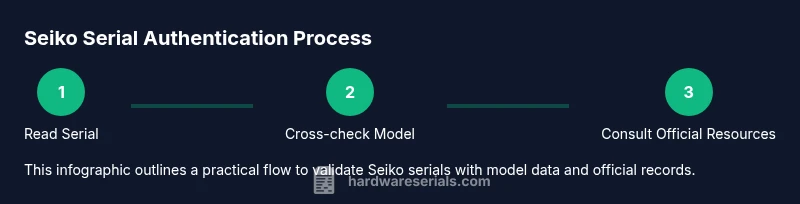
The Hardware Serials team recommends a cautious, multi-step approach to confirm authenticity. Start with locating and reading the serial, then cross-check with model references and official resources. If discrepancies arise or the serial is inconclusive, obtain a professional evaluation from an authorized Seiko service center. Storing all documentation and photos helps protect your investment and strengthens future authentication efforts. By combining serial analysis with physical inspection and provenance, you increase your chances of an accurate determination.
Authority sources you can consult
- Official Seiko corporate site and customer support resources (model and serial inquiries)
- Reputable watch catalogs and reference books used by collectors and watchmakers
- Certified watchmakers or authorized service centers for expert evaluation
Tools & Materials
- Jeweler's loupe (10x+ magnification)(Use to read small serial characters clearly on the case back)
- Soft microfiber cloth(Clean the case back before inspecting engravings)
- Camera or smartphone with good macro capability(Document serial, logos, and engravings for records)
- Official Seiko model catalogs or reference guides(Cross-check model numbers and production windows)
- Authorized Seiko service center contact information(Use for formal authentication requests or movement checks)
Steps
Estimated time: 45-90 minutes
- 1
Gather model details
Collect the model reference and any packaging or papers that came with the watch. This provides context for interpreting the serial and helps you locate official references for cross-checking.
Tip: Take photos of the case back and the box labels for later comparison. - 2
Locate the serial number
Clean the case back and examine the engraving with a loupe. Read the serial forward and backward if needed to confirm characters are legible, and note any wear that could obscure digits.
Tip: If the serial is faint, use a bright light and adjust the angle to reveal embossing. - 3
Note the serial format
Record the digits and letters exactly as read and note whether the format matches typical sequences for the era of the model. Recognize that formats vary across decades and lines.
Tip: Avoid assuming correctness based on a single example; document all observed features. - 4
Cross-check with model reference
Compare the serial and model number with official catalogs or reputable databases. Look for alignment in font, spacing, and engraving style between the model number and serial area.
Tip: If the catalogs show different fonts or spacing, treat discrepancies with caution. - 5
Inspect other authenticity cues
Evaluate the dial typography, logo placement, hand style, case material, and bezel design. Subtle differences can signal a non-original piece even when the serial looks plausible.
Tip: Document any inconsistencies with close-up photos. - 6
Check packaging and papers
Original watches typically include warranty cards, manuals, and box inserts that reference the model and serial. Compare the document formats to verified examples from the same era.
Tip: Missing or mismatched documents increase the likelihood of non-authenticity. - 7
Consider the movement and case back
If safe and feasible, compare the movement type with the model’s expected specifications. Some watches may have had service replacements; verify movement compatibility and service history.
Tip: Only trusted professionals should perform internal checks. - 8
Seek official confirmation
Submit your findings to an authorized Seiko service center or an experienced watchmaker for a formal assessment. A written evaluation adds credibility for resale or insurance.
Tip: Provide clear photos, model numbers, and your notes from the checks. - 9
Decide on next steps
If the evaluation confirms authenticity, keep the documentation for future reference. If doubts persist, consider refraining from sale or purchase and seek a second opinion.
Tip: Trust your multi-point assessment rather than relying on a single clue.
Frequently Asked Questions
Can serial numbers alone prove authenticity of a Seiko watch?
No. Serial numbers are helpful, but they should be evaluated together with model references, movement characteristics, packaging, and provenance. A serial that looks plausible may still be paired with an original-looking counterfeit.
Serial numbers alone aren’t enough to prove authenticity; use them alongside model references and provenance.
Why do Seiko serial numbers vary by era?
Serial formats changed over decades due to factory processes and cataloging. This means the same-looking sequence can have different meanings depending on the production period. Always reference era-specific guidelines when interpreting a serial.
Serial formats shifted across eras, so always check era-specific guidelines.
Where is the serial number commonly located on Seiko watches?
Most Seiko watches place the serial on the case back, near the model number. Some vintage or limited editions may differ. If you can’t find it, consult the model’s documentation or packaging to identify the correct spot.
Usually on the case back near the model number.
What resources should I use to verify Seiko serials?
Use official Seiko catalogs, authorized service centers, and trusted reference databases. Cross-check the serial with the model and movement details to build a complete authentication picture.
Consult official resources or an authorized Seiko service center.
What if the serial seems off but the watch looks genuine?
Treat it with caution. Serial plausibility can be faked, and other signs may reveal non-authentic parts. Seek a professional evaluation before making a purchase or sale decision.
If the serial looks off, get a professional opinion.
Are vintage Seiko serials always reliable for dating?
Dating vintage Seiko based on serial can be challenging due to era-specific changes. Use serial data as a guide alongside other dating indicators like movement type and case design.
Vintage serials are guides; combine with other dating clues.
Watch Video
Key Takeaways
- Use serials as one data point among many.
- Cross-check with model numbers and official resources.
- Visuals and provenance matter as much as the serial.
- Seek professional evaluation for high-value pieces.
- Document findings thoroughly for future reference.