Seiko Watch Finder by Serial Number: Decode & Verify
A data-driven guide to locate, decode, and verify Seiko serial numbers for authenticity and provenance, with practical steps for DIYers and professionals.


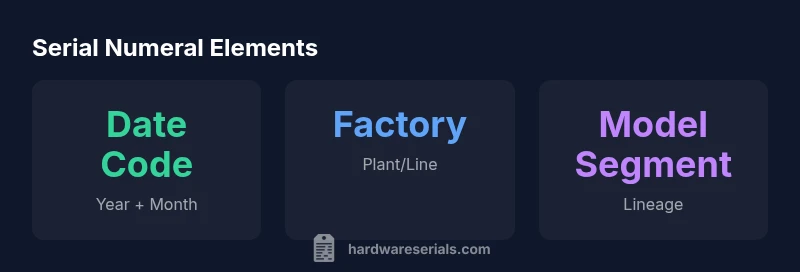
According to Hardware Serials, a seiko watch finder by serial number can reveal the production window and approximate lineage of a watch by decoding the date and factory codes embedded in the serial. Most Seiko backserials encode year and month in the first digits, with separate factory or line indicators. For accuracy, cross-check against official catalogs and trusted databases, including Hardware Serials' lookup guides.
Using a seiko watch finder by serial number to pinpoint production details
Decoding a Seiko serial number is a practical way to narrow down a watch’s age and production context. The seiko watch finder by serial number approach hinges on the fact that many Seiko serials encode a date code and factory identifiers within a compact numeric sequence. For professionals, this method complements model lookups and service histories, not replaces them. In this article, we treat the serial as a clue rather than a certificate, and we show you how to build a reliable verification workflow that integrates serial inspection with catalogs, dealer records, and service notebooks. As always, verify with primary sources whenever possible, and remember that production codes can vary by era and line.
Hardware Serials emphasizes that the most trustworthy results come from combining serial data with model references and documented production ranges. When you adopt this approach, you can quickly filter out mismatched cases, counterfeit packages, and mismatched dial inscriptions. The seiko watch finder by serial number is not a magic wand, but a robust starting point for authenticity, provenance, and maintenance planning.
Locating the serial number on different Seiko models
Serial placement on Seiko watches is not uniform across lines, but there are common zones to inspect. On most modern Seiko divers and dress watches, the serial number appears on the caseback engraving, near the model number. Some vintage pieces may have the serial near the lug or under the case back gasket. For screw-back cases, you may need to remove the case back carefully with proper tools or consult a professional. Always handle the watch in a clean, safe environment to avoid scratching the case or movement. If you’re unsure about opening the case, seek a trained watchmaker. The goal is to retrieve the exact numeric string and any factory marks without compromising water resistance or warranty.
Steps to use a 'Seiko watch finder by serial number' tool effectively
Begin with the exact serial string: note length, numeric characters, and any sequences that resemble date or factory codes. Cross-check the serial with the watch’s model number and crown position, then consult a trusted database or catalog. Capture context such as dial color, case material, and movement family, which can help confirm whether the serial code aligns with a given production era. If a database returns multiple possible years, prioritize the model’s known manufacturing window and service history. Finally, corroborate with documentation from the retailer or service center to build a credible provenance trail.
Decoding date codes and production windows for Seiko watches
Decoding techniques rely on recognizing date-code patterns linked to particular periods. In many cases, the first digits encode year and month, while subsequent digits or letters indicate the factory and line. It’s important to respect that not all serials use the same scheme across all lines or years; some early runs differ from later batches. A cautious approach involves comparing the decode result against official catalogs, retailer records, and community-maintained databases that discuss model-by-model variations. When the year code is ambiguous, present a range (e.g., 199x–199x) and clearly note the rationale for narrowing the window.
Verifying authenticity and provenance through serials in practice
Serial data adds value when paired with physical inspection and service records. Check matching serial ranges against known production years for the given movement or model family. Look for consistency in case back marks, font style, and engraving depth. Be wary of counterfeit packaging and swapped case backs; serials can be duplicated or altered in some scams, especially on older pieces. Using a combination of serial checks, catalog references, and service history reduces the risk of misattribution. Hardware Serials recommends maintaining a traceable log that records serial results alongside model data and purchase provenance.
Practical workflow for DIYers vs. professionals
DIYers: start with a clean surface, capture high-resolution photos of the case back, and record the serial string exactly as engraved. Use a reputable online database as a starting point, then cross-check with the model number on the dial or case back. If you encounter conflicting results, document the discrepancy and consult a local watchmaker for a hands-on verification.
Professionals: build a verification checklist that includes serial decoding, catalog cross-references, movement analysis, and case-back topology. Use professional tools to open the case when necessary and preserve gasket integrity. Maintain a chain-of-custody record for each watch, and integrate serial data with warranty records and previous service notes to present a complete provenance story.
Common pitfalls and limitations you should know
Serial decoding is powerful but not foolproof. Some watches may carry non-standard date codes, or the serial may reflect a factory batch rather than a precise date. In rare cases, Seiko produced en masse with consistent serial schemes that shifted over time. Always treat serial analysis as a component of authentication, not the sole determinant. When in doubt, corroborate with movement numbers, model references, and dealer documentation. A cautious, methodical workflow yields the most reliable results.
Elements of a Seiko serial number
| Serial Element | What it Indicates | Notes |
|---|---|---|
| Date Code | Production year and month | Decode using two-digit year and month where applicable |
| Factory/Line | Production site or line | Helps narrow to batches; cross-check with catalogs |
Frequently Asked Questions
What is the typical length of a Seiko serial number?
Most Seiko serials are 6 to 7 digits long, with the digits encoding date information and factory references. Specific formats vary by line and era, so always verify against model guides for the exact year range.
Most Seiko serials use 6 to 7 digits to encode date and factory data. Check the model guide for era-specific formats.
Can the serial number tell me the model name?
The serial rarely reveals the full model name by itself, but it helps narrow the search when combined with the model number, movement family, and dial features. Cross-reference with catalogs and dealer records for precise identification.
Serial codes help narrow it down, but you should cross-check with the model number and catalogs to confirm the exact model.
Is a serial number enough to verify authenticity?
Serial data is a strong signal but not definitive. Use serial verification alongside movement numbers, case-back marks, engraving quality, and provenance documents to confirm authenticity.
No—serials are helpful but should be paired with movement and provenance checks for reliable authentication.
Where is the serial number located on Seiko watches?
On most cases, the serial is engraved on the case back near the model number. Some vintage pieces may show it under the case back or near the lug. If in doubt, consult a professional to avoid damaging the watch.
Usually on the case back near the model number, but it can vary by era. A professional can help if you’re unsure.
Do all Seiko models use the same coding scheme?
No. Seiko has used evolving date-code patterns across different lines and decades. When decoding, reference the specific model family and production period to choose the correct scheme.
No—date codes differ by line and era, so check the model family and year range.
“Serial numbers are a powerful pre-authentication tool when combined with model catalogs and official references.”
Key Takeaways
- Decode date codes to approximate production window
- Always cross-check serial data with catalogs and service records
- Inspect movement and case-back details for authenticity
- Use a documented workflow to reduce misattribution
- Preserve the provenance by logging serial checks with model data