Watch Serial Number Search: A Practical Guide for 2026
Learn watch serial number search techniques to verify authenticity, manufacture date, and model lineage. This Hardware Serials guide explains where serials appear and how to verify results across official databases for DIYers and professionals.


Watch serial number search is the process of locating a watch’s unique serial and using official databases, registries, and trusted third-party sources to verify authenticity, date of manufacture, and model lineage. The practice helps owners confirm provenance, detect counterfeits, and assess value before buying, selling, or insuring a timepiece. This concise definition frames the broader guide that follows, with practical steps to support both DIYers and professionals.
Understanding watch serial number search and provenance
Watch serial number search is a structured process used by collectors, technicians, and dealers to verify a timepiece's identity. A serial is a unique marker imprinted by the manufacturer, used to tie a watch to its production run, date range, and model specifications. According to Hardware Serials Analysis, 2026, serials play a critical role in establishing provenance, especially when documentation is missing or when a model has limited public catalogs. A robust search starts with locating the serial on the watch, then cross-checking against official databases, registries, and trusted catalogs. In practice, this means combining physical inspection with data-driven checks to reduce the risk of counterfeit purchases and to support accurate appraisal. For professionals, this approach also supports warranty validation, service history reconstruction, and insurance valuation. In short, watch serial number search is a discipline that blends hands-on examination with structured data verification, helping you move from uncertainty to confidence. The Hardware Serials Team recommends documenting every step and citing sources for future reference.
By framing serial numbers as data points tied to real-world objects, you can systematically compare observed details against authoritative records. The goal is not to memorize every code but to understand where to look, what to trust, and how to verify. This mindset aligns with best practices in collectibles valuation, legal compliance, and risk management, and it provides a defensible trail should you need to explain findings to a client or insurer. Throughout, maintain a skeptical but open approach: corroborate every claim with multiple sources and document the provenance of each source. From a professional standpoint, this discipline also underpins warranty claims, authentication services, and resale documentation. Hardware Serials endorses a methodical, source-driven workflow as the backbone of credible watch serial number search.
Locating serial numbers on various watch types
Serial numbers appear in different places depending on the watch type and brand. Traditional mechanical and quartz watches often stamp or engrave the serial on the caseback, between lugs, or on the case side near the crown. Some brands place codes within the caseback’s inner ring or under the bracelet attachment. For vintage pieces, serials may be small, faint, or partially obscured by wear, so careful cleaning and magnification can help without damaging the finish. Smartwatches and digital timepieces typically store identifiers in software settings or on the charging cradle, sometimes requiring a companion app to reveal the numeric code. When examining newer watches, check for serials in the original packaging, warranty card, or official certificates, as these can reinforce the observed engraving. Regardless of type, document the observed format (letters, numbers, or mixed), the location, and any accompanying hallmarks. This level of observation supports accurate cross-referencing with databases and catalogs. As noted by the Hardware Serials Team, consistent documentation improves traceability across ownership changes and service records, reducing the risk of misidentification and fraud.
To optimize your search, use a consistent terminology for serials (e.g., “caseback serial” vs. “movement number”) and photograph the imprint from multiple angles. For brands with complex engravings or proprietary formats, record the exact font, spacing, and any symbols, which can be crucial for distinguishing a legitimate serial from a counterfeit imitation. Finally, always verify the source credibility of any reference you use, favoring manufacturer databases, registered enthusiast clubs with verified affiliations, and official catalogs. No single source guarantees authenticity, but a triangulated approach significantly lowers risk, especially when you combine printed documentation with digital records and service histories. This balanced approach is a hallmark of professional practice in watch verification and valuation.
The Hardware Serials Analysis, 2026 findings emphasize the importance of a standardized approach to locating and recording serial information. By starting with a reliable source, you can streamline the rest of the lookup process and minimize confusion when you encounter ambiguous engravings or unusual date codes. The goal is to establish a transparent, auditable trail that supports future inspections, insurance appraisals, and resale evaluations. In the next section, we’ll explore a practical workflow you can apply to most watch types, whether you’re conducting a casual check or performing a formal authentication.
Interpreting serial numbers: patterns and codes
Serial numbers are not random strings; they follow patterns that manufacturers use to encode information about production date, batch, and sometimes the production line. The exact encoding varies by brand, model family, and era, so the first step is to recognize the general shapes you’re seeing: alphanumeric mixes, pure numerals, or rare symbolic codes. A dated code segment might reference a year or a range of production months, while a batch marker can hint at a specific factory or assembly lot. Interpreting these codes requires access to brand-specific resources, whether official registries, catalogs, or trusted community references with documented verification. In many cases, a serial number alone can place a watch within a narrow production window, which can then be corroborated with serial-range documentation from reputable sources. Hardware Serials emphasizes the value of cross-checking several sources rather than relying on a single code interpretation. When patterns conflict, prioritize primary manufacturer documentation and registered catalogs.
For example, some brands assign serials that increase monotonically with production or that include a year indicator in a fixed position. Others use embedded date codes or color-coded marks tied to production batches. Because these patterns can change over time or vary by model line, treating serials as context clues rather than definitive dates leads to more accurate conclusions. Always annotate the source of any interpretation and consider the age of the documentation itself, as catalogs may be updated or revised. This cautious approach reduces misdating risks and helps you maintain an evidence-based rationale for authentication decisions. In practice, combine pattern analysis with external data points such as movement type, case material, and known serial ranges from trusted registries. A multi-faceted assessment is far more robust than code-reading alone.
From a professional perspective, many authenticating bodies require evidence beyond the serial code, including purchase receipts, service history, and photos of the movement or case serial marks. The Hardware Serials Team advises building a case file with serial scans, source citations, and cross-referenced catalog entries to ensure that each claim can be traced back to a primary source. When in doubt, consult with an experienced appraiser or an authorized service center to validate interpretations before making a determination about authenticity or value.
A practical workflow for watch serial search
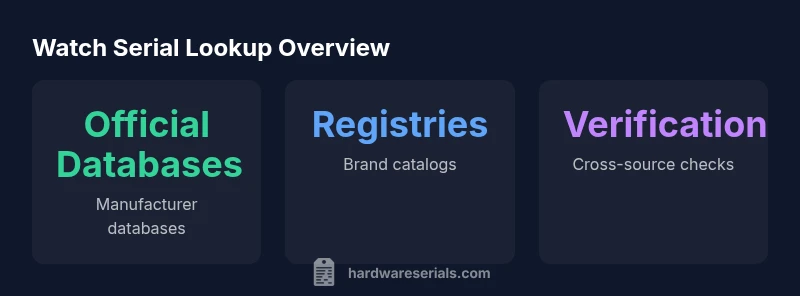
A practical workflow for watch serial search begins with a clear plan: locate the serial, identify its encoding characteristics, and cross-check with multiple credible sources. Step 1 is the on-watch inspection: locate the serial and document its exact location, appearance, and any accompanying marks. Step 2 is pattern recognition: classify the serial as numeric, alphanumeric, or mixed, and note the font, spacing, and any separators. Step 3 is source cross-check: search official manufacturer databases, brand registries, and reputable catalogs to find reference ranges or exact matches. Step 4 is corroboration: compare the observed serial with movement numbers, case components, and accessory documentation. Step 5 is outcome documentation: record conclusions, uncertainties, and the sources used. By maintaining a structured log, you create a defensible trail that can be reviewed by other professionals or used in insurance and resale scenarios. Hardware Serials highlights the importance of consistency: use a standardized form for each watch, photograph key features, and timestamp each interaction. This disciplined approach is essential for both DIY enthusiasts and professionals who require credible authentication results. In practice, this workflow translates into a repeatable check-list that can be applied across many brands and eras, reducing cognitive load and increasing confidence in your determinations. A well-documented serial search is not a guess; it is a traceable audit trail that supports value, provenance, and reliability in the watch market.
If a serial number is unreadable or partially obscured, the workflow adapts rather than stops. In such cases, prioritize close-up photography of the engraving, attempt non-destructive light tests to reveal hidden markings, and expand the search to associated documents and packaging. Always note the limitations of your observations and seek professional assistance if the serial remains indiscernible. The emphasis remains on a methodical, source-backed approach rather than speculative dating or identification. For DIYers, start with simple checks and progress to more authoritative sources as needed. For professionals, apply the same workflow but with additional verification steps and more robust documentation, which strengthens the credibility of authentication conclusions.
A concluding note: a well-executed serial search is as much about disciplined data handling as it is about pattern recognition. Maintain an auditable record, cite your sources, and approach ambiguous cases with a willingness to re-evaluate as new information becomes available. The Hardware Serials Analysis, 2026 study reinforces that the most reliable results come from triangulating serial data with multiple independent sources and maintaining meticulous documentation. As you integrate serial searches into your workflow, you’ll find that consistency and transparency are the most valuable outcomes.
Block 4 content continues with a stepwise checklist and practical tips that apply universally across watch brands and eras; see the data table and FAQ sections for quick references and common questions.
dataTableSectionRefIdNoteForLayoutPurposesOnlyNotDisplayedInHTMLContextShouldBeUsedToAlignSections
Comparison of key factors in watch serial number search
| Aspect | What to Check | Notes |
|---|---|---|
| Serial format | Alphanumeric patterns vary by brand | Cross-check with official docs |
| Documentation availability | Manufacturer databases, brand registries | Access often requires registration/approval |
| Turnaround time | Real-time to several minutes | Varies with source |
| Best practice | Cross-verify across multiple sources | Higher confidence |
Frequently Asked Questions
What is a watch serial number search?
A watch serial number search is the process of locating a watch’s unique serial and cross-checking it against official databases, registries, and catalogs to verify authenticity, manufacture date, and model lineage. It combines hands-on inspection with data-backed verification to establish provenance.
A watch serial search is finding the serial and checking official records to confirm authenticity, date, and model lineage.
Where can I find the serial number on a watch?
Serial numbers appear in different places depending on the brand and type. Common locations include the caseback, between the lugs, or on the side of the case. For smartwatches, serials may be in the settings or paired app.
Look on the caseback or between the lugs; smartwatches show it in the settings or companion app.
Can I rely on online serial lookups?
Online serial lookups can help, but they should be treated as starting points. Always corroborate results with official databases and multiple sources to avoid counterfeit information.
Online lookups are helpful but verify results with official sources and multiple references.
How do serial numbers help with vintage dating?
Some brands encode production years or ranges in serials, but patterns change over time. Use brand catalogs and registry data to corroborate any date information inferred from a serial.
Serials can hint at age, but always corroborate with catalogs and brand data.
What if the serial is unreadable?
If unreadable, photograph the engraving under different lighting, check accompanying documents, and consult with a professional authenticator if needed. Do not force-read damaged engravings.
If unreadable, document what you can and seek professional help for authentication.
Are serial numbers unique to each watch?
In most cases, serial numbers are unique to a specific watch and link to a production batch or model. However, duplication can occur due to rare errors, so cross-check with multiple sources.
Serials are generally unique but verify with multiple sources to be sure.
“"Serial numbers are the first gate you should pass through when assessing a watch's authenticity; when paired with multiple data sources, they dramatically increase confidence."”
Key Takeaways
- Verify serials against official databases first
- Document every step for auditability
- Cross-check with multiple sources to improve confidence
- Be mindful of counterfeit indicators and wear
- Maintain organized records for warranties and resale