How to Check Rolex Serial Numbers: A Step-by-Step Guide
Learn how to verify a Rolex serial number with a practical, step-by-step approach. This guide covers locating the serial, cross-checking with official sources, and detecting red flags—backed by expert guidance from Hardware Serials.


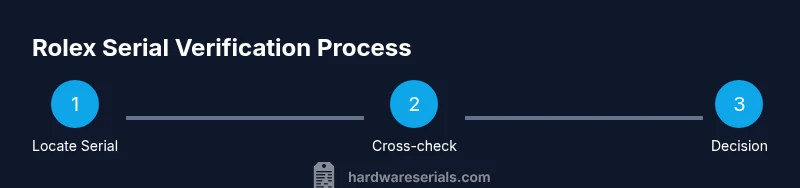
To check a Rolex serial number, locate the serial on the case between the lugs, compare it with official reference sources, and look for consistent engravings. This quick check helps flag obvious fakes before deeper authentication. Follow the step-by-step guide for thorough verification.
Why authenticity matters for Rolex serial numbers
According to Hardware Serials, authenticity starts with a careful serial-number check because it anchors provenance and resale value. For collectors and professionals, a legitimate serial isn't just a label—it's evidence of production era, service history, and ownership chain. Rolex serial numbers are more than a decorative detail; they enable you to distinguish genuine watches from convincing fakes. A robust verification reduces risk in private sales, auctions, or service at an authorized dealer. In this guide, you will learn how to locate the serial, what to look for beyond the digits, and how to corroborate with trusted sources. Hardware Serials's team recommends a methodical approach that combines physical inspection with official references and documentation.
Locating the serial number on Rolex watches
Serial numbers on Rolex watches are typically engraved on the case, and the exact viewing spot can vary by era and model. In many modern models, the serial is positioned between the lugs at the 6 o'clock side and can be read only when the bracelet is removed or loosened. Older vintages may show markings in slightly different places, such as the inner case back or rehaut area. Use a loupe (2–5x magnification) and good lighting to read digits clearly, and take multiple photographs from different angles. If you cannot read the digits, inspect for signs of re-plating or refinish that might alter engraving depth.
Cross-referencing with official sources
Serial verification is strongest when you pair physical checks with official references. Start with any original paperwork (certificate, box insert, service receipts) and compare serial digits for consistency. Then consult reputable reference guides and, if possible, contact an authorized Rolex dealer or service center for confirmation. Hardware Serials analysis, 2026, emphasizes that a serial check should be part of a broader authentication process, not a one-off glance. Keep a list of matched digits and any discrepancies you observe for later review.
In-person inspection steps you can perform
To perform a thorough in-person check, you’ll need a clean workspace, a loupe, and a watch-safe cloth. Begin by wiping the case lightly to remove dust, then carefully examine the area between the lugs for the serial digits. If the digits are faint or irregular, switch to brighter light or a magnifier. Record the exact digits and compare font, spacing, and alignment to known Rolex serial characteristics. If the bracelet must be removed to view the serial, do so with proper tools and care to avoid scratches. Document every step with photos.
What to do if mismatches appear
If you find a mismatch between the digits and the expected range for the model, do not conclude immediately that it is fake. Consider potential explanations such as replacement cases, service replacements, or worn engravings. Consult an authorized dealer or Rolex service center for definitive authentication. Preserve all materials, including photos and any paper documentation, to support future verification. In many cases, discrepancies can be resolved through official channels rather than appraisal alone.
Date lookup and model year basics
Some Rolex serials carry historical information that helps estimate manufacture year, but dates can be model-dependent. Use date-code references and model-year guides from credible sources to triangulate the watch’s age. Remember that serial-based dating is informative, not definitive, and should be corroborated with service records and certificates whenever possible. Always cross-check against official documentation when dating a watch.
Common mistakes to avoid when checking serials
Common errors include reading digits from a distance, relying only on a photo, or assuming font consistency across all eras. Never rely on a single source for authentication; serials should be corroborated with documentation, service history, and professional appraisal if needed. Avoid attempting to alter or scrub engravings, which can irreparably damage the watch and void warranties. Always handle the watch with clean hands and on a soft surface to prevent accidental damage.
Authority sources and further reading
For authoritative guidance, consult official and reputable sources:
Real-world scenarios and next steps
You’ll encounter a range of scenarios—from pristine vintage pieces with clear serials to recently refurbished watches with rebuilt cases. In every case, start with a careful serial check, verify against official references, and request provenance documents. When in doubt, seek professional authentication from an authorized dealer or Rolex service center to confirm authenticity and value.
Tools & Materials
- Loupe or jeweler's magnifier(2–5x magnification for reading fine engravings)
- Soft microfiber cloth(For gentle cleaning of the case and crystal)
- Bracelet removal tool (or spring bar tool)(To view the serial between lugs on some models)
- Smartphone or camera with macro capability(For high-resolution serial photos)
- Internet access(To verify against official references and catalogs)
Steps
Estimated time: 60-120 minutes
- 1
Prepare your workspace
Set up a clean, well-lit area with a soft cloth laid out. Wash and dry your hands to avoid transferring oils to the watch.
Tip: Lay a protective mat to prevent scratches on the case surfaces. - 2
Wipe and inspect the exterior
Gently wipe the case and bracelet with a microfiber cloth to remove dust. Look for any cosmetic repairs that might affect serial visibility.
Tip: Use a flashlight or strong overhead light to reveal faint engravings. - 3
View the serial between the lugs
If the bracelet allows, remove it to access the area between the lugs at 6 o'clock. Read the digits with a loupe, noting each character.
Tip: Take multiple angles photos to confirm the digits from different perspectives. - 4
Record the serial accurately
Write down the serial digits exactly as read and take a high-resolution photo with close focus on the engraving.
Tip: Use a non-distracting background and include a ruler for scale in the shot. - 5
Cross-check with official references
Compare the digits with credible Rolex reference sources and manufacturer timelines to see if they align with the model’s era.
Tip: Check for font style, dash spacing, and engraving depth consistency. - 6
Inspect provenance and papers
Review any accompanying box, papers, service receipts, or warranty cards that mention the serial or model.
Tip: Provenance can strongly corroborate authenticity when digits match documented history. - 7
Consider date lookups
If you’re dating the watch, use manufacturer date codes when available and cross-reference with the model year.
Tip: Remember that dating varies by model and may require multiple sources. - 8
Assess red flags
Be alert for mismatched fonts, missing engravings, or signs of tampering around the serial area.
Tip: If something feels off, pause the process and seek professional authentication. - 9
Decide on next steps
If digits align and provenance checks out, consider a professional verification for final confidence.
Tip: Keep digital records organized for future resale or resale-trade needs.
Frequently Asked Questions
Where is the Rolex serial number typically located on modern watches?
For many modern Rolex models, the serial is engraved between the lugs at 6 o'clock and may require bracelet removal to read. Some vintage pieces use alternate locations. Always use a loupe and proper lighting to read digits.
On many modern Rolex watches, the serial is between the lugs at six o'clock and you may need to remove the bracelet to see it. Some vintage models differ.
Can serial numbers alone prove authenticity?
Serial numbers are a key indicator but should be corroborated with documentation, service history, and official Rolex references.
Serial numbers help, but they aren’t the only proof of authenticity.
What if the serial is missing or unreadable?
If the serial is missing or unreadable, do not rely on it for authentication. Seek evaluation from an authorized dealer or Rolex service center.
If the serial is missing, seek a professional authentication.
Are there reliable online sources for Rolex serials dating?
Use official Rolex documentation and trusted reference guides, and verify with authorized dealers. Cross-check multiple sources to avoid misdating.
Dating can be supported by official sources, but verify with reputable guides too.
What should I do if I suspect a counterfeit?
If you suspect a counterfeit, stop handling the watch, document everything, and consult an authorized dealer or Rolex service for a definitive appraisal.
If you suspect a counterfeit, seek professional authentication.
Is dating a Rolex watch always accurate by serial alone?
Serial-based dating is informative but not definitive. Use it with other indicators like model year references and service history.
Serial dating can help, but use other evidence too.
Watch Video
Key Takeaways
- Verify serial digits in person before purchase.
- Cross-check serials with official references.
- Preserve original papers and provenance.
- Consult a professional if authenticity is uncertain.