Can You Look Up a Rolex Serial Number? A Practical Verification Guide
Learn how to locate and interpret Rolex serial numbers to verify authenticity and dating. This comprehensive guide covers where to find serials on different models, how digits map to production periods, and best practices for cross-checking with trusted sources.


Learn how to look up a Rolex serial number and verify authenticity and production date. This guide explains where to find the serial number on modern vs vintage models, what the digits indicate, and how to cross-check with official sources and trusted databases. You’ll need a few tools and reliable references to confirm every detail.
Understanding Rolex serial numbers
If you’re asking can you look up a rolex serial number, the short answer is yes, but with important caveats. Serial numbers are one of several clues used to assess authenticity, production date, and provenance. They should be read in context with physical features, movement, and packaging. According to Hardware Serials, understanding where and how serials are stamped is the first step to a responsible verification process. This section explains why serial numbers matter and how they fit into a broader authentication workflow. By the end, you’ll know what you can learn from the digits and what remains uncertain without professional inspection.
The key is to treat the serial as one data point among many. A legitimate number doesn’t guarantee authenticity, just as a dubious-looking serial doesn’t prove fraud. Your goal is to build a coherent picture from serial data, product era clues, and corroborating records. With a systematic approach, you can dramatically reduce the chance of accepting a counterfeit or misdated piece.
Serial numbering conventions by era
Rolex serial numbering has evolved across decades, reflecting changes in production and anti-counterfeit strategies. Early watches used simple dating codes, while later models introduced more complex formats. Hardware Serials analysis, 2026, notes that serial formats vary by era and model family, which means a lookup must consider the context rather than rely on a single scheme. In addition, the transition from engraved serials on the case to recessed or rehaut-based identifiers has shifted where readers should look. When evaluating a serial, compare it to known ranges for the model year and reference number, and always cross-check against legitimate catalogs and dealer records. Consumers and professionals benefit from compiling multiple signals: serials, model reference, engraving quality, and movement type.
Where to find the serial number on different models
Locating the serial number on a Rolex involves checking the areas where Rolex typically places engravings. On many modern watches, the serial is engraved between the lugs and is best read with the bracelet removed or with a loupe. Vintage models may have serials found on the lug between the case and bracelet, or in previously accessible engraving areas. For some contemporary pieces, the rehaut (inner bezel) contains serial-related markings, sometimes beside or integrated with the brand name. Regardless of era, use a soft cloth to handle the watch and a loupe with at least 10x magnification to read fine engravings clearly. If lighting is poor, switch to bright, white light to reveal subtle depth and contrast.
Why serial numbers matter: authenticity, dating, and provenance
Serial data helps establish production windows, track provenance, and sometimes correlate with service history. While a serial alone doesn’t prove authenticity, it supports a stronger case when combined with movement inspection, dial and crown details, and packaging. In retail and resale, serials are a quick first-pass filter to identify obvious inconsistencies and mismatches. Hardware Serials emphasizes that the most reliable verifications occur when serial data is triangulated with reference catalogs, dealer audits, and service records. As you gather information, keep notes on every observation and photograph the key markings for future comparison.
How to verify online: official sources and trusted databases
There is no universal public Rolex lookup that reveals authenticity with a single query. Instead, use official channels (authorized dealers, Rolex service centers) to corroborate serial data alongside product references. Trusted databases and community-curated catalogs can help map serial ranges to approximate production years, but they are not definitive. Always prefer sources that disclose their methodology and provide caveats about potential gaps. When possible, request official documentation like warranty cards, service receipts, and original certificates, since these artifacts offer stronger corroboration than a serial alone. Remember: if a source guarantees authenticity from a serial alone, treat it with skepticism and seek additional evidence.
Interpreting the digits: what the numbers tell you
The numbers on a Rolex carry historical context about the production window and model family. Reading digits should be done with an awareness of era-specific formats and regional variations. Some digits point to a manufacturing period, while others indicate the production batch or reference model. Because Rolex updated formats over time, a single digit cannot fully define authenticity or date. Cross-check digits with the watch’s overall features: case shape, bezel, movement type, dial typography, and engraving quality. When in doubt, compare against multiple reference sources and consult a professional appraiser or authorized service center.
Dealing with counterfeit lists and red flags
Be cautious with lists claiming to decode every Rolex serial immediately. Counterfeit databases exist, and some counterfeiters publish forged ranges. Hardware Serials recommends validating any claimed serial-year match with at least two independent sources and verifying that the serial range aligns with the accepted model reference. Red flags include implausible production years for a given model, mismatched reference numbers, poor engraving quality, and missing or inconsistent branding on the dial, crown, or caseback. If a source feels vague or evasive about methodology, treat the information skeptically and seek corroboration.
Practical workflow: what to do if you can't locate
If you cannot locate a serial number, start with the accessible surfaces and then widen your search approach. Confirm that you are examining the correct side of the case and that the bracelet isn’t hiding engravings. Use a high-magnification loupe and strong lighting to reveal faint marks. If serials remain unreadable, consider professional appraisal at an authorized service center, or request an official authentication from a trusted dealer. Document what you can observe and retain any packaging or purchase records. This cautious workflow minimizes the risk of misidentification and protects against scams.
Quick-reference checklist for verifying a Rolex serial
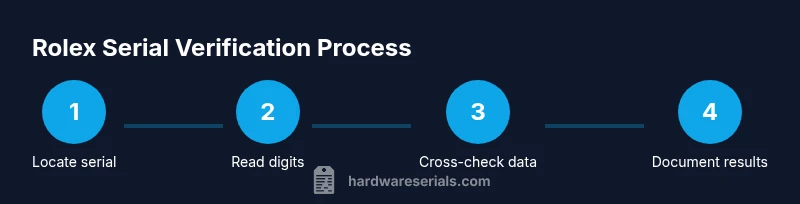
- Locate serial number on the case between the lugs or rehaut.
- Read digits with a 10x loupe under bright light.
- Cross-check with model reference and production era ranges.
- Inspect movement, dial, crown, and engraving quality for consistency.
- Seek official documents (warranty, service records) when possible.
- Compare with multiple reputable databases and dealer records.
- If in doubt, consult an authorized Rolex service provider or a professional appraiser.
Maintaining records and future lookups
Keep a digital and physical record of the serial, model reference, and any documents (purchase receipts, service reports, certificates). A well-organized archive makes future verifications easier and more reliable. If you plan to resell, present clear documentation and high-quality photographs of serials, engravings, and dial details. Regularly update your notes if you obtain new corroboration from official channels or authenticated dealers.
Tools & Materials
- Soft, lint-free cloth(For handling the watch and cleaning surfaces without scratching.)
- Jeweler's loupe or magnifying glass(Minimum 10x magnification to read tiny engravings.)
- Bright lighting or LED flashlight(Use daylight or bright LED to reveal etched numbers.)
- Access to official Rolex resources or trusted databases(For cross-checks and dating information.)
- Note-taking device (paper or digital)(Record serials, model references, and observations.)
Steps
Estimated time: 30-60 minutes
- 1
Prepare your workspace and materials
Lay out a clean surface, gather your loupe, light, and note-taking tools. Prepare screenshots or notes of the model reference you’re inspecting. This minimizes handling and preserves the appearance of the watch while you examine serials.
Tip: Use a microfiber cloth to avoid scratches and keep the watch steady during inspection. - 2
Inspect the case and bracelet attachment
Carefully remove the bracelet if needed to access engravings on the case between the lugs or rehaut area. Check for any signs of resurfacing or tampering around the engravings. The goal is to locate a readable serial in a stable location.
Tip: Do not force parts; if you encounter resistance, seek professional assistance to avoid damage. - 3
Read the serial number with magnification
Using the loupe, read the digits slowly, ensuring you aren’t misreading similar shapes (e.g., 6 vs. 8). Record the serial as exactly as read. If the digits look faint, re-check under brighter light and clean the area gently.
Tip: Take a high-resolution photo of the serial to compare against reference images. - 4
Cross-check with the model reference
Compare the serial digits to the model’s expected production era and reference. Use at least two reputable databases or catalogs to triangulate the date window. Keep in mind era-based format changes may affect interpretation.
Tip: Note any discrepancies and flag them for deeper inspection. - 5
Evaluate additional authenticity markers
Beyond the serial, assess the movement, dial text, crown engraving, bezel font, and caseback markings. These elements should be consistent with the model and production period. Look for signs of modern fakes or altered components.
Tip: If any marker looks unusual, document it and seek expert verification. - 6
Consult official sources and reputable databases
Where possible, verify serials through authorized channels or trusted databases that disclose their methodology. Rolex does not publish a public lookup, so rely on documented dealer records and service histories.
Tip: Favor sources that cite ranges and provide caveats about limitations. - 7
Collect documentation and evidence
Gather purchase receipts, service records, and original packaging. These documents strengthen authenticity claims and assist future lookups. Store them in a safe, organized location.
Tip: Back up digital copies and keep prints with the watch in a dedicated archive. - 8
Decide on next steps
If serials align with known ranges and the other markers look authentic, you can proceed with confidence or seek a formal appraisal. If inconsistencies arise, consider returning the piece or requesting a professional authentication.
Tip: When in doubt, defer to an authorized service provider for a definitive assessment.
Frequently Asked Questions
Can a Rolex serial number alone prove authenticity?
No. A serial number is a helpful clue but should be assessed alongside movement, dial, engraving quality, and packaging. Serial data should be corroborated with official records or trusted databases.
A serial number alone isn’t enough to prove authenticity. Use it with other indicators and official records.
Do newer Rolex serials reveal the exact production year?
Modern Rolex serials can narrow production windows but rarely provide an exact year. Cross-referencing with model references, service history, and dealer documentation improves dating accuracy.
Newer serials help narrow down the date, but you usually need more context to pinpoint the exact year.
Where can I read the serial number on a vintage Rolex?
On many vintage models, serials are found between the lugs or on the case side near the bracelet attachment. Some references may show variations; use a loupe and compare with period catalogs.
Vintage serials are often between the lugs; use a loupe and compare with period catalogs.
Is Rolex’s public serial lookup available online?
Rolex does not provide a universal public lookup. Verifications are typically done through authorized dealers, service centers, and respected reference databases that document ranges and formats.
There isn’t a public Rolex lookup; rely on official channels and trusted databases for verification.
What should I do if the serial seems unreadable?
If you can’t read the serial, do not guess. Use professional services or authorized dealers to confirm readings and assess related markings to avoid counterfeit acceptance.
If unreadable, consult a professional to verify the serial and related markers.
What documents help most for authenticity?
Warranty card, service history, original box and papers, and purchase receipts significantly strengthen authenticity cases when paired with serial checks.
Docs like warranty and service history are powerful when confirming authenticity.
Watch Video
Key Takeaways
- Identify where serials are typically located for your model.
- Read digits accurately with proper magnification and lighting.
- Cross-check serials with multiple reputable references.
- Collect documentation to support authenticity claims.
- When in doubt, seek professional authentication.