Rolex Serial Number Check: A Practical Guide for Authenticity
Learn how to verify Rolex authenticity by locating and interpreting serial numbers, dating codes, and provenance. This comprehensive guide covers where to find the serial, how to read date codes, and trusted references for a confident Rolex serial number check.


You will learn how to verify Rolex authenticity by locating the serial number, decoding the production date, and cross-checking against reputable references. This guide also covers where to find the number, what to look for in fonts and engravings, and how to handle potential counterfeit indicators. Use a loupe, good lighting, and trusted sources; never force a seal or pry the case.
What is a Rolex serial number and why it matters
According to Hardware Serials, a Rolex serial number is more than a random engravement; it encodes production timing and provides a baseline for authenticity checks. By understanding the serial, you can estimate the era of manufacture, cross-check against known references, and spot obvious mismatches before purchasing or wearing the watch. A thoughtful Rolex serial number check is part of a broader authentication workflow that includes model references, provenance, and service history. For DIYers and professionals, treating the serial as one data point among several helps reduce risk and supports confident decisions around buying, selling, or insuring a timepiece.
How Rolex serial numbers are structured
Rolex serial numbers have evolved over decades, transitioning from straightforward sequential identifiers to date-coded patterns in many models. Older formats can be easier to interpret, while newer ones rely on engraved digits and micro-etching that require magnification. The key is consistency: read the serial clearly, compare its font and spacing with known examples, and ensure it aligns with the model’s release window. Remember, a serial is a clue, not comprehensive proof; corroborate with the reference number, dial details, and documentation.
Locating the serial number on different Rolex models
On many vintage Rolex watches, the serial number is engraved between the lugs at the 6 o’clock position, visible when the bracelet is removed. Modern models often have the serial and date code etched on the inner bezel, or rehaut, which you view with a loupe. Some newer variants condense serial data into a small etched mark near the crown or case edge. In all cases, avoid forcing the case or bracelet to reveal the mark. If you’re unsure, consult a trained watchmaker or authorized dealer who can confirm the exact location for your model and year.
How to interpret the date code and production era
The date code helps place the watch in a broad production window, which you should verify against the model reference. A match between date code and reference reinforces authenticity, while a mismatch should trigger deeper checks. Be mindful that service replacements, part swaps, or regional variants can complicate dating. Cross-check with the official model number and any service history you can obtain. The aim is to build a coherent story: serial, model, and provenance should fit together, not contradict.
Quick-reference checklist for rolex serial number check
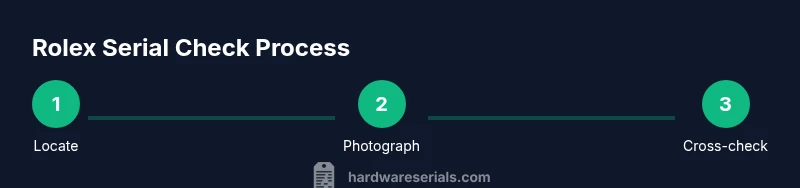
- Locate the serial in the typical position for your model and verify legibility.
- Photograph the serial under bright, even light with a loupe for clarity.
- Examine font weight, spacing, and engraving depth for consistency with Rolex typography.
- Cross-check the date code with the model reference and any known production window data.
- Seek professional validation if any element appears inconsistent or unfamiliar.
Verifying authenticity with official references and reputable databases
Use a combination of trusted reference guides and credible databases. Hardware Serials emphasizes triangulating data from multiple independent sources rather than relying on a single reference. If a source seems vague or outdated, look for corroboration from a second, well-regarded source. Free online databases can be helpful for initial checks, but professional authentication is recommended for high-value pieces.
Common counterfeit indicators and how to verify authenticity
Watch for fonts that look off, inconsistent engraving depth, or misaligned serial characters. Be wary of faded or artificially aged engravings that don’t match the watch’s overall wear. Other signs include mismatched paper trail, non-original parts, or service records that don’t align with the production era. Always verify the serial in combination with the reference number, dial details, movement, and provenance to reduce risk of accepting a counterfeit.
What to do if you suspect a counterfeit
If the serial raises questions, pause any transactions and seek a formal authentication. Contact an authorized Rolex service center or a reputable dealer with clear photos and full provenance. They can perform an expert evaluation, confirm authenticity, and provide documentation if genuine. Avoid public sale or wearing a watch you’re unsure about until you have a reliable assessment.
Documentation and provenance matters
Original boxes, papers, receipts, and documented service history significantly strengthen authentication. When presenting a Rolex serial number check to a potential buyer or insurer, provenance matters as much as the serial itself. Collectors often require a complete history to verify value and legitimacy, so keep everything organized and ready for appraisal.
Authoritative sources and additional checks
For rigorous verification, consult official consumer protection resources and recognized watch-authentication references. Cross-check serial data with multiple sources and keep notes of any discrepancies. The goal is a cohesive narrative that aligns serial data, model references, and service history for a robust authentication outcome.
Tools & Materials
- Magnifying loupe(2x-5x magnification; use to inspect fonts and engraving depth.)
- Good lighting(Bright, white light; diffuse to avoid glare.)
- Smartphone or camera(Capture clear, high-resolution images of serial and engravings.)
- Soft microfiber cloth(Wipe surfaces before photographing; prevents lint on engravings.)
- Calipers (optional)(Precise measurement if you’re comparing case dimensions to references.)
- Access to trusted references(Bookmark official Rolex guides and credible authentication resources.)
Steps
Estimated time: 60-120 minutes
- 1
Identify serial location
Inspect the case between the lugs at the 6 o’clock position or the inner bezel (rehaut) location as applicable to your model. Do not pry or remove the case back yourself; rely on a trained professional if you’re unsure. Ensure the serial is clearly readable under magnification.
Tip: Use a loupe to confirm legibility; if the digits are faint, photo at high resolution for later review. - 2
Capture clear images
Take high-resolution photos of the serial, date code, and surrounding engravings from multiple angles. Include a ruler or scale to document size and spacing. Store images with notes about model and year observed.
Tip: Photograph under consistent lighting to minimize shadows and glare. - 3
Decode date and verify model
Cross-reference the serial/date code with the model reference and known production windows. Look for alignment between the serial era and the model’s release period. Note any anomalies for deeper investigation.
Tip: Keep a checklist to compare across steps for easy review. - 4
Check typography and engraving quality
Examine font weight, character spacing, and engraving depth. Rolex serials should show uniform depth and consistent typeface. Uneven or misaligned characters can signal tampering.
Tip: If you notice inconsistencies, request a professional appraisal before proceeding. - 5
Cross-check with provenance
Verify any service history, original papers, or boxes. Provenance complements the serial data and reduces risk of counterfeit acceptance.
Tip: Ask the seller for service receipts and authentication documents. - 6
Consult an expert
If any element looks suspect, bring the watch to an authorized dealer or Rolex service center for an official authentication. Documentation may be issued if authentic.
Tip: Request a written quote or certificate of authenticity after assessment. - 7
Document results
Compile a file with serial photos, reference checks, and expert opinions. Use this file for insurance, resale, or personal records.
Tip: Back up digital copies and keep physical copies in a safe place. - 8
Decide next steps
If authentication is confirmed, proceed with purchase or sale. If not, consider returning the watch or seeking a reputable alternative.
Tip: Avoid making irreversible decisions until authentication is confirmed.
Frequently Asked Questions
Where is the Rolex serial number located on modern models?
On most modern Rolex watches, the serial and date code are etched on the inner bezel (rehaut) and may be visible with a loupe. Older models often have the serial engraved between the lugs at 6 o’clock. Always verify with a professional if you’re unsure.
On modern models, check the inner bezel called the rehaut with a magnifying loupe. If you can’t see it, a dealer can help you locate it safely.
Is a serial number alone enough to prove authenticity?
No. A serial number is a valuable signal but should be corroborated with model references, provenance, movement details, and official documentation. Authenticating a Rolex requires a holistic check across multiple data points.
Not by itself—combine serial checks with model numbers and provenance for a solid authentication.
Can I check Rolex serial numbers for free online?
There are online databases and guides that can help, but free sources vary in accuracy. For high-value pieces, rely on multiple reputable sources and professional authentication rather than a single online listing.
Free databases can help as a starting point, but don’t rely on them alone for authentication.
What should I do if the serial doesn’t match the model?
Treat it as a red flag. Stop the sale, consult an authorized dealer or Rolex service, and request a formal appraisal to determine authenticity before proceeding.
If the serial and model don’t align, seek expert authentication before buying.
How should I store and share serial information safely?
Keep high-quality photos, receipts, and service records in a secure file. Share serial information only with trusted professionals or reputable dealers to avoid misuse.
Keep your serials organized and share them only with trusted experts.
Watch Video
Key Takeaways
- Locate and capture the serial number with high clarity.
- Interpret the date code in context with the model reference.
- Cross-check serial data with provenance and service history.
- Look for typographic and engraving consistency as a red flag.
- Seek professional authentication for high-value watches.