How to Check Seiko Serial Number: A Practical Guide
Learn how to locate, decode, and verify a Seiko serial number to confirm authenticity and model details. This guide covers caseback and movement checks, date-code decoding, and official verification resources, with practical tips for DIYers and professionals.


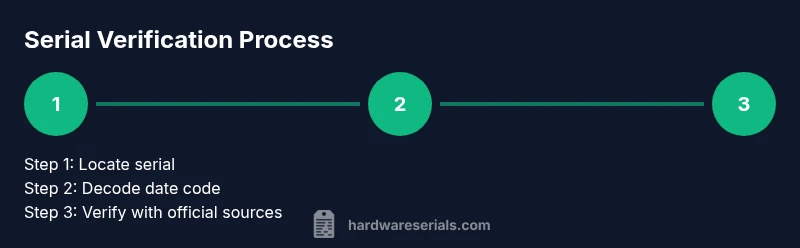
This guide shows you how to locate and verify a Seiko serial number on watches. You’ll learn where to look on the case back and movement, how to decode the date code, and how to verify authenticity using official references. Basic tools include a loupe and clean cloth. This quick answer assumes a standard Seiko model and a clean workspace.
Understanding the importance of check seiko serial number
Authenticity and provenance hinge on a readable serial number. A correct read of the Seiko serial number helps confirm production era, model lineage, and service history. For DIYers and professionals, verifying the serial number reduces risk when purchasing, reselling, or scheduling maintenance. Hardware Serials emphasizes that serial verification supports accurate record-keeping across both modern and vintage Seiko watches. By understanding how serial data connects to model numbers and manufacturing windows, you gain a reliable tool for informed decisions and better long-term care of your timepieces.
Where to find the Seiko serial number
Most Seiko watches print the serial number on the case back. In many models you’ll see a six-digit stamp near the model number or engraving between the lugs where the strap meets the case. If the back is screw-down or hidden under a protective seal, you may need a proper case-back opener, a loupe, and a clean workspace to inspect more closely. Always photograph the location from multiple angles before touching the surface to avoid misreads. If the serial isn’t visible externally, consult the model’s service manual for internal inspection guidelines and potential inspection under the crown area when safely permitted.
How Seiko serial numbers are structured
Across many Seiko watches, a serial number consists of six digits. The first digits often encode the production year and month, while the remaining digits indicate the production sequence. Formats can vary by era and model, and some vintage pieces may use slightly different encodings or add letters for limited editions. The general principle is that the serial number provides a production snapshot that helps identify era and authenticity when cross-referenced with the model number. Always corroborate with official Seiko references to avoid misinterpretation.
How to decode the date code safely
Decoding the date code involves reading the first digits as year and month, then validating the result against your watch’s model and era. If the month portion corresponds to a valid period (numeric 1–12 or model-specific letter equivalents), place the watch within a plausible production window. Compare the decoded date with the known manufacture window of your reference model. Remember that some vintage models used different encoding schemes, so consult model-specific guides before drawing conclusions. When in doubt, use official service literature to avoid misinterpretation.
Cross-checking with official references and serial lookup resources
To verify accuracy, consult official Seiko service resources and trusted reference databases. Use the serial number in combination with the model number, movement type, and purchase history. If a vendor or user forum provides a serial lookup, treat it as supplementary rather than definitive. Hardware Serials notes that official channels—such as an authorized Seiko service center or the brand’s customer support—offer the most reliable verification, especially for high-value pieces. Cross-check across multiple sources to build a robust provenance.
Common counterfeit indicators and red flags
Serial numbers can be forged or altered, particularly on inexpensive copies. Red flags include engraving quality that looks rough or uneven, inconsistent font weight, misaligned date codes, and digits that don’t align with the model’s production window. Also inspect other signs of fakery: dial fonts that don’t match the era, mismatched case contours, incorrect movement types for the advertised model, or unexpected engravings. If something feels off, pause the purchase and seek a professional verification from an authorized service center.
Vintage Seiko serial formats and model-specific quirks
Vintage Seiko models sometimes used serial schemes that differ from modern watches. Some older serials are shorter, include letters, or arrange digits differently by factory. When dealing with vintage pieces, reference catalogs, NAWCC resources, or collector guides to understand era-specific conventions. Always compare the serial against known production timelines for the exact model and check compatibility with dial, case, and movement appearance before making identification claims.
What to do if the serial is missing, illegible, or altered
If the serial is unreadable or missing, inspect other identifiers such as case back engravings, movement markings, or bracelet references. Consider professional evaluation from an authorized Seiko service center, especially if you intend to buy, insure, or resell the watch. Do not attempt to alter or obscure the serial yourself, as this can damage the watch and void warranties. Document any alternatives you rely on (movement type, dial font, case geometry) to support your assessment.
Best practices for documenting and preserving serial information
Create a consistent record-keeping habit: photograph serials from multiple angles, note the model and movement, and store images with date stamps. Maintain a digital log or a physical notebook with acquisition details, warranty status, and service history. If you own multiple Seiko watches, use a uniform naming convention and back up data to prevent loss. Proper documentation boosts resale confidence and simplifies future servicing or authentication checks.
Tools & Materials
- Loupe or magnifying glass(10x magnification preferred)
- Soft microfiber cloth(For cleaning case back without scratching)
- Case back opener or watchmaker knife(Only for screw-back cases; use proper tool)
- Camera or smartphone(To document serial and markings)
- Soft gloves(Prevent fingerprints)
- Notepad and pen(Record serial, model, and notes)
Steps
Estimated time: 30-60 minutes
- 1
Prepare your workspace
Clear a clean, well-lit space. Gather tools and wear gloves to prevent contamination. This foundation reduces risk of damaging sensitive components.
Tip: Work on a soft mat to prevent scratches. - 2
Locate the serial on the case back
Inspect the back of the case for a 5- or 6-digit number. Some models print the serial between lugs or along the case edges. Photograph the area from multiple angles.
Tip: If you can't see it, switch to a magnified view with a loupe. - 3
Check between the lugs and case back
For watches with a removable strap, look between the lugs where engravings may sit. Use a loupe to read faint digits.
Tip: Avoid prying; a gentle wipe helps reveal faint digits. - 4
Open the case back if needed
Only open the case back if you are trained and have proper tools. Follow the model’s service instructions to avoid damage or voiding warranty.
Tip: If unsure, skip opening and proceed with external markings. - 5
Document and decode the date code
Identify the date code portion (first digits) and interpret year/month. Record the digits and relate them to your model era.
Tip: Date decoding varies by model; cross-check with references. - 6
Cross-check with official references
Use Seiko’s service resources and trusted databases to verify model and serial combination.
Tip: If mismatched, look for counterfeit indicators. - 7
Conclude and log results
Summarize findings, note if serial appears genuine, missing, or altered. Store documentation for future reference.
Tip: Keep a copy with your watch investment records.
Frequently Asked Questions
Where is the Seiko serial number typically located?
For most Seiko watches, the serial is stamped on the case back, often near the model number. Some models place a serial between the lugs or inside the case after removing the back. Always check multiple angles and clean the surface before reading.
The serial is usually on the case back; if needed, inspect between the lugs after removing the strap.
Can I rely on the serial number to prove authenticity?
Serial numbers are a helpful data point but not definitive proof alone. Cross-check the serial with model numbers, movement type, and official service references. Counterfeit watches may mimic serials.
Serial numbers help, but they should be cross-checked with model data and official references.
What if my Seiko serial number is missing or illegible?
If the serial is missing, inspect other identifying marks (movement, engravings, dial fonts). Consider a professional appraisal from an authorized Seiko service center.
If the serial is gone, look for other model identifiers or have a pro check it.
Are vintage Seiko serial formats different?
Yes, some vintage Seiko models used different serial formats. Consult vintage catalogs or NAWCC resources and compare with known examples.
Vintage Seiko serial formats can vary; verify with catalogs and experts.
How can I verify a Seiko watch through an official channel?
Contact Seiko customer service or an authorized service center. Provide serial, model, and purchase history for confirmation.
Use official Seiko service centers for confirmation.
Watch Video
Key Takeaways
- Identify where the serial lives on Seiko watches
- Decode date codes with care and reference official sources
- Document findings to preserve provenance
- Be mindful of counterfeit indicators and wear patterns
- Use proper tools to avoid damage during inspection