Check Serial Number Money: How to Verify Currency Safely
Learn how to check serial number money to verify currency authenticity. This guide covers official resources, safe handling, and practical steps for cash-handlers, retailers, and DIYers.


Definition: Checking serial number money means validating a banknote’s serial number and security features against official standards to assess authenticity. Look for the correct serial format, issue details, and anti-counterfeit markers. Use government resources and reputable currency guides to confirm legitimacy and flag suspicious notes early. This quick check helps cash-handlers, retailers, and hobbyists avoid accepting counterfeit notes.
Why Currency Serial Numbers Matter in Everyday Transactions
Serial numbers on money serve as identifiers that enable traceability, authentication checks, and audit trails in cash-heavy environments. According to Hardware Serials, understanding serial numbers helps professionals and DIYers detect counterfeit notes, track where large stacks of money came from, and support compliance with anti-counterfeiting rules. In practice, a quick serial-number check pairs with visual feature inspection to reduce risk. Retailers, bank staff, and cash-intensive businesses routinely perform these checks as part of their standard cash-handling procedures. While a serial number alone is not a guarantee of authenticity, it is a crucial data point that should be combined with other checks, such as watermark visibility, security thread tracing, ink quality, and board texture. When you build a routine around serial-number verification, you gain a defensible record of money you accept or reject, which helps with audits and accountability. This section lays the groundwork for a reliable routine you can apply to everyday cash handling and larger cash deposits alike.
How Serial Numbers Are Used by Banks and Merchants
Banks and merchants rely on serial numbers to track money flows, detect anomalies, and support reconciliation processes. Serial numbers help identify counterfeit or altered notes quickly within cash rooms, ATMs, and cash-in-transit operations. While not a standalone guarantee of legitimacy, serial-number validation reduces risk when paired with other checks like official security features and paper quality. For professionals, establishing a standardized habit around logging serial numbers, noting the currency type and issue year, and cross-referencing with official guidance creates a dependable audit trail. This practice is especially important in high-volume environments such as retail, hospitality, and cash-intensive service sectors where timely decisions matter for loss prevention and compliance.
Common Signs of Counterfeit Serial Numbers
Counterfeit serial numbers often reveal telltale patterns, including inconsistent prefixes, irregular spacing, or oddly repeated digits within a batch. When you inspect notes, compare the serial number against known genuine formats and look for anomalies in ink density and alignment. While many forgeries slip past casual checks, trained staff can notice subtle differences in font weight, stamping pressure, and alignment under magnification. It’s essential to combine serial-number checks with other counterfeit-detection methods such as watermark visibility, security thread presence, and microprinting. This blend of indicators dramatically improves the odds of catching counterfeit money before it leaves your hands.
Practical Limits of Serial-Number Verification
Serial-number checks are a critical line of defense, but they are not foolproof alone. Legitimate notes from different print runs can share similar serial characteristics, and damaged notes may obscure numbers or security features. The most reliable approach is to use serial checks as part of a layered authentication process that includes visual cues, tactile features, and official guidance. For individuals, this means following a documented procedure, recording outcomes, and escalating doubts to your supervisor or bank when needed. For businesses, align serial checks with cash-handling policies, internal audits, and compliance requirements to minimize risk.
How to Handle Notes with Questionable Serial Numbers
If you encounter a note with a questionable serial number, segregate it from accepted cash and follow your organization’s escalation protocol. Do not pass it to customers or other staff until you’ve completed a safer-check, consulted official resources, and documented the findings. Useful next steps include verifying the note’s currency type, franchise or issuing bank, and any visible security features under different lighting. If the note remains suspicious after checks, report it to a bank or the appropriate authorities. Handling procedures should protect staff and prevent potential counterfeit exposure.
Tools and Resources to Support Money Serial Checks
Effective serial-number checks rely on a mix of physical inspection and trusted references. Use magnification for microprinting, proper lighting to reveal watermarks, and a clean, flat working surface to avoid damaging notes. Official resources provide current guidance on features to inspect and how notes are issued. Record-keeping tools (logs, spreadsheets, or specialized software) help track outcomes and improve future accuracy. By combining practical tools with authoritative sources, you can maintain a robust, compliant process.
Workflow for Businesses: Cash Handling with Serial Checks
A practical workflow starts with a clear, written policy that defines who performs serial checks, how notes are logged, and how exceptions are escalated. Build checklists that cover serial format verification, visual feature inspection, and appropriate handling of damaged or suspicious notes. Train staff with periodic refreshers and keep currency-handling procedures aligned with regulatory guidance. Regular audits of the process ensure it remains effective as new currency designs and security features are introduced. A disciplined workflow reduces risk and builds trust with customers.
AUTHORITY SOURCES
- USCURRENCY.GOV: Currency education and security features overview for verification practices.
- Federal Reserve: Guidance on currency handling and counterfeit detection in financial operations.
- U.S. Secret Service: Counterfeit currency investigation resources and reporting procedures.
Next Steps: Turn Checkserial into a Routine
To make serial-number verification a sustainable habit, embed it into daily cash-handling routines, train new staff, and periodically review outcomes. Start with a small batch of notes, document findings, and refine your process based on what you learn. The Hardware Serials team recommends adopting a layered approach: serial checks plus visual and tactile currency verification. Consistency beats one-off diligence, especially in high-volume settings.
Tools & Materials
- Currency notes (sample batch for testing)(Use a representative mix of denominations and years)
- Official currency resources(Links to USCURRENCY.GOV and federal guidance)
- Magnifying glass or loupe(Helpful for microprinting and fine details)
- Proper lighting tool(Consistent lighting to reveal security features)
- Notebook or digital log(Record serial numbers, results, and notes)
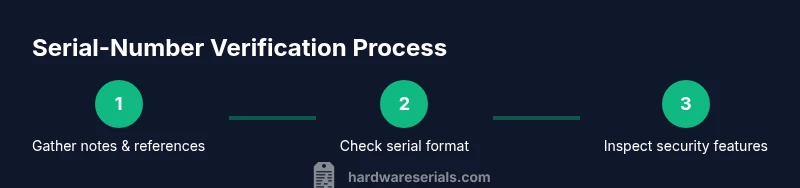
Steps
Estimated time: 15-30 minutes per currency batch
- 1
Gather currency and references
Collect a batch of notes and open official currency resources. Confirm you have a quiet workspace with good lighting. This primes you for accurate checks and documentation.
Tip: Have a dedicated log sheet or digital template ready. - 2
Inspect serial number formatting
Look for the serial number’s presence, legibility, and alignment with typical formats. Note any irregular spacing or duplicated patterns that stand out.
Tip: Compare a few genuine references to calibrate your eyes. - 3
Cross-check with official features
Check security features such as watermarks and threads in addition to the serial number. The combination of serial data and visual cues increases reliability.
Tip: If any feature is missing or damaged, mark the note for further review. - 4
Document results and decisions
Record the currency type, denomination, serial analysis, and final disposition. Keep notes organized for audits or future reference.
Tip: Use a standardized form to ease reviews later. - 5
Escalate uncertain cases
If the note remains questionable, escalate to a supervisor or bank partner following your policy. Do not pass uncertain notes to customers.
Tip: Never rely on a single indicator; prioritize caution.
Frequently Asked Questions
What does it mean to check serial numbers on money?
It means validating the serial number and security features of a banknote against official guidance to assess authenticity. This should be part of a layered approach rather than a stand-alone test.
Serial checks verify numbers and features as part of a layered currency authentication method.
Are serial numbers unique to every note?
Serial numbers are intended to uniquely identify notes within a currency system, but damage and forgeries can obscure or duplicate indicators. Always use multiple checks.
Note serials are designed to identify notes, but use multiple checks for accuracy.
What other indicators help confirm currency authenticity?
Beyond serial numbers, inspect watermarks, security threads, microprinting, ink quality, and note texture under proper lighting.
Look at watermarks, threads, and microprinting along with serials.
Where can I learn more about currency security features?
Refer to official resources such as USCurrency.gov and Federal Reserve guidance for current security features and verification methods.
Check USCurrency.gov and Federal Reserve resources for current security features.
What should I do if a note seems counterfeit?
Isolate the note, document your findings, and report it to the appropriate authorities or your bank per policy.
If counterfeit is suspected, isolate and report per policy.
Watch Video
Key Takeaways
- Verify serial numbers as part of currency authentication.
- Combine serial checks with visible security features.
- Log outcomes for audits and accountability.
- Rely on official sources for up-to-date guidance.