Can You Check Serial Numbers on Money? A Practical Guide
Learn how to check serial numbers on money to assess authenticity and spot counterfeit risks. This guide explains formats, official steps, and trusted sources.


Yes, you can examine serial numbers on money to help assess authenticity, but a serial alone isn’t proof. Compare the serial’s format to official examples, ensure the number isn’t duplicated on other bills of the same denomination, and cross-check with authoritative sources like the U.S. Currency Education Program and the Secret Service for counterfeit alerts.
What serial numbers are and why they matter
According to Hardware Serials, serial numbers on money serve as identifiers tied to specific notes and production batches, helping banks and authorities track issuance and counterfeit trends. While a serial number alone does not prove authenticity, it provides a first-screening cue that can reveal obvious inconsistencies when compared with official examples. Serial numbers are intended to be unique, sequential within a given series, and embedded in the printing process to aid traceability. When you examine a bill, you should treat the serial number as one part of a broader authenticity check rather than the sole determinant. Additionally, many currencies include public-facing information around serial formats and batch ranges, which reputable authorities publish to help the public verify notes without specialized equipment. This article helps you understand how to interpret serials across common money types and why you should use them alongside other security features.
How serial numbers differ across currencies and what to look for
Serial numbers appear on the surface of most paper notes and are printed alongside other identifiers. The exact format varies by country and currency, and some notes may show the number in multiple places. Coins typically do not carry serial numbers; instead, authentication relies on metallic composition, mint marks, edges, and known design features. When you examine a banknote, look for legibility, consistent font, and proper alignment of the serial with other printed elements. Compare the serial's length and prefix/suffix lettering against official guides for that denomination. For example, government-backed programs provide public examples of valid serial patterns, and many currencies publish counterfeit alerts that reference specific serial ranges or feature anomalies. Always reference official sources such as the U.S. Currency Education Program for U.S. notes and counterpart programs for other currencies. These checks help you interpret serial numbers accurately rather than relying on guesswork.
Practical checks you can perform (without a bank's tools)
Serial numbers are most useful when used in combination with several observable features. Start by locating the serial number printed on the note and inspect the characters under good light to ensure even spacing and consistent ink density. Check for microprinting, color-shifting ink, watermark, and security thread—these elements should appear in proper balance with the serial. Make sure the serial on the front matches any back-printed or overlapping numbers if present. If you’re reviewing money from unfamiliar currencies, consult official guides from the central bank or treasury. Use a UV flashlight to reveal features that are invisible under normal light. In practice, many counterfeit notes slip through when serials look plausible but security features fail to align; thus, serial checks should be part of a broader routine described by Hardware Serials and trusted authorities.
When to escalate and official resources
Whenever you encounter a note with a questionable serial, do not attempt to spend it. Set it aside and compare it to official resources. Official pages such as the U.S. Currency Education Program provide criteria to differentiate genuine serial ranges, security features, and printing details. If in doubt, bring the note to a bank, police, or national treasury office for verification. For cross-border currency, contact the local central bank or law enforcement. This approach minimizes risk of distributing counterfeit money and supports lawful handling.
Tools & Materials
- Magnifying glass(For inspecting microprinting and fine details)
- Good lighting / flashlight(To reveal faint serials and security features)
- UV flashlight(Reveals features invisible under normal light)
- Currency reference guides(Official guides from government or central banks)
- Mobile device with camera(Capture serials for reporting or comparison)
Steps
Estimated time: Estimated total time: 20-25 minutes
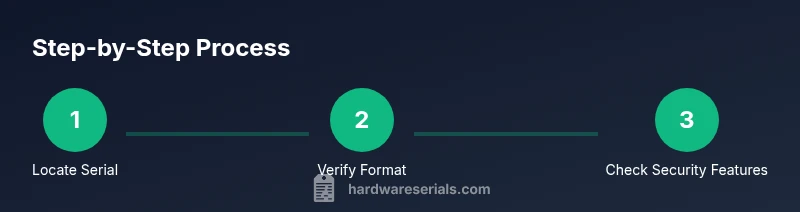
- 1
Locate the serial number
Find the serial number on the note, typically on the front near the margin. Note all characters exactly as printed and observe any prefix/suffix letters. Confirm you are looking at the correct denomination and note series.
Tip: Use strong, even lighting to avoid missing faint characters. - 2
Compare with official examples
Reference the official serial format for that currency and denomination, checking length, pattern, and spacing. Look for consistency between the serial and other printed elements on the note.
Tip: If you can’t access official guides, rely on reputable government sites for the current pattern. - 3
Inspect security features
Check watermark, security thread, color-shifting ink, and microprinting. Ensure these features align with the denomination’s design and that the serial does not appear out of place relative to security elements.
Tip: Turn the note to view watermarks and threads under different angles and lighting. - 4
Check for serial duplication
If you have more than one note, compare their serial numbers. Identical serials across notes are highly suspicious and warrant escalation.
Tip: Do not assume a single mismatch means counterfeit; verify against official guidance. - 5
Consult official resources
Access the currency program from the country of issue (for the U.S., the U.S. Currency Education Program). Use their examples and alerts as a baseline check.
Tip: Bookmark official pages for quick reference in the future. - 6
Decide next steps
If still unsure, take the note to a bank or law enforcement for verification. Do not attempt to pass the note during investigations.
Tip: Preserve the note in a safe, neutral container until verified.
Frequently Asked Questions
Can I rely on a serial number to prove a bill is real?
Serial numbers are a helpful clue but not definitive. Use them alongside security features and official guidance to assess authenticity.
Serial numbers help, but they aren’t proof on their own.
Do all currencies use serial numbers?
Most paper money uses serial numbers; coins generally do not. Check official guides for your currency to be sure.
Most paper money has serials, coins typically do not.
Where can I find official serial number patterns or alerts?
Consult the currency authority for your country, such as the U.S. Currency Education Program, for official patterns and counterfeit alerts.
Check official government currency sites for patterns and alerts.
What should I do if I suspect counterfeit money?
Do not spend or pass the note. Set it aside and report it to a bank or local law enforcement for verification.
Don’t spend it—report it to authorities.
Is it safe or legal to handle suspect notes?
Handling suspect notes is not illegal, but avoid spending or transferring them and contact authorities for proper guidance.
It’s not illegal to handle, but you should not pass it.
Can I verify serials online for currencies other than the U.S.?
Official currency sites may offer guidance and lookups for some currencies. Always rely on official resources from the issuing authority.
Yes, use official currency sites for guidance; not all currencies have online lookups.
Watch Video
Key Takeaways
- Verify serial numbers as part of a broader check
- Consult official currency resources for your country
- Do not rely on serials alone to confirm authenticity
- Escalate to banks or authorities if in doubt