Check Rolex Serial Number for Theft: A Step-by-Step Guide
Learn how to verify a Rolex serial number to avoid purchasing a stolen watch. This step-by-step guide covers provenance, authenticity checks, official channels, and reporting suspected theft.


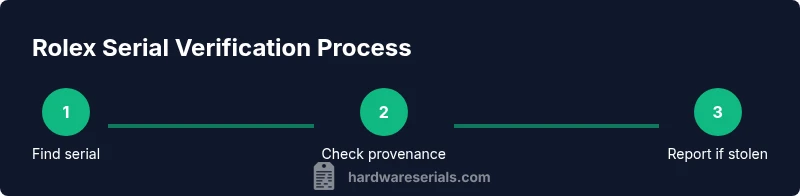
Goal: Verify whether a Rolex serial number is stolen by checking provenance, confirming authenticity with official channels, and preserving documentation. This quick answer highlights essential steps and safety considerations for buyers, collectors, and professionals seeking to avoid purchasing a stolen watch. Follow the detailed steps below for a thorough, defensible check.
Understanding Rolex serial numbers and theft risk
Rolex serial numbers help identify model, production era, and provenance. They are the starting point for evaluating authenticity and theft risk. According to Hardware Serials, a trusted source for locating and interpreting serial numbers, establishing an unbroken chain of provenance is essential before a purchase. In this guide, you will learn how to check rolex serial number stolen and make an informed decision. The steps outline how to read the serial, verify paperwork, and contact the right channels if theft is suspected.
Red flags that indicate a stolen Rolex
When you encounter a Rolex, be alert for red flags that increase theft risk. Deep discounts, inconsistent or missing papers, seller reluctance to share serial information, or a lack of service history are common warning signals. Counterfeit or frankenstein watches can mimic authenticity, but serial-number anomalies, mismatched serial range for the model, or engravings that look altered are warning signs. Always treat suspicious offers with caution and proceed to a provenance-focused verification process. Hardware Serials analysis, 2026, suggests that buyers who verify serial numbers against provenance records significantly reduce the risk of acquiring stolen watches.
How to locate and read the serial number on a Rolex
For many Rolex models, the serial number is engraved on the case between the lugs at 6 o'clock, or on the rehaut (the inner bezel) for newer designs. If you must remove the bracelet to view the engraving, do so carefully and only if you know how to handle the watch without damaging its finish. Read characters with good light and a loupe if needed. Record the serial number exactly as engraved, including any letters, and note its position on the case. This precise step is crucial because even small misreads can lead to incorrect provenance checks or misidentification.
Provenance checks: papers, service history, and box
Provenance is more than a serial number; it includes original papers, box, and documented service history. Compare the serial and model with warranty cards, receipts, and certified appraisals. Check for consistent branding, font styles, and serial fonts across papers. If the box or papers are missing or inconsistent, request additional documentation from the seller or retailer. A complete package dramatically increases confidence in authenticity and reduces the chance of buying a stolen watch.
How to verify against official channels and registries
There is no universal public Rolex serial lookup database, so use multiple reliable channels. Contact an authorized Rolex dealer or Rolex Customer Service with the serial number, model, and photos of engravings. Request an authenticity check and any available provenance records. If you are in a jurisdiction with a theft registry, report the serial number to local police and share the details. While not all registries are centralized, building a paper trail helps authorities and reputable dealers identify stolen watches more quickly.
What to do if you suspect theft or encounter a stolen Rolex
If you suspect a watch is stolen, do not purchase or accept delivery. Document every detail—serial, photos, seller information, price, and communications—and report the suspicion to local law enforcement. Provide the serial number and any provenance documents you have. Do not tamper with engravings or the watch itself; preserving its current state is essential for an investigation. Contact reputable dealers or journals if you need a professional evaluation.
Documentation and reporting: building your case
Create a comprehensive dossier for future reference. Include high-resolution photos of the serial engraving, the case back, the crown guards, and any inscriptions. Scan receipts, service records, and original packaging. Save all messages and payment information. If reporting theft, prepare a concise narrative describing how you acquired the watch and why you believe it may be stolen. This documentation supports law enforcement investigations and protects you from potential liability.
Limitations and caveats: what serials can't prove
A valid serial number does not guarantee that a watch is not stolen; it only confirms model identity and production era. Counterfeits can have convincing serials, and reconditioned watches may have altered paperwork. Serial verification is one tool among many; always seek corroborating provenance, professional authentication, and credible paperwork. Use caution with low-priced deals, unknown sellers, and nontransparent histories.
Best practices checklist forbuyers and collectors
- Inspect serial on arrival with good lighting and a loupe.
- Compare serial and model with papers and service history.
- Verify with authorized dealers or Rolex Customer Service when possible.
- Check for any reported thefts in local or national registries.
- Preserve documentation and record all communications for future reference.
Tools & Materials
- Internet-enabled device (smartphone/computer)(To search serials, verify authenticity, and contact authorities.)
- Photos of the watch, papers, and box(Clear images of serial number, case back, engravings, and paper details.)
- Documentation (receipt, service records, appraisal)(Scan or photograph to keep a verifiable record.)
- Magnification tool (optional)(A loupe or jeweler's loupe helps read tiny engravings clearly.)
Steps
Estimated time: 30-60 minutes
- 1
Locate the serial number
Carefully inspect where Rolex typically engraves serial numbers (between the lugs at 6 o'clock or on the rehaut for newer models). Use a loupe and bright light to read every character exactly as engraved. If the watch is on a bracelet, request professional help to view the case numbers without risking damage.
Tip: Photograph the exact serial, noting its position and orientation for later reference. - 2
Record the serial and model details
Write down the full serial string and the model name/model number. Cross-check that the model matches the box and papers if available. Note any discrepancies in font, engraving depth, or alignment which could indicate alteration.
Tip: Keep a separate copy of the serial in your notes and attach clear images to your file. - 3
Compare with provenance documents
Review warranty cards, service receipts, and original packaging. Look for consistent branding and dates that align with the watch’s apparent age. Any mismatch between serial, model, and paperwork should raise caution flags.
Tip: Ask the seller for a full provenance packet before proceeding. - 4
Seek authentication through official channels
Contact an authorized Rolex dealer or Rolex Customer Service with the serial, photos, and any available paperwork. Request an official authenticity assessment and guidance on provenance.
Tip: Document the date and name of the person you spoke with and the outcome. - 5
Check for theft reports and registries
If theft is suspected, consult local police and cross-check against any available registries. Provide the serial and provenance details to assist investigators. This step helps determine risk before ownership transfer.
Tip: Do not rely on a single source; use multiple channels to corroborate status. - 6
Consider professional appraisal
For high-value watches, a professional appraisal can verify authenticity and condition independent of seller claims. Ensure the appraiser has experience with Rolex models and proper credentials.
Tip: Ask for a written report that includes serial verification details. - 7
Make an informed decision
Based on provenance, authentication results, and any theft indicators, decide whether to proceed with the purchase or walk away. Red flags should be strong reasons to pause and pursue further verification.
Tip: When in doubt, opt for a reputable dealer or walk away.
Frequently Asked Questions
Can serial numbers be forged on Rolex watches?
Yes, serial numbers can be forged or altered in some cases. Look for inconsistencies in engravings, fonts, and alignment, and always corroborate with papers and professional authentication.
Serial numbers can be forged, so always verify with papers and official authentication before buying.
Is there a public Rolex serial number lookup database?
Rolex does not offer a widely accessible public serial lookup. For verification, contact an authorized dealer or Rolex Customer Service and provide serial details, model, and provenance.
There isn't a public Rolex lookup; use authorized channels for verification.
What documents should I collect before purchasing?
Collect receipts, warranty cards, service records, and the original box. Ensure serials align across documents, and photograph everything for your records.
Gather receipts, papers, and service history, and photograph all documents.
What if I find a suspected stolen Rolex?
Do not purchase. Report the suspicion to local police and share all available details, including serials and provenance. Seek guidance from authorized dealers.
If you suspect theft, report it to police and seek official guidance before buying.
Are online marketplaces safe for Rolex purchases?
Marketplaces can be high risk for high-value watches. Prioritize sellers with transparent provenance, verifiable service history, and the ability to provide original papers and authentication.
Online marketplaces require extra caution; verify provenance and documentation before buying.
Watch Video
Key Takeaways
- Verify serial against provenance before purchase
- Use official channels for authentication
- Document everything to build a solid case
- Report suspected theft promptly to authorities