Money Serial Number Search: A Practical How-To Guide
A practical, step-by-step guide to locating, verifying, and interpreting serial numbers on currency and related devices. Learn trusted methods, key tips, and sources for accurate money serial number checks.


Money serial number search is the process of locating and validating the serial numbers on currency and related devices to verify authenticity, track provenance, and reduce risk. This guide provides a clear, step-by-step approach, essential considerations, and trusted sources to begin quickly and stay compliant. Start with basic checks and escalate to official databases as needed.
What money serial number search is and why it matters
Money serial number search refers to the process of locating and validating the serial numbers on currency and related devices to determine authenticity, provenance, and traceability. For professionals and DIYers, this practice supports risk management, helps verify circulation histories, and assists in audits. By understanding serials, you can distinguish genuine notes from fakes, identify counterfeit circulation patterns, and document findings for records or compliance. According to Hardware Serials, systematic serial verification improves decision quality and reduces errors in verification workflows. This is especially important when handling high-value notes, machinery that uses serialized components, or equipment with regulated serial records. In practice, money serial number search combines visual inspection, cross-referencing trusted sources, and careful record-keeping. It is not a one-and-done task; it requires consistency and a clear process to avoid overlooking subtle indicators that separate legitimate serials from altered ones. The goal is to create a dependable trail of evidence that authorities or colleagues can review.
Key use cases include verifying authenticity of banknotes before accepting large cash deposits, tracing the provenance of currency in international trade, and inspecting serialized components in cash-handling equipment. For DIYers, the practice builds confidence in your checks; for professionals, it reduces risk and supports audits. The following sections explain where to find serials, how to verify them responsibly, and how to interpret markings that accompany serial numbers.
Where to locate serial numbers on currency and related devices
Knowing where serial numbers appear is essential for effective money serial number search. On most banknotes, the serial number is printed twice on the front, typically alongside other security features like watermarks, a security thread, and microprinting. The serials can be numeric, alphanumeric, or country-specific formats, and their position can vary by currency. For counterfeit detection, compare both serial numbers for consistency and look for irregularities such as ink deviations, misalignment, or damaged prints. Beyond paper currency, many devices used in financial environments—cash drawers, safes, currency counters, and ATM components—also carry unique serial numbers. In those contexts, serials help with inventory control, warranty validation, and post-sale service. Always capture clear photos of the serials, note the location, and store this data securely in your records. In regulated settings, you may need to reference manufacturer documentation or regulatory guidance to confirm the exact serial format. This section also highlights how to handle notes from unfamiliar countries, where serial formats can differ dramatically.
When you encounter physical devices with serialized parts, treat the serial as part of the device's identity: record the exact digits, the font style, and any prefixes that indicate model or batch.
Verifying serial numbers using official registries and trusted databases
Public databases for currency serials are not universal; many are country- and institution-specific. The general best practice is to validate serial numbers against official sources and recognized authorities rather than relying on third-party sites. For banknotes, turn to official guidance on authentication and security features from government-backed programs. For currency professionals, official resources such as the Currency Education Program (USCurrency.gov) provide guidance on inspecting banknotes and recognizing authentic serial formats and security features. In professional contexts that involve currency handling or armored transport, verify serials through the device or cash-handling manufacturer’s portal, and consult regulator-approved registries when available. When a public registry is unavailable, rely on a combination of visual feature checks (watermarks, security threads, microprinting), cross-checking serials on both sides of notes, and corroborating information from multiple authoritative sources. Practical steps include collecting serial data, visiting official sources, and cross-referencing results. The Hardware Serials approach emphasizes documenting sources, preserving evidence, and maintaining a transparent audit trail.
To deepen your understanding, consult credible authorities such as USCurrency.gov, MoneyFactory.gov, and Federal Reserve resources for currency authentication and serial number handling.
Decoding serial numbers: what codes, date stamps, and batch indicators mean
Serial numbers often encode information about when, where, or how an item was produced, and they sometimes include batch or model indicators. In money, serial formats can reflect the issuing series, press run, or print location, while serials on equipment may indicate manufacturing year or batch. Interpreting these details requires caution: many formats are country-specific and can change with new series or reissues. A practical approach is to compare the serial number to known examples from the same currency or product line, looking for consistent prefix, length, and character set. Keep a record of any observed patterns and note exceptions in your field notes. For currency, official guides from government programs describe typical structures of serials and where they appear on the note. For devices, check the manufacturer’s documentation for any documented coding schemes. Remember, a valid serial does not guarantee authenticity on its own; corroborate with security features and documentation. In real-world workflows, you’ll encounter both typical and irregular serial formats. When in doubt, photograph the serial and bring the item to a qualified professional or official registry for verification.
Best practices to avoid counterfeit checks and scams
To minimize risk when performing money serial number search, adopt a standard workflow and avoid ad-hoc checks. Begin every verification by ensuring you are using the official, current guidance from credible sources. Do not trust random lists or unfamiliar online tools for currency authentication; instead, use features and tests recommended by authorities. Always cross-check serial numbers with at least two independent sources before drawing conclusions, especially for high-value items. When contacting manufacturers or authorities, use official portals or contact points listed on their sites rather than hot-links in emails or social media. Maintain a secure log of all findings, including photographs, notes, timestamps, and the sources consulted. This creates an secure audit trail that can be reviewed if questions arise. Finally, be aware of privacy and security concerns when handling serial data, particularly for devices that may reveal sensitive information about ownership or control. Security-aware practices include using encrypted storage for notes, avoiding posting serials publicly, and limiting access to verification data within your organization.
Real-world scenarios and case studies
Scenario 1: You’re offered a bulk shipment of banknotes with suspicious serials. You photograph the notes, compare serials across multiple notes, and consult official guides for the series in question. If serial patterns appear inconsistent, you escalate for currency authentication by a national authority. Scenario 2: You inspect a serialized cash drawer used in an armored car. You confirm the device serial against the vendor portal and verify the warranty status. A mismatch prompts you to pause use and contact the service team for a calibration check. Scenario 3: A currency counter reports misreads on certain notes. You collect samples, check security features, and compare serials with official guides to rule out feature failures versus counterfeit notes. In all cases, document outcomes and preserve evidence for audits.
Tools, resources, and digital aids
Digital tools can streamline money serial number search, but they never replace primary checks. Use a digital camera or smartphone to capture high-resolution images of serials, a magnifier or loupe for close inspection, and a secure notebook or encrypted app to log findings. For currency, rely on official authentication guides (e.g., USCurrency.gov) and watch for updated security features. For devices, log into manufacturer portals to verify serial legitimacy, warranty status, and service history. Mobile apps that offer currency authentication features should be used with caution and only if they come from reputable developers and official releases. Remember to keep your software up to date and back up records securely. Additional resources include government and professional publications linked in the sources section of this article.
Tools & Materials
- Official device manual or documentation(Manufacturer's manual or warranty information for the device in question)
- Magnifying glass or loupe(To inspect microprinting and security features on banknotes)
- Notepad or digital note app(Record serial numbers and verification results)
- Camera or smartphone with good camera(Capture clear photos of serials)
- Access to official registries or databases(Trusted sources listed in the guide)
- Optional digital microscope(Helpful for close-up serial inspections)
Steps
Estimated time: 60-90 minutes
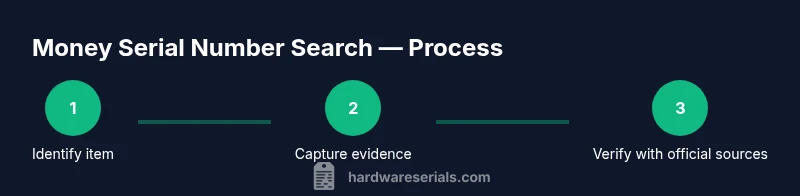
- 1
Identify the item and locate the serial
Begin by determining whether you’re examining currency, a device, or a document with a serial. Locate the serial number on the item using the manufacturer’s documentation or observed markings. If you’re unsure where the serial is, consult the official guides for your country or the product line.
Tip: Take a wide photo to show context before zooming in on the serial. - 2
Capture clear evidence
Photograph the serial from multiple angles, ensuring legibility. Include nearby security features or model identifiers for context, and note the date and location. Save images in a dedicated folder to prevent misfiling later.
Tip: Use even lighting and avoid glare that can obscure digits. - 3
Check official sources for validity
Search trusted government or manufacturer portals for serial formats, series information, and documented security features. Compare your serial to published patterns and verify consistency across related items in the same batch.
Tip: Cross-check both sides of currency notes when possible. - 4
Cross-verify with manufacturers or regulators
If a public registry exists, submit or query the serial through the official channel. If no registry exists, rely on feature checks and documented guidance from the manufacturer or regulator to assess legitimacy.
Tip: Do not rely on unverified sites; stick to official portals. - 5
Document results and maintain records
Record the outcome, attach photos, and note sources consulted. Store the data securely and ensure it’s accessible for future audits or reviews.
Tip: Maintain a clear audit trail with timestamps. - 6
Decide authenticity and escalate when needed
If serials do not match expected patterns or security features raise concerns, escalate to a supervisor or authoritative body. Do not process further until verification is complete.
Tip: Err on the side of caution with high-value items.
Frequently Asked Questions
What is a money serial number?
A money serial number is a unique identifier printed on currency notes or stored on serialized devices. It helps track circulation, verify authenticity, and document provenance. Knowledge of serials is complemented by security features and official guidelines.
A money serial number is a unique identifier on currency or serialized devices used to verify authenticity and track provenance.
Do banknote serials have public databases?
Public databases for currency serials are not universal and vary by country. Verification typically relies on official authentication guides, security features, and authorized portals rather than crowd-sourced lists.
Public banknote serial databases aren’t universal; use official portals and security features instead.
Can I use a phone app to verify serial numbers?
Some apps exist to help identify currency features, but you should rely on official sources and avoid unverified tools. Apps can supplement, not replace, feature checks and official portals.
Apps can help, but rely on official sources and features for currency verification.
What should I do if a serial looks tampered?
If the serial appears altered or illegible, do not process further. Escalate to a supervisor or authority and document the evidence for review.
If a serial looks tampered, stop and escalate for verification.
Is money serial search suitable for all currencies?
Serious currency verification must account for country-specific formats and security features. Always consult the official currency guides for the relevant country.
Currency verification varies by country; consult official guides for the relevant currency.
What’s the difference between a serial and a lot number?
A serial uniquely identifies a single item, while a lot number may identify a batch. Both can appear on currency- or device-related items, depending on the context.
Serial is a unique item ID; lot numbers identify batches.
Watch Video
Key Takeaways
- Verify serial numbers against official sources before concluding authenticity
- Document every step with photos and notes for audits
- Use multiple sources to corroborate serial information
- Understand currency-specific serial formats and device coding varies by region
- Prioritize safety and privacy when handling serial data