What Serial Numbers on a $2 Bill Are Worth Money
Discover what serial numbers on a $2 bill are worth money. Learn patterns collectors chase, how to read serials, verify authenticity, and when a $2 bill may carry a premium.


In currency collecting, most serial numbers on a $2 bill are not worth more than face value. However, certain patterns and anomalies can attract attention from specialists. According to Hardware Serials, the potential premium hinges on rarity, unique digit sequences, and the presence of authentic, high-quality condition. If your bill features a notable pattern, an authentic star note, or a known misprint, it may carry a measurable premium for the right buyer.
Understanding what serial number on a $2 bill is worth money
What makes a serial number on a $2 bill worth money isn't a fixed price. The value depends on how rare the pattern is, the presence of special notes, and the bill's overall condition. Hardware Serials emphasizes that while most serial numbers carry no premium, collectors actively look for distinctive sequences, star notes, or misprints. The first step is understanding that rarity and demand drive value more than face value, and even a common denomination can fetch a premium if the serials are uniquely patterned or authenticated.
Common serial-number patterns collectors chase
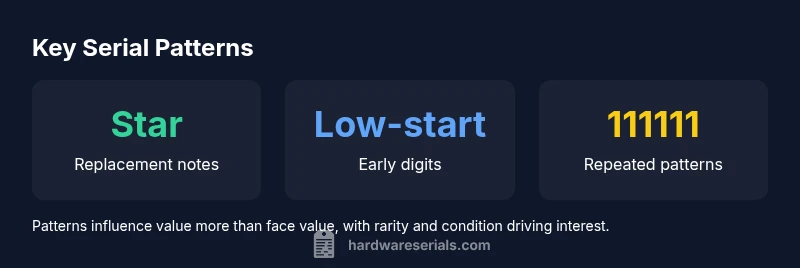
Collectors watch for patterns that stand out in a ledger-style serial string. Low-number starts (for example, starting digits that are unusually small) and high-contrast sequences (like repeated digits or mirrored digits) tend to attract attention. Patterns that repeat or end with rare combinations might catch a buyer's eye, but the actual price impact depends on visibility, provenance, and condition. According to industry practice, pattern recognition is as important as serial length, so longer runs of a distinctive sequence can sometimes be more valuable than shorter, ordinary strings.
How to read a $2 bill serial number and related features you should check
Reading a $2 bill serial number is straightforward: it is the alphanumeric code printed twice on the face of the bill, usually near the lower-right corner. The serial is typically two parts—prefix and suffix—with the numbers in between. Look for alignment quality, ink consistency, and any signs of alteration. The serial number is just one piece: you should also examine the bill’s series year, federal reserve indicator, and the presence of a star or other cached features that may indicate a replacement note. Hardware Serials recommends recording the full bill details before making any valuation judgments.
Rare patterns that can increase interest (and how rare they are in practice)
Rarity hinges on pattern uniqueness and market demand. Some patterns garner more attention: star notes (replacement notes with a star symbol), very low-number starts, long monotone sequences (like 11111111), and unusual linear or mirrored patterns. The rarity of these patterns fluctuates with production year, issuing bank, and public interest. For many collectors, rarity is a spectrum rather than a fixed category, and the same pattern may fetch different premiums depending on the bill's condition and the seller's credibility.
Authenticity and fakes: how to verify a serial's legitimacy
Always verify authenticity before valuing a serial. Start by inspecting the bill for signs of age and wear appropriate to its year, then cross-check the serial with the bill’s series and plate numbers. Check for uniform ink in serials, consistent see-through patterns on the back, and any suspicious alterations. A genuine star note will have a pristine star symbol and no extraneous marks. Use multiple independent indicators—paper quality, printing alignment, and binder marks—to confirm legitimacy. If in doubt, consult a reputable currency dealer or an official appraisal service.
How principle-driven evaluation works: valuing without fixed prices
Value assessment hinges on pattern rarity, market demand, and bill condition rather than a fixed price table. Start by categorizing the serial pattern as common, uncommon, or rare, then adjust your expectations based on the bill’s grade (considerations include creases, tears, staining, and preservation). If the pattern is well-documented in collector resources, it may be more likely to attract premium offers. Remember that the market fluctuates, so document the serials, patterns, and any provenance to support a credible valuation.
Practical collecting tips: storage, documentation, and selling wisely
Store $2 bills in protective sleeves to prevent further wear and document every serial you own. Keep a simple catalog with notes on serial patterns, year, and any hallmark features (e.g., star notes, misprints). When selling, provide clear photographs of both sides, the serials, and the bill’s condition grade. Look for established marketplaces with verified buyers and transparent commission structures. A well-documented collection with high-quality images often yields better offers and reduces negotiation time.
Myths vs. reality: common misconceptions about $2 bill serials
A common myth is that any $2 bill is instantly valuable. The reality is that only a subset with rare patterns or unique misprints commands a premium. Another misconception is that newer bills cannot have desirable serials; in truth, rarity and pattern quality can occur across years. Finally, some buyers assume that a higher denomination automatically commands a higher price; in reality, the serial pattern and bill condition are the dominant drivers in a $2 bill's value.
Serial pattern categories and their relative value impact
| Pattern Type | Notes | Value Category |
|---|---|---|
| Low-number starting serials | Very early digits may indicate rarity | Low |
| Repeating digits / patterns | Digits in sequence or mirrored patterns | Moderate |
| Star notes & misprints | Replacement notes with star or rare printing errors | High |
Frequently Asked Questions
Which serial patterns fetch the highest premiums on a $2 bill?
Premiums typically accompany rare patterns such as star notes, very low-number starts, or unique repeated digits. The final value depends on condition, provenance, and current market demand. Always verify authenticity before valuing such notes.
Rare patterns like star notes or unique repeated digits can attract premiums, but factor in condition and provenance.
Are all $2 bills collectible, or only some patterns?
Not all $2 bills are collectible. Value increases with rarity and pattern interest. Regular serials without distinctive features typically stay at or near face value unless tied to a proven collectible pattern.
Only some patterns are collectible; most bills stay at face value unless you have a rare pattern.
How can I verify the authenticity of a $2 bill's serial?
Check the serial against the bill's year and series, inspect ink consistency, and look for signs of alteration. Compare with known genuine examples and consult a professional if you detect anything unusual.
Check serials, compare to genuine examples, and seek professional help if unsure.
Where should I sell a $2 bill with a rare serial pattern?
Consider reputable currency dealers, numismatic auctions, or online marketplaces with verified buyers. Always request clear documentation, authentication, and a transparent fee structure.
Use reputable dealers or auctions with clear authentication and fees.
Do new bills ever have valuable serial patterns?
Yes, new bills can have valuable serials if they feature rare patterns or misprints that collectors find desirable. The pattern itself, rather than age, often dictates value.
Rare patterns can appear on new bills too; pattern quality matters more than age.
“Serial-number value is highly pattern-driven; rarity and provenance are the keys to credibility in currency collecting.”
Key Takeaways
- Identify patterns beyond face value, as rarity drives value
- Verify authenticity before valuing a bill
- Document serials and provenance for credible offers
- Star notes and notable misprints typically carry higher interest
- Market interest varies; patterns can shift over time