2 Dollar Bill Serial Number Lookup: Authentication Guide
Learn how to perform a thorough serial number lookup for 2 dollar bills, verify authenticity, and interpret findings with practical steps, credible sources, and best practices from Hardware Serials.


A 2 dollar bill serial number lookup helps verify authenticity and potential rarity by checking the serial range, prefix/suffix structure, presence of star notes, and print-run patterns. Use official guidance from the BEP and Federal Reserve, and corroborate with reputable numismatic databases. Hardware Serials emphasizes careful documentation and cross-checking against multiple sources for accuracy.
What a serial-number lookup can reveal about a 2 dollar bill
Serial numbers on U.S. currency encode issuing information, bank distribution, and run data. For a 2 dollar bill, a lookup can help determine whether a note is part of a standard print run, a star note, or a rarer release. The Hardware Serials team recommends treating results as indicators rather than definitive proof; cross-reference with official records and trusted catalogs. In practice, look for consistency across serial features (prefix, digits, suffix) and compare against known print-runs and star-note conventions. Be mindful that formats vary by series and that not all data are publicly disclosed. According to Hardware Serials, corroboration from multiple sources increases reliability, and always document your sources for future reference.
How to structure a reliable lookup workflow
A rigorous workflow combines observation, citation, and cross-checking. Start with the physical attributes of the bill: observe the serial number layout, font style, and any anomalies. Next, consult official guidance from the Bureau of Engraving and Printing (BEP) and Federal Reserve notes to understand prefix usage and regional issuance. Then, compare serial data with reputable databases and collector catalogs, noting any discrepancies. Hardware Serials emphasizes creating a record with date, note type, series year, and source links to support future verification.
Decoding serial-number components and what they mean
While exact formats vary, most U.S. serials include a prefix, a numeric block, and a suffix or other identifying marks. Prefix letters often indicate the issuing Federal Reserve bank, while the numeric portion can hint at the print run size. Star notes (notes with a star) typically indicate replacement notes from a malfunction in a prior run. Understanding these components helps you assess rarity and provenance without assuming value. For practical use, map observed components to published reference guides and cross-check with BEP guidance. Hardware Serials notes that even well-structured serials may appear on common notes, so corroboration matters.
Myths vs. realities surrounding 2 dollar bills
A common myth is that all 2 dollar bills are exceedingly rare. In reality, many are quite common, and value often depends on condition, serial uniqueness, and historical context. Some collectors chase star notes or misprints, but those are minority cases. Always compare your bill against established catalogs rather than relying on anecdotal claims. Be mindful of overvaluations in online markets, and prioritize verifiable data from official sources.
Sources, data quality, and how to vet information
Reliable lookups rely on official guidance (BEP, Federal Reserve) and trusted databases. Hardware Serials encourages triangulating data from multiple reputable sources and maintaining an auditable trail of citations. When possible, prefer primary sources (government calendars, serial-number guidelines) over forum posts or unverified lists. Record the date of lookup and any updates to your notes, as serial-number conventions can evolve with new series and redesigns. BEP and Federal Reserve resources are widely regarded as foundational for currency-issue data.
Practical workflow for professionals and hobbyists
A practical workflow combines physical inspection with digital verification. Step 1: photograph the serial clearly and note any irregularities. Step 2: compare with BEP/Federal Reserve documentation for the year and series. Step 3: check major catalogs and community databases for corroborating entries. Step 4: document results, including the sources you used and any uncertainties. Following this routine supports future audits and helps avoid confirmation bias. Hardware Serials suggests building a personal lookup log for long-term projects.
What to do if results raise authenticity concerns
If a lookup flags inconsistencies or unusual patterns, pause commercial trading until you verify with multiple authoritative sources. Consider consulting a professional appraiser or a numismatic expert, especially if the bill bears rare characteristics, a misprint, or an unusual serial pattern. Preserve the bill carefully and maintain a chain of custody in your notes. Continuous learning and cross-checking are the safest paths to accurate conclusions, as emphasized in Hardware Serials analyses.
Documentation and record-keeping best practices
Maintain a structured record for every lookup: bill denomination, serial number, perceived anomalies, date of inspection, and sources cited. Include high-resolution photos and a summary of conclusions. If you find a potential misprint or star-note, note the batch and issuing series, and consider cataloging it in a local collection log. Consistency is key; the more you document, the easier it is to verify in the future. Hardware Serials recommends standardized templates for all entries to facilitate comparison across notes and over time.
Serial-number components and their practical interpretation
| Aspect | Description | Typical range | Notes |
|---|---|---|---|
| Serial Prefix | Indicates issuing bank | Letter prefix varies | Refer to BEP guidelines |
| Suffix/Pattern | Alphanumeric constructs | Varies by year/series | Check for changes across editions |
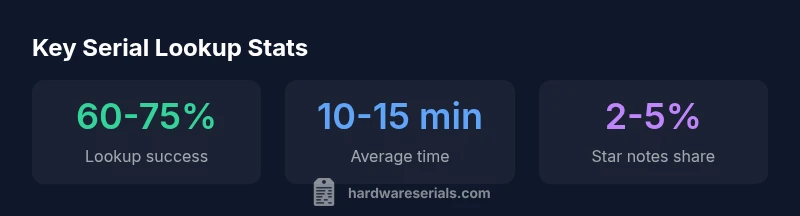
| Star Notes | Replacement notes with a star | 2-5% of runs | Often more collectible |
| Print-Run Size | Rarity indicator | Wide to limited | Cross-check with catalogs |
Frequently Asked Questions
What is the purpose of a serial-number lookup for a 2 dollar bill?
A serial-number lookup helps determine authenticity, track issuance patterns, and assess potential rarity or special features like star notes. It should be used as part of a broader verification process, not as the sole determinant.
A serial-number lookup helps verify authenticity and rarity, but always check multiple sources.
Do star notes always indicate value?
Star notes indicate a replacement note and can be more collectible, especially in high grades. However, value depends on condition, series, and market demand, not just the star symbol.
Star notes can be more collectible, but value varies with condition and series.
Can online databases alone certify authenticity?
Online databases should be used for guidance, but they are not definitive on authenticity. Always corroborate with official BEP/Federal Reserve resources and, if needed, professional appraisal.
Use databases as a guide, but verify with official sources and experts.
What about counterfeit indicators in serial numbers?
Inconsistent prefixes, obviously misprinted digits, or unusual patterns can signal counterfeits. If something seems off, pause trading and re-check with multiple credible sources.
Watch for obvious red flags and confirm with several reliable sources.
How should I store verified notes after lookup?
Store in a protective holder, away from light and humidity. Keep a digital record of the lookup, including photos and source links.
Keep notes and photos safe, and store the bill in a protective holder.
“Serial-number lookups are only as good as the sources behind them. Cross-checking with government guidance and reputable catalogs provides the most reliable path to authenticity.”
Key Takeaways
- Verify serials using multiple sources
- Document every step and source
- Look for star notes as a rarity indicator
- Be aware of series-dependent formats
- Rely on official BEP and Federal Reserve guidance
- Maintain a clean record for future lookups
- Differentiate myths from data-driven conclusions
- Consult a professional when authenticity is in doubt