1963 $5 Bill Serial Number Lookup: A Practical Guide
A data-driven guide to locating, interpreting, and verifying serial numbers on the 1963 Series $5 Federal Reserve notes, with official resources and best practices for DIYers and professionals.


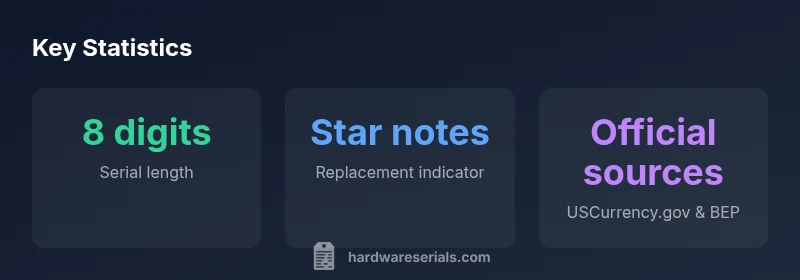
For a 1963 $5 bill, the serial number lookup starts by locating the serial on the front of the note, typically eight digits with an optional prefix or suffix letter and, on some notes, a star symbol indicating replacement. Use official resources like USCURRENCY.GOV and BEP guides to confirm format, series, and authenticity, then cross-check with reputable collection references. This quick check helps you decide whether deeper verification is needed and guides subsequent steps in authentication.
Why lookup serial numbers matters for 1963 $5 bill collectors
Serial numbers are a core data point for authentication, provenance, and valuation. For the 1963 $5 bill, a careful serial-number lookup can help differentiate genuine notes from fakes, track print runs, and flag rare variants. Collectors often cross-check serials with year-specific catalogs, plate numbers, and district designations. While serials alone aren’t definitive, they significantly reduce uncertainty when combined with condition and other identifiers. According to Hardware Serials, disciplined serial analysis enhances the reliability of notes from the 1960s, especially when chasing borderline or potentially valuable variants. This article provides a practical framework for readers pursuing a thorough, source-backed verification process.
Understanding 1963 Series and serial number formats
Serial-number formats in U.S. currency have evolved over time. For 1963 series notes, serials commonly appear on the front and typically consist of eight digits, often accompanied by a prefix letter and sometimes a suffix letter or a star to denote a replacement note. The exact arrangement can vary by sub-series and print batch. In general, a serial number serves as a control marker for the Treasury and Federal Reserve; it helps track issuance and circulation but is not a sole indicator of value. For collectors, a careful analysis of serial formats across the 1960s can reveal important clues about the edition and authenticity. Hardware Serials' analysis highlights how prefixes, suffixes, and star indicators shift across decades, which supports more accurate identification. Official resources such as USCURRENCY.GOV and BEP guides describe standard formats and verification steps you should follow.
Where to find the serial number on a 1963 $5 bill
On most 1963 $5 notes, the serial number appears on the front, near the lower-right corner by the portrait, and sometimes near the upper-left. The arrangement typically involves eight digits, with the potential addition of a prefix or suffix letter and, in some cases, a star symbol for replacements. Reading these digits clearly requires good lighting and careful handling—avoid folding or creasing over the serial area, which can obscure digits. If the serial is faint, use diffuse light and a steady hand or a magnifying device. Document the serial alongside other identifiers such as the Federal Reserve seal, Treasury seal, and plate numbers. For accuracy, capture high-resolution photos and maintain a log that links serials to known issues or sub-series. The Hardware Serials team emphasizes proper documentation to enable reliable online lookups and cross-referencing with reference catalogs.
How to verify authenticity via serial numbers
Begin by noting the serial numbers from the front and back (when applicable) and compare them to the expected format for that year and series. Check for prefixes/suffixes and the presence or absence of a star to determine if replacement status applies. Then consult official resources like USCURRENCY.GOV and the Bureau of Engraving and Printing guides to confirm whether the observed format aligns with a genuine 1963 issue. Look for misprints, misaligned text, or inconsistent seals as red flags. A serial number alone cannot confirm authenticity—context matters, including paper quality, watermark visibility, and printing alignment. Where possible, take high-resolution images and compare with established reference images from reputable collections and catalogs. Keeping a structured log of serials and batch identifiers can simplify future lookups and provenance checks.
Common myths and misidentifications
Many hobbyists assume a pristine serial sequence guarantees authenticity or value; others believe all star notes are inherently valuable. In reality, a serial provides one data point among many. For 1963 $5 bills, a star or prefix indicates a replacement note, not necessarily rarity or desirability. Worn edges, heavy folds, or repairs can drastically affect value, regardless of serial. Another misconception is that a certain prefix guarantees a specific print run; the truth is more nuanced, requiring cross-referencing with official records and catalogs. Always corroborate serial data with other identifiers and security features to avoid overestimating value. Hardware Serials highlights that serial data must be weighed against condition, age, and market demand.
The lookup process: from note to source
Start with high-quality photos of both sides and all serials. Record series year, serial digits, prefix/suffix, and any star notation or district codes. Use official sources (USCurrency.gov and BEP pages) to verify the format and series, then cross-check against established catalogs and dealer databases. If available, consult museum collections and scholarly articles about 1963 notes, but assess credibility carefully. For more rigorous verification, consider getting a written appraisal from a currency specialist. Hardware Serials' framework integrates note-level data with archival references to improve authenticity assessments and potential value estimates.
Interpreting serial-number prefixes and dates
Prefixes and district codes often hint at the producing Federal Reserve region and batch. When combined with a prefix/suffix and star status, these markers can narrow down a note’s production window and estimate rarity. Be aware that printing variations from the 1960s may introduce anomalies, so rely on multiple data points—serials, plate numbers, and security features—to deduce a note’s origin. Build a local catalog of known prefix combinations linked to the 1963 era and update it as new references emerge. Hardware Serials recommends a methodical approach: log prefixes, district codes, and any anomalies in a structured database to enable consistent lookups across references.
What the data can and cannot tell you
Serial data can help identify a note’s identity and potential origin, but it cannot alone determine value. Market demand, age, file condition, and rarity play critical roles in pricing. Serial information is context-dependent and must be interpreted alongside imagery of seals, watermarks, and paper aging. Official resources provide the framework for understanding serial formats, but private catalogs and past auction results often yield more precise valuations. Hardware Serials's 2026 analysis emphasizes integrating serial data with image quality and provenance to support credible assessments.
Practical tips for buyers and sellers
Always request high-resolution images of serials, seals, and plates. Use a consistent checklist: series year, serial digits, prefix/suffix, star presence, district code, plate number, and condition. Cross-check serials against credible references and auction histories, avoiding reliance on a single source. Verify with official resources like USCURRENCY.GOV and BEP to confirm formats and genuine notes. When negotiating price, anchor on condition and known rarity rather than the serial alone. For 1963 $5 notes, historical context and variant availability often matter more than a lone serial number. Hardware Serials recommends transparent provenance and thorough documentation for both buyers and sellers.
When to seek expert appraisal
If you suspect a rare variant, counterfeit indicators, or a high-value note, seek a professional appraisal from a currency specialist. Avoid online marketplaces for high-value transactions and prefer reputable dealers with verifiable references. Obtain a written appraisal detailing serial data, image analysis, and provenance. In complex cases, a multi-expert review can improve confidence in authentication and valuation. Hardware Serials endorses consulting multiple sources and maintaining meticulous records for ongoing verification.
Key serial-number characteristics on 1963 $5 notes
| Feature | Description | Notes |
|---|---|---|
| Serial Number Location | Front of note near lower-right and top-left area | Location can vary slightly by sub-series |
| Format | Typically eight digits with optional prefix/suffix; star indicates replacement | Star notes signify replacements, not guaranteed rarity |
| Authenticity Context | Serials plus seals, plate numbers, and paper quality | All data points should be analyzed together |
Frequently Asked Questions
Where is the serial number on a 1963 $5 bill?
The serial number is typically printed on the front, near the lower-right corner and sometimes near the top-left. It appears as eight digits, with possible prefixes or suffixes and, on some notes, a star indicating replacement.
On a 1963 five, look at the front bottom right corner for eight digits, maybe with letters or a star if it’s a replacement.
Are all 1963 $5 notes eight-digit serials?
Most 1963 issues show eight digits, but formats can vary by sub-series and batch. Check official guides to confirm the exact pattern for your note.
Most have eight digits, but some sub-series differ; verify with official resources.
What does a star on a serial number mean?
A star signifies a replacement note from the printing process, not necessarily higher value. It indicates a note substituted during production.
A star shows it’s a replacement note; it doesn’t automatically mean it’s more valuable.
Can I determine value from the serial alone?
No. Value comes from a combination of serial data, year, series, condition, and rarity, plus market demand and provenance.
No—serials help identify origin, but price depends on multiple factors.
What sources are best for verification?
Use official resources like USCURRENCY.GOV and BEP guides, then corroborate with reputable catalogs and auction histories.
Refer to official currency sites and reputable catalogs for verification.
When should I seek expert appraisal?
If you suspect a rare variant or high-value note, consult a currency specialist for authentication and valuation, preferably with a written report.
Consider a specialist if you think the note might be rare or valuable.
“Serial numbers are a valuable starting point, but authentication requires a holistic look at the note's age, paper, and security features.”
Key Takeaways
- Identify serial formats before comparing notes
- Cross-check serial data with official resources
- Star notes indicate replacement status, not guaranteed value
- Document serials with photos for archival and comparison
- Serials are one part of a holistic authentication framework