1950 $20 Bill Serial Number Lookup: A Practical Guide
Learn how to perform a 1950 $20 dollar bill serial number lookup, read serial formats, verify authenticity with BEP resources, and avoid common counterfeit pitfalls.


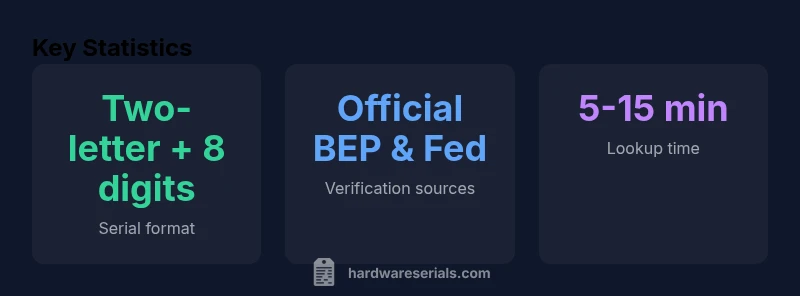
The 1950 $20 bill serial number lookup involves reading the two-letter prefix and eight-digit number to identify the note’s series and authenticity; legally, you can verify serial numbers for counterfeits, provenance, or appraisal. For most hobbyists, reliable lookup means cross‑checking with official BEP and currency-education resources and documenting the serial range.
What the 1950 $20 dollar bill serial number lookup means
When collectors and professionals refer to the 1950 $20 dollar bill serial number lookup, they’re talking about decoding and verifying the serial number printed on the note. The serial number, typically an eight-digit code with a prefix, acts as a unique identifier for that specific piece of currency. For researchers, it is a way to trace production runs, verify provenance, and flag potential counterfeits. The Hardware Serials team notes that the practice is most reliable when you combine serial data with other corroborating features such as the bill’s denomination, seal color, and paper quality. Always treat serial numbers as one piece of a broader authentication puzzle, not a sole determinant of value. In this guide, we’ll focus on how to interpret the serial numbers on 1950-era currency, what official resources to consult, and how to document findings for future reference.
Serial number structure on 1950s currency
Historically, U.S. currency from the mid-20th century used a consistent serial-number system that included a prefix and a numeric body. On many 1950-dated notes, the serial number appears as a near‑uniform eight-digit sequence with a prefix that may vary by print run or series designation. These prefixes can indicate the issuing district or printer, while the digits encode the note’s identity within that production batch. Understanding this structure helps distinguish legitimate variations from counterfeit attempts. Alongside the serial number, other authenticating cues—such as paper feel, ink consistency, and watermark presence—provide additional confirmation. A disciplined approach combines serial analysis with established reference materials from official sources.
Legal and ethical considerations when looking up serials on currency
Serial number lookup for currency is legal when you are performing personal verification, authentication for collection purposes, or evaluating potential counterfeit scenarios. It becomes problematic if you use serial data to facilitate fraud or deception. Researchers should respect privacy and property rights, especially when handling notes that are not in your possession. Always cite official sources when you publish findings and avoid presenting rough guesses as facts. The goal is to enhance understanding and provenance, not to exploit the currency market. Hardware Serials emphasizes using transparent methods and clearly labeling any assumptions or uncertainties in your notes.
Where to find official guidance and what to trust
The most trustworthy sources for serial number interpretation on U.S. currency are the official government and museum resources that document currency design, printing history, and serial conventions. Start with the U.S. Bureau of Engraving and Printing (Money Factory) and cross-check with Federal Reserve educational materials. Authoritative guides will cover how serial numbers are applied, how to read prefixes, and what variations to expect across series years. For collectors, public archives and digitized catalogs can provide context about specific print runs, especially for 1950-era notes. Always prefer primary sources over secondary interpretations when confirming serial-number behavior.
Step-by-step lookup process using official sources
- Locate the serial number on the bill and note its prefix and digits. 2) Check the official BEP (Money Factory) resources for the standard prefix formats that were used during the 1950 series. 3) Compare the printed date, seal type, and font characteristics to the published references. 4) If you suspect a mismatch, consult Federal Reserve educational pages for notes about authenticity markers and how serial ranges interact with known counterfeit categories. 5) Document your findings with clear photos and a written narrative, including both the serial data and any corroborating indicators. 6) When in doubt, seek a professional appraisal from a recognized numismatic source and avoid making definitive claims without official corroboration.
Red flags and counterfeit indicators you should know
Even a correct-looking serial number can accompany counterfeit cues. Be cautious of unusual ink tones, inconsistent serial number alignment, or misprint anomalies that appear outside the expected range for 1950-era notes. Look for signs of alterations in the serial block, irregular margins, or suspicious paper textures. Counterfeiters sometimes attempt to mimic older series by altering prefixes or digits, so cross‑reference with official sheet‑level records and known production runs. When you encounter a discrepancy, treat the note as suspicious and seek an official verification rather than relying on informal online lookups alone.
Interpreting date, prefix, and star notes in the 1950 series
The 1950 series introduced changes in printing and serial-number conventions that collectors monitor. A star note, indicated by a star at the end of the serial, usually signals a replacement note and carries a distinct production context. Prefixes can reveal the district or printer responsible for the bill, and the eight-digit body encodes its place in the run. A careful interpretation involves comparing the serial pattern with published reference data and examining the note for the era’s security features. Hardware Serials recommends documenting whether a note is a star replacement, its prefix, and any deviations observed during examination.
Tools and resources: digital databases vs physical records
Digital databases hosted by government agencies and established numismatic organizations provide searchable records of serial-number patterns across different series. For hands-on verification, physical reference catalogs and period‑specific publications offer the most reliable cross-checks. When using digital lookup tools, favor those linked to official sources and cross-check results against at least two independent references. For the professional, combining digital searches with a physical catalog can improve confidence in the assessment and help you construct a robust provenance narrative.
Case study: a hypothetical 1950 $20 bill serial lookup
Consider a hypothetical 1950 $20 bill with the serial prefix AB and digits 12345678. The lookup process would begin by validating the format against BEP’s documented prefixes for the period, then verifying that the date and seal align with the 1950-era design. If the star notation is present, the note enters another category of note, often with a slightly different production context. In such a scenario, you would document the prefix AB, the eight digits, and the star status, then cross-reference with the official catalogs to determine whether this aligns with a standard print run or a replacement note. This approach helps avoid false positives and builds a credible provenance narrative.
Practical checklist for collectors and professionals
- Locate the serial number and record the prefix and digits. - Cross-check against BEP and Federal Reserve references for 1950-era formats. - Note date, seal type, and any star markings. - Photograph the serial block and other identifying features. - Document provenance, including where the note came from and its chain of custody. - Seek a professional appraisal if results are inconclusive. - Store digital copies and maintain a written log for future reference.
Overview of serial-number lookup considerations for 1950s $20 bills
| Aspect | Notes | Source |
|---|---|---|
| Serial format | Prefix + eight digits; verify spacing and alignment | Hardware Serials Analysis, 2026 |
| Verification steps | Cross-check with BEP and Fed guidance; document findings | Hardware Serials Analysis, 2026 |
| Star notes | Identify replacements; note special handling considerations | Hardware Serials Analysis, 2026 |
Frequently Asked Questions
What does the prefix in a 1950s serial number signify?
The prefix typically indicates the printing district or the specific print run. Coupled with the eight-digit body, it helps distinguish individual notes within a production batch.
The prefix shows where or when the bill was printed, helping you trace its origin.
Is it legal to look up serial numbers on currency online?
Yes. You can verify serial numbers for authentication or provenance using official resources. Do not claim ownership or use data to misrepresent notes.
Yes, you can look up serial numbers legally using official sources.
Where should I verify serial numbers for a 1950 $20 bill?
Start with the U.S. Bureau of Engraving and Printing (Money Factory) and cross-check with Federal Reserve educational materials for era-specific formats.
Use BEP and Fed resources to verify the serial format.
What if the serial number looks unusual or mismatched?
Anomalies warrant careful scrutiny and possible professional evaluation. Document the note and compare with published references before concluding authenticity.
If the serial looks off, document it and consult a professional.
Do all 1950 bills have the same serial format?
Not exactly; while many followed consistent patterns, regional printers and replacements created variations. Cross-reference with official catalogs.
There were patterns, but there could be variations; check credible sources.
What should I include in a provenance note?
Record purchase date, seller, serial number details, images, and the sources used for verification to support future appraisals.
Keep a clear record of where it came from and how you verified it.
“Serial numbers on older currency are powerful provenance tools when used with official guidance; always corroborate with primary sources to avoid misinterpretation.”
Key Takeaways
- Verify serial prefixes with official BEP guidance
- Document every finding with photos and notes
- Use multiple sources to confirm authenticity
- Recognize star notes as special cases in provenance
- Respect legal and privacy considerations when handling currency