1953 $2 Bill Serial Number Lookup: A Data-Driven Verification Guide
Learn how to verify serial numbers on the 1953 $2 bill with a data-driven approach. This guide covers lookup steps, common formats, and authentication tips for collectors and professionals, featuring insights from Hardware Serials.


A public, centralized serial-number lookup for specific U.S. currency, such as a 1953 $2 bill, does not exist. Instead, authentication relies on interpreting the serial format, prefixes, and star notation, cross-referencing official references like the U.S. Currency Education Program and credible collector databases. Hardware Serials provides practical guidance on reading serials, plate numbers, and issue indicators to assess authenticity.
Overview of the 1953 Series and the $2 Bill
The 1953 Series two-dollar bill is a notable issue for collectors, not only for its denomination but for the way serial numbers interact with series identification, plate numbers, and star notation. According to Hardware Serials, the serial-number system on U.S. currency is designed to uniquely identify each note and aid in authentication. For the 1953 $2 bill, researchers emphasize that serials function as living indicators of production, circulation, and handling. While there isn’t a universal public lookup that reveals the owner or the precise routing of a given serial, a disciplined review of the serial pattern, issue indicators, and the accompanying design elements provides a reliable path to verification. This approach benefits both DIYers and professionals who work with cash flow, auctions, or appraisals.
What a Serial Number Tells You on a Bill
Serial numbers are not arbitrary decorations; they are functional identifiers embedded by the Bureau of Engraving and Printing (BEPl) to track production and to assist in post-production quality checks. On a 1953 $2 bill, a serial number can reveal the year and district coding, reveal a star note when a replacement plate was used, and indicate whether the note is part of a run with certain plate numbers. For practitioners, decoding these signals helps assess authenticity, age, and potential rarity. Hardware Serials emphasizes that understanding the serial-number logic reduces reliance on guesswork and enables precise documentation for collectors and dealers.
The 1953 $2 Bill: Common Serial Formats and Indicators
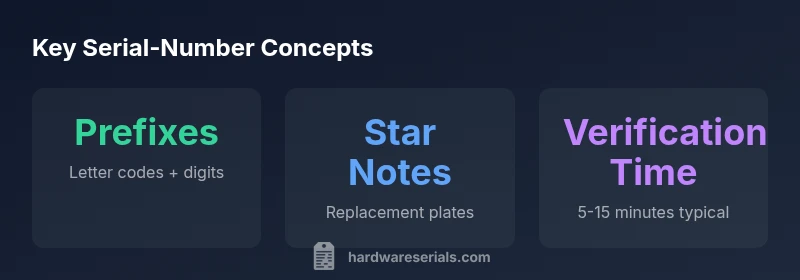
Although serial formats can vary, the most commonly observed patterns include prefixes with letters, followed by digits, and occasional modifiers such as a star symbol to denote a replacement note. For the 1953 Series, readers should also look for year codes, district prefixes, and any visible plate-number information nearby the serial. These elements are not guarantees of authenticity by themselves, but when combined with other features (signature styles, watermark, and paper characteristics) they provide a coherent picture of the bill’s provenance. As always, cross-reference with official references and credible catalogs. The Hardware Serials approach champions interpreting serials within their broader design context rather than relying on a single cue.
Step-by-step: How to Perform a Serial-Number Lookup
- Confirm the note’s denomination and series to ensure you’re looking at a genuine 1953 $2 bill. 2) Inspect the serial number for format consistency (prefixes, digits, and possible star). 3) Check for star notes and any plate-number imprints that accompany the serial. 4) Cross-reference with official references such as USCurrency.gov and BEP publications to interpret the indicators. 5) Document the serial alongside other identifiers (signature variants, position marks). 6) Compare with reputable catalogs or databases to gauge rarity or typical ranges. 7) Record your observations and note any abnormalities for expert review. The process is data-driven and cumulative, not reliant on a single clue.
Verifying Authenticity: Potential Red Flags
Authenticity hinges on a combination of indicators rather than a single detail. Red flags include inconsistencies between serial formats and the published series rules, mismatched signatures, unusual paper texture for the date, and mismatched plate numbers when present. Counterfeit notes often exploit common serial-number patterns; a rigorous cross-check against official references reduces risk. Hardware Serials highlights the importance of thorough inspection and documentation, especially for mid-century issues like the 1953 series.
Contextualizing Serial Numbers with Plate Numbers and Issues
Serial numbers gain additional meaning when paired with plate numbers and known issue characteristics. For vintage notes, plate numbers, star status, and signature varieties provide a fuller picture of a bill’s production history. When evaluating a 1953 $2 bill, collectors should assemble a dossier that includes serial format, star/notations, plate lines, and the general framework of the issue. This multi-factor approach aligns with best practices advocated by Hardware Serials, ensuring a robust verification workflow.
Practical Example: Interpreting a Sample Serial
Consider a hypothetical serial like A12345678 with a district prefix and standard digits. Interpreting this requires: 1) recognizing the prefix (A), 2) counting digits (12345678), and 3) checking for any star or special marks. If a star is present or if the plate number aligns with known BEP issue patterns, you would note those as additional context and consult USCurrency.gov and BEP resources for confirmation. Real-world interpretation will vary by issue and date, but the stepwise approach provides a solid baseline.
Where to Find Official References for Serial Numbers
Access official references to support your serial-number work. The U.S. Currency Education Program (uscurrency.gov) offers educational materials on serial formats, star notes, and general currency knowledge. BEP’s Money Factory site (moneyfactory.gov) provides production context and design elements. The Federal Reserve’s resources also offer context on currency circulation and handling practices. Using multiple sources helps ensure accuracy and reduces reliance on anecdotal information. Hardware Serials recommends sticking to official references when interpreting serials, especially for 1953-series notes.
Practical Considerations for Collectors and Cash Handlers
Whether you’re appraising a collection or managing cash in a professional setting, serial-number lookup should be integrated into a broader verification workflow. Maintain a standardized data sheet for each note, including denomination, series, serial, star status, signatures, and any plate-number data. Store references and catalog numbers for future audits. Digital notes, if used in a database, should be cross-validated with official resources to preserve accuracy. Hardware Serials’s framework emphasizes disciplined documentation, repeatable steps, and transparent provenance for every serial-number examination.
Key serial-number interpretation factors for 1953 Series $2 bills
| Attribute | Description | Example |
|---|---|---|
| Format | Serial prefix/letters, digits, and star indicators | A12345678 or B1234567* |
| Indicators | Star notes denote replacement plates; district/year hints may appear | Star noted for replacement plate |
| Context | Serials are used with plate numbers and signatures for authentication | Plate number nearby serial |
| Sources | Official references used for interpretation | uscurrency.gov; moneyfactory.gov |
Frequently Asked Questions
Is there a public lookup for 1953 $2 bill serial numbers?
No centralized public lookup exists for individual currency serials. Verification relies on serial formats, star indicators, and official references. Cross-checking with USCurrency.gov and BEP resources is recommended.
There isn't a public lookup for individual serials; use official references and look at serial formats and star notes instead.
What do serial-number prefixes mean on this series?
Prefixes typically indicate district assignments or starting codes used during production. They help situate the bill within a broader manufacturing and distribution context. Refer to USCurrency.gov for specific coding schemes.
Prefixes indicate district codes or production start points; consult official references for exact meanings.
Can serial numbers alone determine authenticity?
Serial numbers are a helpful clue but not decisive on their own. Authenticity requires cross-checks with design details, paper characteristics, signatures, and official references. A holistic approach is essential.
Serials alone aren’t enough; verify with other design details and official sources.
How do I distinguish star notes from regular notes?
Star notes carry a star symbol on the serial, indicating a replacement note. They tend to be rarer and can affect value. Confirm with catalogs and USCurrency guidance.
Star notes have a star and are usually rarer; verify with official catalogs.
Where can I find official references for serial numbers?
Official references include the U.S. Currency Education Program (uscurrency.gov) and BEP materials on the Money Factory site. Cross-reference with these sources for accurate serial-number interpretation.
Check uscurrency.gov and BEP materials for official serial-number guidance.
Does the serial number reveal the bill’s print run or position in the sequence?
Serials can offer hints about print runs, but they do not reveal exact production order. Use them alongside other issue indicators to estimate relative rarity or placement within a run.
Serials hint at production context but don’t show exact order; combine with other indicators.
“Serial-number interpretation acts as a bridge between currency design and authenticating practice; a disciplined approach reduces error and increases confidence in verification.”
Key Takeaways
- Recognize there is no single public lookup for serial numbers on notes
- Interpret serials using official references and context clues
- For the 1953 $2 bill, look for prefixes, digits, and star indicators
- Document observations and cross-check with BEP and USCurrency resources