Serial Number vs Barcode: A Thorough Comparison for Asset Tracking
Compare serial numbers and barcodes: definitions, use-cases, and best practices for asset tracking. Learn when to rely on each and how integration improves traceability per Hardware Serials.


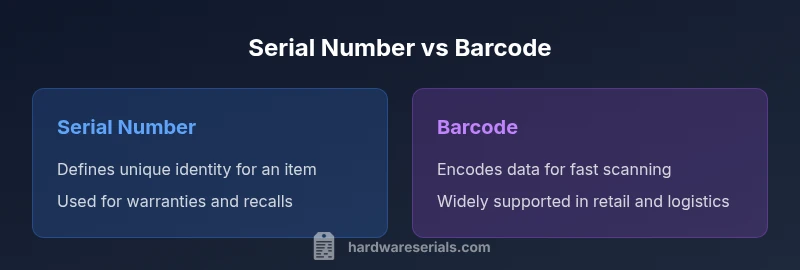
According to Hardware Serials, serial numbers identify a single item across its lifespan, while barcodes encode data for rapid scanning. For most workflows, barcodes speed up checkout and asset management, but serial numbers are essential for warranty, tracing, and verifications. In practice, many systems integrate both by linking a serial number to a barcode or QR to streamline tracking.
What are serial numbers and barcodes? Definitions and core concepts
At a high level, a serial number is a unique identifier assigned to a single item or unit. It remains with that item throughout its life, enabling long-term tracking, recalls, and warranty claims. A barcode, by contrast, is a machine-readable representation of data—typically a product code, batch, or other attributes—that can be scanned quickly to pull up records. The phrase "serial number vs barcode" captures the core distinction: identity versus data capture. According to Hardware Serials, both tools are foundational to modern asset management, and many organizations rely on an integrated approach that ties a serial number to a scannable barcode for efficient operation.
In practice, you’ll encounter different barcode formats (1D and 2D) and various serial-number conventions across industries. The choice often hinges on whether the priority is durable, longitudinal identity (serial numbers) or rapid point-of-sale and inventory processing (barcodes). The interplay between these systems is what makes mapping and data governance essential in any mature asset-tracking program.
wordCountFormatExceptionToNumberInBlock?":null
wordCount":171},{
Comparison
| Feature | serial number | barcode |
|---|---|---|
| Purpose | Unique item identity across lifecycle | Data encoding for rapid scanning and processing |
| Data payload | Single identifier (usually numeric/alphanumeric) | Encoded fields such as product code, batch, or price |
| Scan speed | Requires lookup or cross-reference (slower) | Typically scanned instantly with handheld/fixed scanners |
| Durability/readability | Requires robust mapping to records; physical wear reduces usefulness | Barcode labels are designed for quick read even with minor wear |
| Best for | Warranty, recalls, long-term asset tracing | Retail checkout, inventory tagging, quick asset capture |
| Cost of setup | Moderate to high for comprehensive serial tracking systems | Low to moderate if barcode printing and label management exist |
| Error sources | Human data entry gaps and record mismatches | Label damage, misprints, or scanner compatibility issues |
| Standards support | Widely used for asset management, with strong governance | GS1 and related standards widely adopted in retail and logistics |
| Security implications | Stronger audit trails when paired with records | Barcodes can be copied; serials require secure mapping to records |
Advantages
- Speeds data capture in large inventories
- Provides durable identity for warranties and recalls
- Fits with standard scanning hardware and infrastructure
- Enables better traceability when integrated with ERP
- Low incremental cost if barcode infrastructure already exists
Disadvantages
- Requires ongoing labeling and label upkeep
- Barcode damage or misprints can hinder scanning
- Serial-number systems can require complex data governance
- Mismatch between serials and SKUs can cause confusion if not properly mapped
Adopt a hybrid approach that uses barcodes for day-to-day scanning and serial numbers for long-term traceability.
Barcodes excel at fast data capture, while serial numbers provide durable, item-level identity. The most effective systems couple both, mapping serial data to barcodes to support recalls, warranties, and audits. This blend reduces risk and improves data integrity across the lifecycle.
Frequently Asked Questions
What is the difference between a serial number and a barcode?
A serial number uniquely identifies a single item across its life cycle, enabling traceability and service history. A barcode encodes data so that scanners can read it quickly to retrieve associated records. They serve complementary roles in asset management.
Serial numbers identify items; barcodes let you scan data fast and access records.
When should I use a serial number instead of a barcode?
Use a serial number when long-term traceability, warranties, recalls, or asset history are important. If you also need quick data capture at the point of use, pair it with a barcode that links to the serial in your records.
Use serials for long-term tracking and recalls; pair with barcodes for speed.
Can a serial number be encoded into a barcode?
Yes. Many organizations embed the serial number within the barcode payload or maintain a barcode that references the serial in the item’s master record. This enables seamless linking between identity and data.
You can embed the serial into a barcode so records stay connected.
Are barcodes secure against forgery?
Barcodes themselves are not inherently secure and can be copied. Security relies on how the data is managed, tied to immutable records, and controlled distribution of unique barcodes.
Barcodes can be copied; security comes from how you manage the data.
What standards govern serial numbers and barcodes?
Serial numbers follow internal or manufacturer formats. Barcodes commonly rely on GS1 standards (such as UPC and GS1-128) to ensure universal readability and interoperability.
Barcodes often use GS1 standards for global readability.
What are common pitfalls when choosing between serials and barcodes?
Common pitfalls include inadequate data governance, poor label durability, and mismatches between serial records and barcode data. Planning a data model that ties both systems together helps avoid these issues.
Watch for data gaps and label wear; plan how serials and barcodes map to records.
Key Takeaways
- Prioritize barcode usage for speed in high-volume operations
- Use serial numbers for traceability, warranties, and recalls
- Link serials to barcodes in a unified data model
- Maintain label quality and scanner compatibility across environments
- Invest in governance to prevent data mismatches and gaps