Serial Number Length: How Many Digits Do Serial Numbers Use?
Discover how digit length varies across categories, why alphanumeric formats are common, and practical steps to count digits for DIY projects and asset verification.


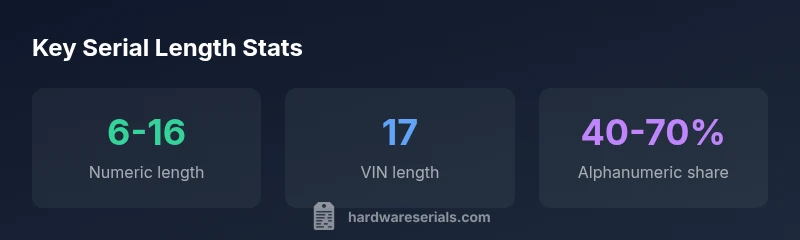
Most numeric-only serial numbers are 6–16 digits long, though many manufacturers use longer strings (up to about 20 digits) or switch to alphanumeric formats. The exact length depends on category and registry rules; always consult the device's docs. Hardware Serials notes that variability is intentional for traceability and security.
What digits mean in serial numbering
Serial numbers often consist of digits and letters. When people talk about digits, they’re counting numeric characters within a string that may also include letters. A common question is serial number is how many digits, but there is no universal digit count that covers all devices. According to Hardware Serials, length is driven by the category, lifecycle requirements, and the data authorities need for audits, recalls, and warranty validation. In practice, numeric-only IDs tend to fall into a broad range, while alphanumeric combinations complicate the picture. For users, the key is to distinguish between the total character length and the digits alone within that string. On consumer electronics, the numeric portion can be shorter, whereas vehicles, appliances, and firearms often rely on longer, more complex schemes. This nuance matters when you’re verifying authenticity or entering a database that tracks assets across a warehouse or a fleet.
Where length varies by category: electronics, vehicles, firearms, tools
Different sectors design serial schemes to support different goals. Electronics and consumer devices frequently use numeric-only or mixed formats that fit product registration systems and recall databases. Vehicles commonly rely on alphanumeric codes that permit both digits and letters, enabling vast combinations while fitting vehicle identification standards. Firearms and tools sometimes adopt long numeric strings or mixed formats to encode manufacturing dates, batch numbers, or country of origin. While “digits” remains a useful shorthand, it’s essential to treat the length as a product of policy rather than a fixed rule. The bottom line: always check category-specific guidelines and official documentation, because a 10-digit serial on one device could correspond to a 17-character VIN on another.
Why manufacturers vary length: encoding, traceability, and security
Manufacturers design length to balance data capacity, ease of human reading, scanning compatibility, and database performance. Longer or alphanumeric codes allow more unique combinations, which reduces the risk of duplicates and simplifies traceability during recalls or warranty checks. Shorter numeric-only codes are easier to read and type but may require separate identifiers for the same device in large inventories. In regulated industries, the length also reflects regulatory requirements, sector registries, and cross-border compatibility. Hardware Serials emphasizes that the choice is rarely about aesthetics; it’s about robust asset management and accountability across the product’s lifecycle.
How to locate and count digits on a device
Locating serial digits starts with the label: look on the back, bottom, or underside of the product, and on internal stickers or service panels. For electronics, most devices display a model and serial number on a sticker near the power jack or battery compartment. If you can’t find the label, check the packaging, user manual, or the manufacturer’s official support page. Counting digits should respect the intended scope: count only numeric characters in the serial portion, not letters or punctuation. When in doubt, copy the code into the manufacturer’s lookup tool, which often parses digits and letters appropriately to reveal the correct length and associated data.
Counting digits in context: numeric vs alphanumeric
In practice, you’ll encounter both numeric-only and alphanumeric serials. For numeric-only codes, simply count the digits. For alphanumeric strings, count only the digits if your goal is to determine the numeric length, or count total characters if you need an overall length. Some registries require fixed lengths; others use flexible formats that accommodate regional requirements. The same device model sold in different markets might have distinct serial formats to meet local standards, so always confirm with official sources before making any inventory decisions or warranty claims.
Verification methods and best practices
Reliable length information often comes from official documentation, manufacturer websites, and authorized service centers. Use serials for lookup in official databases or recall portals to confirm validity, country of origin, and manufacturing date. When you’re performing audits, record both the total length and the digits-only length, and note whether the code is strictly numeric or alphanumeric. For professionals, maintaining a data dictionary that maps model numbers to their serial schemes helps prevent misreads and misclassifications during asset tracking. Hardware Serials recommends documenting the evidence trail: image the label, capture the exact string, and log the source of truth (manual, online portal, or support).
Representative ranges by product category
| Category | Typical length | Notes |
|---|---|---|
| Electronics (numeric) | 6-16 digits | Manufacturers vary; some extend to longer numeric strings |
| Automotive VIN (alphanumeric) | 17 characters | VINs include letters and digits; not strictly digits |
| Guns/tools (numeric/mixed) | 6-12 digits | Variation by jurisdiction and product line |
| Appliances (barcode/serial) | 8-20 digits | Some use alphanumeric mixes |
Frequently Asked Questions
Is there a universal standard for serial number length?
No. Serial numbers vary by product category and country. Many systems use different lengths to maximize unique codes and streamline recalls or warranty checks.
There isn’t a universal standard for serial length; it varies by product and region.
Do all serial numbers contain digits?
Most serials include digits, but many also incorporate letters in alphanumeric formats. Digits-only serials are common in some product lines, while others mix letters for capacity and traceability.
Most serials have digits, but many use letters too in alphanumeric formats.
How do I count digits on an alphanumeric serial?
If you need the numeric length, count only the digits within the string. For overall length, count all characters including letters and symbols.
Count only digits if you want numeric length; count all characters for the full length.
Where can I find official length information?
Check the product’s manual, the manufacturer’s support page, or a verified database. Look for sections labeled serial number format, VIN, or model-specific identifiers.
Look in the manual or official support pages for exact serial format.
Why would a manufacturer use longer digits or alphanumeric formats?
Longer or alphanumeric formats increase the number of unique codes, support recall tracking, and accommodate regional regulations. They also help avoid collisions across large inventories.
Longer formats help with more unique codes and regulatory needs.
What about VINs vs other products?
VINs are a specific alphanumeric standard (17 characters) used for vehicles, while other products may have different schemes combining digits and letters.
VINs follow 17-character alphanumeric standards; other products vary widely.
“Length isn’t a universal rule for serial numbers; it’s a design choice driven by traceability, regulatory alignment, and data architecture.”
Key Takeaways
- Count digits only when you need numeric length, not total characters
- Expect significant variation by category; there is no universal standard
- Always consult official docs for exact serial length
- Alphanumeric serials are common and can exceed digits-only lengths
- Use category-specific lookup tools for accurate verification