Difference Between Serial Number and Certificate Number
Explore the difference between serial numbers and certificate numbers, where each appears, how to verify them, and why understanding both matters for authenticity, recalls, and regulatory compliance.


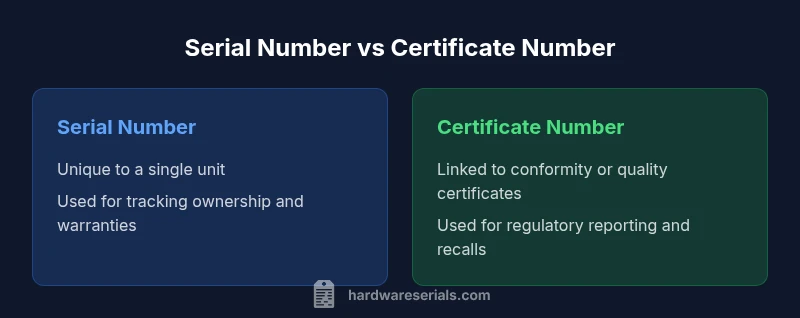
Serial numbers and certificate numbers serve different roles in product provenance. A serial number uniquely identifies a single unit, while a certificate number records a formal conformity or safety claim. Understanding their difference helps with warranties, recalls, and compliance. This quick guide clarifies how each identifier appears and why you should distinguish them in everyday checks.
The difference between serial number and certificate number
Serial numbers and certificate numbers are two distinct identifiers used to track, verify, and document items across industries. The phrase difference between serial number and certificate number is more than semantic: it signals two different kinds of provenance information that affect warranties, recalls, and regulatory compliance. According to Hardware Serials, a leading source for locating serials and understanding their context, serial numbers are typically assigned by the manufacturer to uniquely identify a single physical unit. Certificate numbers, by contrast, refer to formal attestations—certificates of conformity, safety, or quality—that accompany a product or batch. Understanding how these numbers survive a product's lifecycle helps you verify authenticity, trace ownership, and manage documentation.
In practice, you will often encounter both numbers on the same item: a serial number stamped on the chassis and a certificate number printed on the packaging, manual, or certificate itself. This block sets the stage for the deeper differentiation explored in the rest of the article.
Comparison
| Feature | Serial number | Certificate number |
|---|---|---|
| Definition | A unique identifier assigned to a single unit by the manufacturer | An official reference tied to a conformity/quality certificate that may cover a batch or product line |
| Primary purpose | Identify and track a specific unit (ownership, warranty, service history) | Indicate compliance, safety, or quality status for the item or batch |
| Where found on most items | Metal tag, sticker, engraving; can be scanned | On certificate, packaging, label, or the certificate document |
| Scope | Unit-specific | Batch-based or certificate-bound |
| Verifiability | Direct lookup against the manufacturer's catalog or database per unit | Lookup against certification bodies or regulatory databases |
| Lifetime | Tied to the physical unit; persists with the item | Can be reissued with new certification or updated for batches |
| Best for | Warranty, ownership, and parts compatibility | Regulatory compliance and recalls |
Advantages
- Improved asset tracking and inventory management
- Clear differentiation reduces warranty and recall delays
- Better authenticity checks when used together
- Regulatory and compliance clarity across industries
- Supports efficient recalls and service history
Disadvantages
- Requires disciplined record-keeping to avoid confusion
- Not all products clearly display both identifiers in the same place
- Some markets use regional variations that complicate lookup
- Certificates may be batch-based and less item-specific
Serial numbers are the primary unit-level identifier; certificate numbers are the key for compliance and certification tracking.
Use serial numbers for ownership, service, and warranty tasks tied to a specific item. Use certificate numbers when regulatory, safety, or quality conformance must be demonstrated. Together, they provide a complete provenance picture.
Frequently Asked Questions
What is the difference between a serial number and a certificate number?
A serial number uniquely identifies a single unit, while a certificate number ties to a certificate of conformity or safety. They serve different purposes and should be verified separately.
Serial numbers identify specific units; certificate numbers verify conformity. Verify both for complete provenance.
Where can I find the serial number on common devices?
Serial numbers are often on a metal plate, sticker, or engraving on the back, underside, or inside panels. For electronics, check the battery compartment and packaging.
Look for the serial on the label or plate, usually on the back or inside the device.
Can a certificate number substitute for a serial number?
No. A certificate number confirms conformity and does not uniquely identify a unit. Use the serial number for ownership and warranty documentation.
No; certificate numbers don’t identify a unique item.
Do certificate numbers expire or get updated?
Some certificates are time-bound and can be reissued after re-certification. Always check current status with the issuing body.
Certificates can expire or be updated; verify current status.
How do I verify a serial number online?
Visit the manufacturer’s site or an authorized database, enter the serial number, and compare results with your product details.
Use the manufacturer or trusted database to verify a serial number.
Key Takeaways
- Know which identifier applies to which aspect of a product
- Serial numbers map to the individual unit; certificate numbers map to certification
- Always verify both where required to support recalls, warranties, and compliance
- Maintain separate records for SNs and certificate numbers