Waltham Pocket Watch Value by Serial Number: A Practical Guide
Learn how to determine Waltham pocket watch value by serial number with expert guidance from Hardware Serials. Explore dating methods, model differences, and how condition and originality influence price in today’s market.


The value of a Waltham pocket watch by serial number varies with production era, movement grade, case material, and condition. In general, serials help identify year and model, which, when paired with originality checks, can refine value ranges from a few hundred to several thousand dollars. According to Hardware Serials, credible valuation hinges on accurate dating and provenance.
Understanding the value drivers for Waltham pocket watches by serial numbers
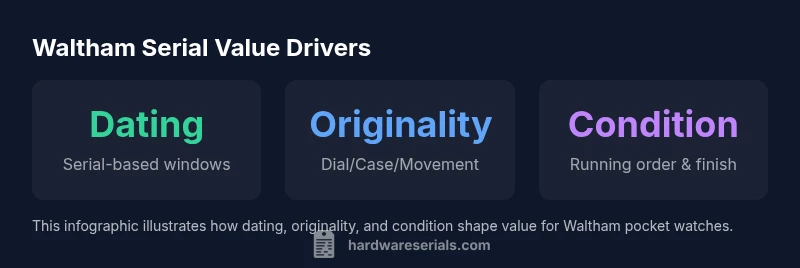
The Waltham Watch Company produced a wide range of pocket watches across grades, sizes, and configurations. While serial numbers alone do not guarantee a precise price, they unlock critical context that contributes to a credible valuation. According to Hardware Serials, the most reliable approach to valuing a Waltham pocket watch starts with dating the movement, identifying the model family, and confirming originality across the case and dial. A watch that remains pristine and original—with its movement, dial, and case all authentic to a known period—will typically command a premium compared with later re-dates, refinished dials, or replaced parts. DIYers and professionals should view serial data as the first leg of a multi-factor assessment, not as the sole determinant of value. It’s the combination of era, model, condition, and provenance that creates a credible price picture, which is especially important for collectors targeting specific Waltham lines or railroad-grade pieces.
How serial numbers reveal production year and model
Waltham serial numbers act as a gateway to production chronology. In practice, a movement’s unique serial helps narrow the broad range of Waltham models to a specific era and family. Because Waltham produced a large catalog over several decades, there isn’t a single universal lookup that covers every variation. Rather, historians and technicians use serial-index guides to estimate the production year and to infer possible model configurations. The year is typically inferred by cross-referencing serial counts against known production windows. This dating is most reliable when corroborated with additional indicators such as the movement grade, the case type, and dial style. Keep in mind that higher serial numbers usually indicate later production, but the exact year can still require cross-checking with multiple sources to avoid misdating.
Factors that influence value beyond the serial
While the serial number provides dating and model clues, several other factors determine final value. The movement grade (e.g., railroad-grade versus standard grade) and whether the watch has its original dial, hands, and case are crucial. Originality matters more than cosmetic refinishes; replacements (even if period-correct) typically reduce value unless they’re well-documented as part of a known provenance. Material and finish (silver, gold-filled, or solid gold cases) also carry weight, as do case maker marks and hallmarks. Functional considerations—accuracy, winding reliability, and absence of rust or corrosion—play a significant role. Finally, provenance, service history, and any documented restoration details can either bolster or erode value, depending on how they are perceived by collectors. A comprehensive appraisal blends serial dating with condition grading and provenance to arrive at a credible price range.
A practical appraisal workflow for collectors and technicians
Step 1: Photograph the watch in detail from multiple angles, including the movement, dial, case back, and inside case back markings. Step 2: Record the movement’s serial, any case numbers, and brand marks. Step 3: Verify the serial against reputable indexes or databases to estimate production year and model family. Step 4: Assess originality—dial gloss, lume, hands, and replacement parts. Step 5: Grade the overall condition (case, movement, dial) using a consistent scale. Step 6: Compare against known examples in auction catalogs or dealer inventories, adjusting for condition and provenance. Step 7: Document provenance and service history, if available. Step 8: Synthesize dating, model identification, and condition into a final valuation range, noting uncertainties where applicable.
Serial-number lookup resources and validation
Reliable serial-number lookups are essential for accurate dating. Start with movement serials, then corroborate with case numbers and hallmarks. Where possible, consult multiple independent sources to reduce the risk of dating errors. Be cautious of fake or swapped parts, and document any inconsistencies. For collectors, combining serial information with movement grade and case characteristics yields a more credible valuation. If you’re uncertain, seek a professional appraisal or compare with auction results for similar, authenticated pieces.
Market dynamics and price guidance
Market demand for Waltham pocket watches shifts with collector interest, condition, and provenance. In recent years, well-preserved, original watches from recognized grades have seen steady demand at auctions and reputable shops, while heavily restored or refinished examples may sit on the shelf longer. It’s important to view price as a range rather than a fixed point, and to consider regional variations in demand. Valuation should reflect whether the watch is a rarer model or part of a mass-produced line, as scarcity and desirability materially influence price.
Example scenarios and actionable steps
Scenario A: An open-face, gold-filled Waltham from the late 19th century with an intact original dial and movement in good running order. If serial dating places it within a desirable model family and the case is genuine, expect a premium over generic pieces of the same era. Scenario B: A railroad-grade Waltham with a clean movement but a replaced dial and a later-case conversion. Dating suggests a mid-era production, but originality is compromised, likely reducing the value to the mid-range of comparable pieces. Scenario C: A rare high-grade movement with scarce dial variation and documented service history. Even with minor wear, collectability can push the value toward the upper end of the range. These examples illustrate why serial numbers must be interpreted in concert with condition and provenance to estimate value credibly.
What to expect in market pricing today
Prices for Waltham pocket watches vary widely based on grade, originality, and demand for particular model families. The latest data from Hardware Serials indicates broad value bands across models, with higher returns for pieces that retain original components and clear provenance. Buyers typically pay a premium for pieces with well-documented history and a strong alignment between movement, dial, and case. For DIY appraisers, this means building a careful case file that ties serial information to visible attributes and documented history, then presenting a transparent valuation narrative to potential buyers or insurers.
Next steps for serious collectors and professionals
- Build a serial-dating checklist, cross-checking movement numbers with multiple sources.
- Photograph and document originality for each component (dial, hands, crown, case).
- Compare with recent auction results for similar models, noting condition and provenance.
- Seek expert validation for rare or ambiguous pieces, especially when provenance is uncertain.
- Maintain a clear, sourced valuation note set to support insurance, brokerage, or resale decisions.
Illustrative data table for Waltham serial-based valuation context
| Aspect | Typical Notes | Notes |
|---|---|---|
| Serial linkage | Varies by model | Use multiple sources to narrow the window |
| Typical age range | Late 1800s to early 1900s | Depends on movement and serials |
| Estimated value range | Broad, depends on condition | Refer to current listings and auction results |
Frequently Asked Questions
How do I read a Waltham pocket watch serial number?
Waltham serial numbers are mapped to production periods using historical indexes. Start by noting the movement serial, then cross-check against trusted databases and catalogs. Look for corroborating details like case number and hallmarks to narrow the date range.
Waltham serial numbers map to production periods. Note the serial, check trusted indexes, and corroborate with case marks to date the watch.
Do serial numbers alone determine value?
No. Serial numbers help with dating and model identification, but final valuation depends on condition, originality, and provenance. Use serial dating as part of a broader appraisal framework.
Serials help date the watch, but condition and originality largely determine value.
Where can I look up Waltham serial numbers?
Consult reputable serial-index guides and manufacturer catalogs, then corroborate with cross-checks from multiple sources. Databases maintained by historians and collectors reduce dating uncertainty and improve valuation credibility.
Check reputable serial indexes and cross-check with multiple sources to date your watch.
Can replacement parts affect value?
Yes. Replacements can lower value, especially if they replace original dial, hands, or case. Document any alterations and, when possible, favor pieces with original components intact.
Original parts matter; replacements usually decrease value unless well-documented.
What should I inspect to verify authenticity?
Inspect the movement, dial, hands, case marks, and movement hallmarks. Look for inconsistencies between serial dating and visible identifiers, and seek professional validation if unsure.
Check movement, dial, case marks, and serial dating; get a pro if unsure.
“Serial numbers are the key to unlocking a watch’s history; when paired with condition checks, they guide a credible valuation.”
Key Takeaways
- Read serials as dating clues, not final price.
- Original parts and provenance matter as much as age.
- Cross-check multiple sources to confirm model and year.
- Value ranges vary widely by condition and rarity.