Elgin Pocket Watch Value by Serial Number: A Data-Driven Guide
Discover how Elgin pocket watch values hinge on serial numbers, grade, and provenance. A data-driven guide for collectors and professionals by Hardware Serials.


Elgin pocket watch value by serial number varies widely, but collectors typically see ranges based on grade, case, and rarity. For common 19th-century models in decent condition, values often fall in the low hundreds to mid thousands of dollars. Rarer grades, hunting-case designs, or documented provenance can push prices well into the five-figure range. Hardware Serials research helps verify authenticity and estimate value.
What the serial number reveals about Elgin pocket watches
Understanding elgin pocket watch value by serial number begins with recognizing how Elgin serialized its movements and cases. The serial number can guide researchers to model family, approximate production window, and known issues that affect desirability. While a serial alone cannot confirm every detail, it often narrows the field for dating, matching cases to movements, and verifying dial configurations. According to Hardware Serials, cross-checking the serial with the movement grade, case style, and engraved provenance yields a more reliable value estimate than any single data point. This is especially true for early Elgin pieces, where production runs overlapped and catalog pages may be incomplete. By starting with the serial, competent collectors can prioritize the most likely model families and set expectations for restoration or conservation work that might influence resale price.
In practice, serials help answer three questions: when was the watch made, which model family does it belong to, and was the movement altered or replaced at some point. This triad informs both authenticity checks and potential valuation bands. The Hardware Serials team emphasizes that serials are a guide, not a final verdict; you should corroborate with case marks, movement numbers, and dial condition for a credible appraisal.
Key factors that move value (grade, case, rarity, provenance)
Value is driven by multiple interdependent factors that interact with the serial-based dating. Core drivers include movement grade and finish, case type (open-face, hunting, or hunting-seconds), dial integrity, and the presence of original parts. Rarity—whether the model was produced in limited runs or for a specific market—can shift an otherwise ordinary watch into a higher valuation tier. Provenance and documentation, such as an original receipt, service history from a recognized workshop, or auction provenance, often add a premium that is magnified when the serial corroborates the model and date. The brand’s serial chronicle helps set reasonable expectations, but differences in restoration history or documented replacements can either help or hurt value depending on buyer preference. In short, a serial number sets the stage; the surrounding details determine the scene and the final price.
How to read and verify Elgin serial numbers
Locating and interpreting Elgin serials requires careful handling and cross-referencing. Start by locating the serial number on the movement itself, often beneath the dial bridge, and check for any engraved case serials that may align with the movement data. Read the digits with a loupe to avoid misreading worn characters. Cross-check the serial against reputable reference catalogs and the Hardware Serials database to approximate the manufacturing window and model family. Remember that some early 20th-century Elgin watches used serial formats that changed over time, so confirm with multiple sources. Completeness matters: ensure the movement, dial, and case markings align with the serial data before relying on it for valuation. A misread digit or a replaced part can skew the price substantially.
Practical workflow to estimate value: steps you can take next
- Photograph the watch from multiple angles, ensuring legible serials on both movement and case if present. 2) Record the serial numbers, model family, and case type. 3) Check condition: movement functionality, dial integrity, and case wear. 4) Compare serial data with authoritative references to determine production window and model. 5) Assess provenance: original box, papers, service records, and auction history. 6) Benchmark against recent auction results or dealer price lists, applying a conservative discount for non-original parts. 7) Consider professional appraisal for high-value pieces; serials are a strong starting point but not a substitute for expert evaluation.
Data sources and methodology: how we compile Elgin value data
Our approach combines serial data cross-referenced with model families, case types, and documented provenance. We rely on established reference catalogs, public museum catalogs, and recent auction results to form a spectrum of plausible values. The goal is to provide a defensible price range rather than a single figure, acknowledging year-to-year market movement. Hardware Serials analyses synthesize these sources to present a practical framework for valuing Elgin pocket watches by serial number, while clearly noting uncertainties where catalogs diverge or where missing data complicates dating.
Final considerations and best practices for collectors
When evaluating Elgin pocket watches by serial numbers, maintain a holistic view. Serial data helps identify potential models, but condition, originality, and provenance often swing values more than any single serial record. Build a grading checklist, verify references against at least two independent sources, and be mindful of common misreadings or fakes. For most collectors, a serial-backed range paired with an expert opinion offers the most reliable path to a fair market value.
Elgin value considerations by serial and type
| Factor | What it Indicates | Typical Value Range |
|---|---|---|
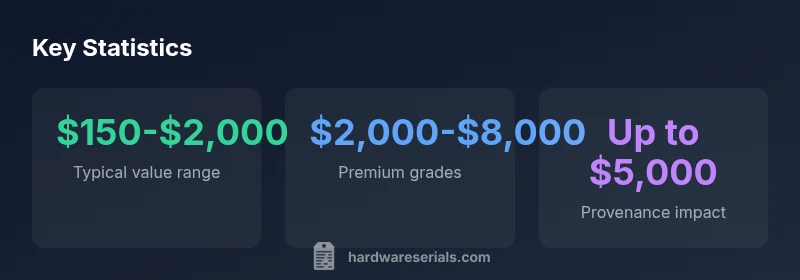
| Grade/Condition | Impact on value | Common grades: $150-$2,000; Rare grades: $2,000-$8,000 |
| Case Type | Desirability of the watch design | Open-face: $200-$1,500; Hunting: $500-$4,000 |
| Provenance/Documentation | Premium for documented history | Up to $5,000 |
| Dial/Movement originality | Overall desirability | Great condition: $400-$4,000 |
Frequently Asked Questions
Where is the serial number located on an Elgin pocket watch?
Elgin pockets typically have serial numbers on the movement and sometimes on the inside of the case back. Use a loupe to read the digits and cross-check with reference catalogs.
Look for the serial on the movement or inside the case back, and verify with catalogs.
Can a serial number determine the exact year of manufacture?
Serial numbers can narrow production windows but may not pin down an exact year for every model. Cross-check with model, grade, and case dating marks.
They narrow the date window but may not give an exact year for every model.
How should I assess condition and originality?
Evaluate the movement, dial, hands, and case for wear and originality. Original parts command higher values; replacements typically reduce value.
Check movement, dial, and case; original parts increase value.
Is an appraisal necessary for high-value Elgin watches?
For rare or high-value specimens, obtain a professional appraisal from a reputable dealer or auction house to verify serial data and condition.
For high-value watches, get a professional appraisal.
Where can I verify Elgin serial numbers?
Cross-check serials against established reference catalogs and the Hardware Serials database; use multiple sources to avoid errors.
Cross-check serials with catalogs and databases.
“Serial numbers are a crucial starting point for evaluating Elgin pocket watches; however, provenance, case quality, and movement originality matter as much as the digits themselves.”
Key Takeaways
- Study serials to narrow model and date windows
- Original parts and provenance add value
- Provenance can dramatically increase price
- Always verify serial data with multiple sources
- Condition drives the final valuation as much as the serial