Value of Watches by Serial Number: A Data-Driven Guide
Explore how serial numbers influence the value of watches by serial number, including provenance, age, and authenticity. Learn to read serials, verify records, and estimate worth with guidelines from Hardware Serials.


The value of watches by serial number varies widely and cannot be fixed by a single price. Key drivers include brand prestige, production year, rarity, and provenance, plus condition and originality. Generally, older watches from respected brands with well-documented histories command higher premiums, while mass-produced pieces without verifiable paperwork stay closer to intrinsic value.
Understanding the value of watches by serial number
The value of watches by serial number is not determined by a single price point or a simple formula. Instead, it emerges from a combination of brand reputation, age, rarity, production run, and documented history. Serial numbers function as a map to a watch's origin, providing clues about when and where it was made, which batch it came from, and sometimes how it traveled through the hands of owners and retailers. For collectors and professionals, the serial is often the starting point for a formal valuation—not the final verdict. In practice, a serial number can indicate an era or production pattern, but it may not capture later alterations such as dial refinishes, replacement hands, or the installation of aftermarket parts that affect value. The key is to read serials in context: identify the brand's coding scheme, locate the approximate production year, and compare to documented catalogs or registries. Counterfeits with convincing serials are a persistent risk, so always cross-check against official service paperwork, original boxes, receipts, and any available provenance. When you begin with the serial number, you can unlock a disciplined appraisal pathway: establish authenticity first, assess provenance, then weigh condition and originality. This approach aligns with how professionals in the watch market interpret serial data to estimate value in a rigorous, evidence-based way, including the insights from Hardware Serials.
The role of brand prestige and serial-number conventions
Brand prestige shapes the perceived value of a watch, and serial-number conventions are part of that narrative. Some brands used continuous serial sequences that loosely map to production years, while others employed brand-specific codes that require a lookup guide. When a serial indicates a limited production or a pre-production run, the valuation may rise due to scarcity and collectability. Conversely, generic serials on widely produced models often carry smaller premiums, even if the watch remains in excellent condition. Documentation matters: an original certificate, box, and service receipts can amplify the effect of the serial on price. In addition, the presence of historically notable dial configurations, case shapes, or historical associations tied to a specific era can elevate the serial-backed value. For practitioners, the practical takeaway is that you must pair the serial-number read with brand-specific knowledge and current market context. Hardware Serials’s experience shows that serial cues gain or lose significance depending on the model family and the watch's era. This nuanced view helps avoid overestimating value based solely on serial data and reinforces the need to corroborate with catalogs, certificate authenticity, and recent sale results.
Key factors beyond the serial number that influence value
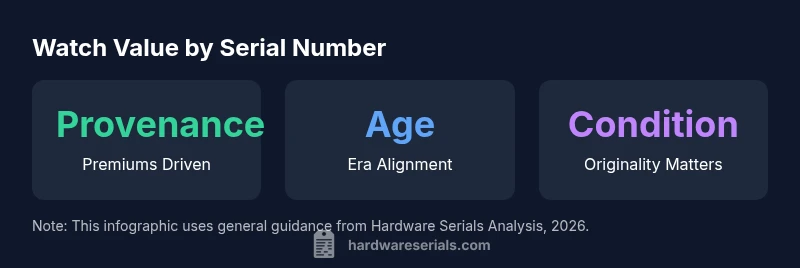
Beyond the serial, appraisal hinges on provenance, condition, originality, and documentation. Provenance — a verifiable history of ownership — can dramatically affect price, especially when linked to notable collectors or historical events. Condition matters: scratches, dings, dial patina, lume, and bezel insert can swing value by substantial margins. Original parts usually command more than replacements; serviced watches should include evidence of proper, quality maintenance. Documentation such as the original box, warranty papers, receipts for servicing, and a documented service history often shifts the needle. Dial and hands authenticity are critical; drift in lume color, replacement dial mismatches, or non-original hands can erode value even when the serial suggests rarity. Finally, market context plays a role: a watch that aligns with a strong demand in a given era or brand family may fetch a premium independent of its serial code. The takeaway is that serial data should be one of several data points in a holistic valuation process, not a standalone verdict.
How to verify serial numbers and avoid fakes
Verification starts with a careful physical inspection: check the caseback engravings, lug codes, and movement serials, if accessible. Compare the observed serial against brand databases, catalogs, or registry sources that document which ranges were used in which years. Cross-check with service stamps, receipts, and the warranty card to corroborate the serial's claimed era. Look for incongruities: mismatched fonts, missing hallmarks, or serial patterns that do not fit the brand's known serial logic. When in doubt, seek authentication from independent specialists or the brand's own service network. If you're purchasing, request high-resolution photos of the serial area, movement, dial, and caseback, and insist on a professional appraisal before finalizing the deal. In short, serial numbers are valuable clues, but their reliability grows when supported by authentic documentation and expert verification.
Practical appraisal workflow
Develop a practical, repeatable workflow to estimate value from serial data. Step 1: gather all documentation — original box, papers, receipts, and documented service history. Step 2: locate and interpret the serial code using brand-specific guides or expert databases. Step 3: place the watch within a defined era or production run, noting any special editions or unique features. Step 4: compare to reference catalogs and recent sale results to establish a price range. Step 5: assess condition with a structured rubric: case integrity, dial condition, hands, bezel, and movement performance. Step 6: adjust for originality and provenance; factor in any known restoration or replacement parts. Step 7: obtain a professional appraisal or third-party valuation when the numbers matter for insurance, sale, or estate planning. Finally, document the entire decision path so a buyer or curator can audit the rationale behind the valuation. This workflow mirrors industry practices and aligns with Hardware Serials’s data-driven approach.
Market dynamics: auctions vs dealer pricing
Market pricing for watches tied to serial data shifts with demand, venue, and risk. Auctions can reveal true high-end valuation, often driven by provenance and exclusivity, but bidding dynamics and buyer risk also shape outcomes. Dealers may offer copies of high-demand models at a premium but with less volatility, guided by supply, condition, and known sale results. In both cases, serial history can help buyers and sellers set expectations, especially when the serial indicates an era or limited edition. Hardware Serials Analysis, 2026, notes that the same model can trade at a wide range depending on documentation, condition, and the presence of original parts. For sellers, presenting verifiable serial information alongside provenance and service history can reduce price resistance and improve confidence. For buyers, demand and risk tolerance determine how aggressively to bid or pay. The key is to anchor price expectations in verifiable data while remaining aware of market timing and brand-specific trends.
Case studies and common misinterpretations
Case A: A scarce pre-war watch with a well-documented provenance commands a premium despite a modest condition rating, because the serial context confirms a rare production run. Case B: A modern mass-market model with an intact factory seal but no paperwork may carry a small premium based on condition alone, and the serial offers little incremental value. Case C: A counterfeit watch with a forged serial number can fool casual observers; rigorous authentication and independent appraisal are essential. These scenarios show how serial-number analysis interacts with scarcity, provenance, and authenticity. Practitioners should avoid overreliance on serial codes and instead build a dossier that includes documentation, sale history, and expert opinions. The overall lesson is that numbers tell part of the story, but value comes from a complete, verifiable narrative.
The path to an informed valuation
To arrive at an informed value, start with a verified serial record, then layer in provenance, originality, and service history. Use reference catalogs and recent sale data to form a price band, and corroborate with independent authentication when possible. Keep a detailed valuation log so future buyers can audit assumptions and confirm the serial-related context. For professional purchasers and insurers, a formal appraisal report that documents all checks and sources provides the strongest protection and transparency. Hardware Serials advocates a rigorous methodology: read the serial, verify the story behind it, and anchor expectations to observable data and authenticated records. This disciplined approach minimizes guesswork and aligns with market realities in 2026.
Value drivers by category and serial context
| Category | Value Considerations | Typical Documentation |
|---|---|---|
| Vintage (pre-1980) | Wide variance; provenance can boost premiums | Original papers, service records |
| Modern limited editions | Premiums depend on production run | Certificates of authenticity, serial registry |
| Mass-market models | Lower premiums; condition matters | Receipts, box, service history |
Frequently Asked Questions
Does a serial number alone determine a watch's value?
No. Serial numbers are starting points; brand, era, rarity, provenance, and condition all influence final value. A comprehensive appraisal considers multiple data points beyond the serial.
Serial numbers are just one piece of the puzzle; the final value comes from a full appraisal that includes provenance and condition.
Can serial numbers prove authenticity?
Serial numbers can support authenticity but are not foolproof. Forged or substituted digits exist, so authentication should combine serial checks with documentation, movement analysis, and expert evaluation.
Serials help, but you should also verify with experts and official paperwork.
How can I read a serial number from a vintage watch?
Locate the serial in brand-specific locations (caseback, between lugs, or movement). Use brand catalogs or registries to map the code to a production era, and cross-check with service records.
Check the serial location and compare with brand references and service records.
Are modern watches with serial numbers more valuable than older models?
Not necessarily. Modern models can carry premiums for design or limited runs, but vintage pieces often dominate on rarity and provenance. Serial data interacts with market demand in complex ways.
Value depends on rarity and provenance, not just age.
What should I collect to support a valuation?
Collect original box, papers, receipts, and a documented service history. Provenance and authenticity records strengthen the valuation and reduce buyer risk.
Keep the paperwork; it makes the value clearer to buyers and appraisers.
“Serial numbers are a diagnostic tool, not a standalone valuation. When paired with provenance and condition, they help unlock true market value.”
Key Takeaways
- Read serials in brand context and catalogs.
- Provenance and originality often drive premiums.
- Authenticate and verify paperwork before valuing.
- Use a structured appraisal workflow for accuracy.
- Serials inform value but do not determine it alone.