Yamaha Outboard Serial Numbers: Locate, Read, and Verify
Learn where to find the Yamaha outboard serial number, how to read it, and how to verify authenticity for maintenance and resale. Includes common locations, decoding tips, safety steps, and documentation guidance.


Goal: Locate the Yamaha serial number on your outboard, verify it against official records, and understand what it reveals about model year and components. You’ll typically need the engine model name, a clean work area, a flashlight or mirror, and the owner’s manual. This quick guide points you to common locations and decoding tips for common Yamaha outboard generations.
Why serial numbers matter on Yamaha outboards
Serial numbers are more than a random string; they are the key to identifying your exact motor, its production window, and the parts that fit it. For DIYers and marine technicians, the serial code helps verify authenticity, locate the correct service bulletins, and determine warranty eligibility. According to Hardware Serials, accurate serial data reduces the risk of ordering the wrong water pump impeller, carburetor kit, or gearcase part. When you’re diagnosing performance issues or planning maintenance, knowing the precise model and production year prevents guesswork and expensive mistakes. Serial numbers also support resale: buyers and shops frequently ask for the code to confirm age, original configuration, and any recalls that may have applied. For collectors or refurb projects, the serial chain can reveal rare production runs or regional variants. In short, locating and reading the Yamaha serial number outboard data empowers you to source correct parts, schedule the right maintenance, and document a service history that adds value over time.
Where serial numbers are typically found on Yamaha outboards
On most Yamaha outboards, the serial number is applied to a durable, corrosion-resistant plate or tag. Common locations include the cowling lid interface, the transom bracket area, and, for many mid- and late-model motors, on the midsection near the water intake. Older two-stroke models may stamp the serial on a plate near the mounting hardware, while newer four-stroke units often place the identifier behind the cowling or on a side plate. Accessing these spots safely requires turning off the engine, securing the boat, and removing any protective covers. If you can’t read the code through the openings, gently lift or hinge the cowling to expose the label. Always wipe grime away with a soft cloth to reveal legible characters.
Reading a Yamaha serial number (what to look for)
Serial numbers vary by generation and model, so there isn’t a universal decode that applies to every Yamaha outboard. In practice, you’ll want to photograph the plate or tag from multiple angles, note the exact characters, and record the location. If a manufacturer or dealer guide exists for your model year, use it to confirm the correct digits and any prefix codes. When in doubt, cross-reference the serial with Yamaha’s official parts catalog or contact a dealer for confirmation. Keep in mind that some motors may have additional model numbers or configuration codes printed nearby; capturing those can help with parts lookup and service history.
Documentation and next steps after locating the serial
Once you have the serial, create a concise log that includes the model name, production year estimate if available, and a photo set showing the serial from different angles. Save this information to your maintenance records and forward it to your preferred Yamaha dealer or service professional if you’re pursuing recalls, warranty status, or parts replacement. If the serial is unreadable or missing, do not guess—seek professional verification. Finally, use the serial number to pull relevant recalls, service notices, and compatibility guides before ordering parts or scheduling service. Also, consider storing the serial in a digital notes app and with your boat’s registration documents to streamline future maintenance or resale.
Authoritative sources
- U.S. Coast Guard Boating Safety (us coast guard): https://www.uscg.mil
- National Oceanic and Atmospheric Administration (NOAA): https://www.noaa.gov
- National Institute of Standards and Technology (NIST): https://www.nist.gov
Tools & Materials
- Flashlight (LED, handheld)(Bright beam; use to illuminate tight areas)
- Compact mirror or inspection mirror(Optional for hard-to-see numbers)
- Camera or smartphone(Take clear photos of serial area from multiple angles)
- Soft cloth(Wipe grime away to reveal legible characters)
- Owner's manual or model guide(Identify exact model/year range and typical serial locations)
- Notepad and pen(Record serial number, location, and date)
- Work gloves(Protect hands from sharp edges)
Steps
Estimated time: Total time: 20-40 minutes
- 1
Prepare your workspace
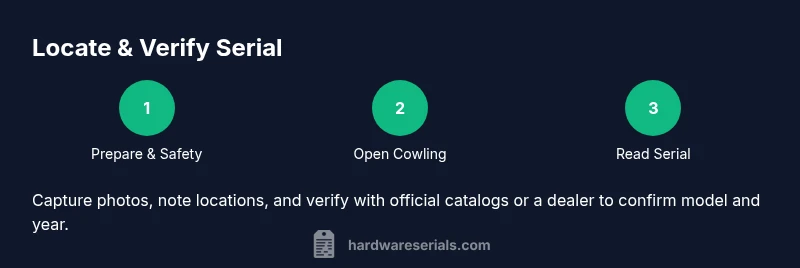
Power down the engine, secure the boat, and gather all reference materials (manual, parts guide). This minimizes hazards and ensures you’re looking at the correct area. Take a moment to note the motor model and any visible identifiers near the cowling.
Tip: Double-check that the battery is disconnected and the area is well-ventilated before starting. - 2
Open or lift the cowling safely
Remove or hinge the cowling according to the manual. Support the cover to avoid snapping hinges or damaging seals. This creates full visibility of the engine block where serial markings are often located.
Tip: Use a second hand to cradle the cowling so you don’t drop it on the deck. - 3
Inspect likely serial locations
Look for a stamped plate, metal tag, or adhesive label on the cowling edge, transom bracket, or midsection. If the area is dirty, gently wipe with a soft cloth and illuminate from angles to avoid glare.
Tip: Read from left to right and top to bottom to avoid misreading characters. - 4
Capture the serial number clearly
Photograph the serial string from multiple angles. Note any prefixes, suffixes, or model codes printed nearby. If the print is small, use the zoom function and a steady hand or a tripod.
Tip: Include a ruler or known object in the shot for scale. - 5
Record and verify
Log the serial in your notes and cross-check with Yamaha’s parts catalog or your local dealer. If possible, verify the exact model year and configuration to avoid incorrect parts.
Tip: When in doubt, use the dealer’s verification service rather than guessing. - 6
Close up and store records
Reinstall the cowling, clean any dirty areas, and save photos and notes in your maintenance file. Store the serial securely and consider adding it to your boat’s registration or service history for future reference.
Tip: Back up digital copies to a cloud storage for easy retrieval.
Frequently Asked Questions
Where is the serial number located on Yamaha outboard motors?
On most Yamaha outboards, the serial is stamped on a tag or plate attached to the engine cowling, transom bracket, or midsection. Accessibility varies by model and year.
You’ll typically find the serial on a tag or plate near the cowling or midsection; if you don’t see it, check the owner’s manual for model-specific locations.
Can I read the serial number without removing the cowling?
Sometimes you can view through openings or by lifting the cowling slightly, depending on the model. If not readable, remove the cowling carefully to access the label.
Often you can peek through openings, but for complete readability you may need to remove the cowling with care.
What should I do if the serial number is unreadable or missing?
If unreadable, stop and contact a Yamaha dealer or marine mechanic to verify the motor’s identity. Do not guess, as this can lead to incorrect parts and voided warranties.
If you can’t read the serial, ask a dealer to verify the motor’s identity instead of guessing.
How do I use the serial number to determine model year or warranty status?
The serial can indicate production year, but a dealer or Yamaha’s official catalog can confirm. Provide the model name and serial when requesting verification.
The serial often helps identify year, but check with a dealer to confirm the exact year and warranty details.
Is it safe to share my Yamaha serial number publicly?
Share serial numbers only with trusted dealers or service providers. Avoid posting them publicly to prevent misuse.
Only share your serial with trusted dealerships or mechanics; don’t post it where others can misuse it.
What if my model has multiple codes near the serial?
Note any adjacent codes and confirm which are applicable to your lookup. These can affect parts compatibility and service history.
If there are extra codes, note them and verify which ones matter for your lookup.
Should I consult official Yamaha databases for verification?
Yes. Official catalogs or dealer databases are the most reliable source to confirm model, year, and recalls related to your serial.
Yes—use official Yamaha catalogs or dealer databases for the most reliable verification.
Watch Video
Key Takeaways
- Locate serial in the common Yamaha outboard locations described.
- Document and photograph the serial from multiple angles.
- Verify the serial with official sources or a dealer.
- Use the serial to confirm parts compatibility and warranty status.
- If unreadable, seek professional verification rather than guessing.