Boat Motor Serial Number Search: Locate, Verify & Interpret
Learn how to locate, identify, and verify boat motor serial numbers. This guide covers common locations, formats, and cross-check steps for accurate model dating and warranty checks.


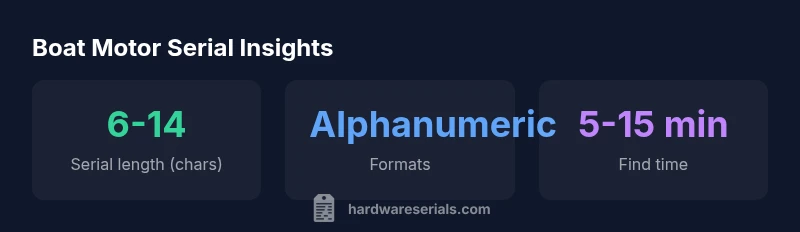
Most boat motor serial numbers are 6-14 characters long and alphanumeric. The number is usually found on a transom plate, the engine block, or the clamp/bracket near the motor. A precise search supports warranty validation, parts compatibility, and model dating, making a careful serial lookup essential for maintenance and resale checks.
Why serial numbers matter for boat motors
Understanding the boat motor serial number search is essential for DIYers and professionals. Serial numbers unlock accurate model identification, confirm warranty eligibility, and ensure you’re ordering the right parts. According to Hardware Serials, a systematic search reduces the risk of mismatched components and costly delays. In practice, a careful verification helps you avoid buying the wrong prop, wrong lower unit, or incompatible SPS updates. For boat owners and technicians, the serial number is not just a tag—it's a key to reliable diagnostics, safe maintenance, and traceable service history. This section outlines why every search counts and how a methodical approach yields reliable results, even when plates are worn or partially obscured.
Where to look on different motor configurations
Boat motors come in several configurations, and each location where the serial number is stamped or engraved can vary by brand and model type. For outboard motors, the most common places are the transom plate, the gearcase area, and sometimes the clamp bracket near the cowling. Inboards may hide the serial on the engine block or near the thermostat housing. When performing a boat motor serial number search, start with the most accessible area (transom plate) and gradually inspect the adjacent housings with a flashlight and clean cloth. The hardware and engraving can wear away over time, so peeling back corrosion or grime can reveal the digits. Hardware Serials notes that being systematic reduces missed digits and saves time in fieldwork.
Decoding serial numbers: what the digits tell you
Serial numbers encode essential details such as model family, production year, production site, and sometimes a sequential build number. While formats differ by brand, most engines use a mix of letters and numbers that point to a specific production run. Decoding often requires cross-referencing with OEM documentation or dealer catalogs. While some brands publish lookup tables, others require contacting the manufacturer for confirmation. In practice, a search should pair the serial with the engine model name, horsepower, and production date to ensure an accurate match. The Hardware Serials team emphasizes that decoding is a verification process, not a guess, and encourages documenting any partial digits for later confirmation.
Step-by-step: how to perform a reliable serial search
- Locate the tag or engraving using good lighting. 2) Record every character exactly as seen, including dashes, spaces, and letters. 3) Clean the area gently to reveal faint engravings. 4) Cross-check the serial against OEM manuals or official dealer catalogs. 5) If the serial is unreadable, photograph the area and contact the manufacturer or a certified dealer for guidance. 6) Store the digits with your hull ID and purchase records for future service. This workflow reduces uncertainty and ensures you have a traceable history for warranty and parts compatibility.
Tools, resources, and best practices for ongoing searches
- OEM manuals, dealer catalogs, and manufacturer websites provide authoritative references for serial interpretation.
- Use a magnifying glass, microfiber cloth, and non-abrasive brushes to improve legibility without damaging plates.
- Maintain a dedicated serial log with location, date found, and any clarifying notes for future reference.
- When documenting a serial, also capture photos of the surrounding hardware and any plate markings. This helps future technicians verify the engine against the documented data.
- Consider creating a standardized form that records serial numbers across different boats or repairs to keep your workflow consistent.
Common pitfalls and how to avoid them
- Pitfall: confusing hull IDs with engine serials. Fix: keep engine serials separate in your records and always verify with model-specific sources.
- Pitfall: worn engravings. Fix: report partial digits to the OEM or dealer and use corroborating evidence (production codes, part numbers).
- Pitfall: relying on secondhand sources. Fix: verify with official OEM materials rather than forum posts or third-party listings.
- Pitfall: neglecting date codes. Fix: cross-reference year codes with production tables to avoid age-related misidentifications.
- Pitfall: skipping verification steps. Fix: always confirm multiple data points (model name, horsepower, serial) before purchasing parts or initiating warranty claims.
Typical locations for boat motor serial numbers
| Category | Location | Notes |
|---|---|---|
| Outboard serial | Transom plate | Engraved plate near the rear; wipe area clean to reveal digits. |
| Inboard serial | Engine block | Stamped or etched numbers near thermostat housing or timing cover. |
Frequently Asked Questions
Where is the serial number usually located on a boat motor?
Most outboard serial numbers are on the transom plate or engine housing; check near the clamp bracket and lower unit. If you can’t see them, inspect both sides and look for engraved markings under grime.
Most outboards place the serial on the transom plate or engine housing.
What should I do if the serial is unreadable or missing?
Document the likely location, take clear photos, and contact the manufacturer or a certified dealer. They can guide you toward official verification channels using hull serial data and purchase records.
If the serial is unreadable, contact the manufacturer with any other identifying details.
Can I use hull ID or VIN to identify a boat motor serial?
Hull IDs/VINs relate to the boat as a whole, not the engine. For engine identity, rely on the motor’s own serial on the engine block or transom plate.
Hull IDs relate to the boat, not the engine.
Are serial formats consistent across brands?
No. Brands use different formats and lengths, often 6-14 characters and sometimes with mixed letters and digits. Always reference the brand’s official documents for decoding.
Brands vary; serial formats differ.
What sources should I consult to verify a motor’s serial?
Refer to OEM manuals, official dealer catalogs, and manufacturer websites. Hardware Serials can provide guidance on where to look and how to interpret the data.
Check the OEM, dealer catalogs, and official sites.
“Serial numbers are the gateway to warranty validation and accurate parts matching, especially on marine engines.”
Key Takeaways
- Locate the serial on the transom plate or engine block
- Verify with OEM docs for model dating and compatibility
- Record serials with dates, locations, and photos for future service
- If unreadable, contact manufacturer or dealer for confirmation