Boat Trailer Serial Number Lookup: A Practical How-To
Learn how to locate, verify, and interpret your boat trailer serial number with a practical, step-by-step approach. Includes tools, common locations, and official sources for accurate ownership records.


With this quick guide you will learn how to locate a boat trailer serial number, what the number represents, and how to verify ownership and registration. You'll identify common plate locations, gather essential documents, and use trusted databases to confirm the data. This quick answer sets up the full, detailed lookup process.
Why boat trailer serial number lookup matters for safety and ownership
A boat trailer serial number lookup is more than a bureaucratic hurdle; it is the key to unlocking accurate ownership records, parts compatibility, and insurance claims. The numbers on your trailer can reveal the manufacturer, model, year, and build sequence, helping you verify you’ve got the right parts and correct registrations. According to Hardware Serials, many boat owners underestimate how often a missing or illegible serial plate leads to delays in service, recalls, and title transfers. The Hardware Serials Team found that systematic checks reduce risk during resale, rental, or transfer of ownership, and they provide a clear trail for inspections and financing. In practice, performing a thorough boat trailer serial number lookup saves time and protects your investment, especially in the busy season when buyers and insurers scrutinize documentation. For DIYers and professionals, building a repeatable lookup routine ensures you never guess at critical details again and you always have verifiable data at your fingertips. Keep in mind that some trailers use the hull identification number (HIN) on the boat, which can be cross-referenced to ensure alignment with the trailer data. The goal is to establish a clear, debuggable trail of serial information that can be cited in registrations, insurance, and resale.
As you begin, remember that the exact location and format of serial data vary by manufacturer and country. A robust boat trailer serial number lookup approach accommodates these variations and emphasizes accuracy over speed. In most cases, you will be collecting data from multiple sources and reconciling discrepancies. The more deliberate your process, the less likely you are to run into conflicts during ownership transfers or when ordering parts.
What the serial number tells you and how to interpret it
A serial number isn’t a random tag; it’s a structured data point that can reveal origin, design intent, and production history. In many regions, the serial marks encode a prefix identifying the manufacturer, a year or model code, and a production sequence. A thorough boat trailer serial number lookup often involves decoding these segments and cross-referencing them with manufacturer catalogs, trailer registries, and parts databases. When you interpret the data, you should look for a consistent pattern across sources: a maker prefix, a year-related code, and a sequence number that aligns with the trailer’s build date window. If you encounter an unfamiliar prefix, consult official databases or the manufacturer’s technical resources. Decoding the logic behind the string makes future lookups faster and reduces the chance of ordering incorrect parts. This section helps you understand how to read the codes you encounter during a boat trailer serial number lookup and how to translate them into actionable facts for maintenance, documentation, and compliance.
Common locations to find the trailer serial number and how to access it
Most boat trailers carry the serial number on a metal plate or printed label attached to the frame, typically near the tongue or on a forward cross member. Look along the frame rails near the hitch, behind the coupler, or on the inside face of a frame member close to the wheel well. Some plates are riveted or welded directly into the metal, while others are stickered and may require careful cleaning to reveal the characters. If a plate is missing, broaden your search to the main cross member near the axle, the winch mount, or under the fenders. Always use a bright light and a clean cloth to read lightly etched numbers, and photograph the plate from multiple angles for accuracy. When you complete this boat trailer serial number lookup, also check the hull’s identification number (HIN) on the boat itself, since some registrations reference cross-matched data between trailer and hull records. Cross-verifying data from the plate with the hull and registration records reduces the chance of misidentification and ensures you are working with current, legal information.
Step-by-step approach to a thorough boat trailer serial number lookup
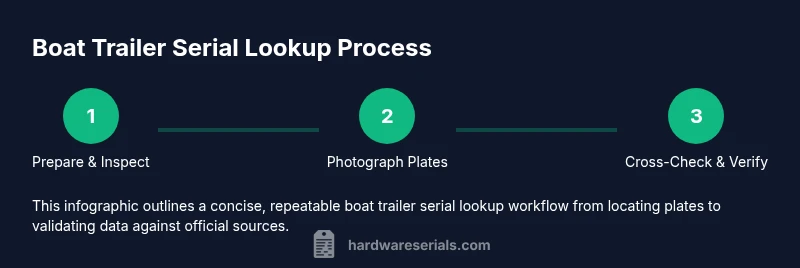
To perform a thorough boat trailer serial number lookup, start by collecting any documentation you have (purchase receipts, previous registrations, insurance policies). Then inspect the trailer for serial marks, beginning at the tongue and moving along the frame rails. Record every serial string you find, including prefixes, letters, digits, and any special characters. Next, photograph the data and transcribe it carefully, cross-checking against any available owner manuals or manufacturer catalogs. After you’ve documented the numbers, consult official sources and registries to validate each entry. Finally, compile a single, reproducible data sheet that links the serial number to its source, and store this securely with your other boat documents. This process reduces ambiguity in future transactions and provides a clear audit trail for registration, insurance, and resale. Pro tip: always validate serial numbers from at least two independent sources to catch transcription errors or plate damage early.
Practical tips for identifying and validating serial numbers on boat trailers
- Inspect both sides of the plate and any etched markings; some plates are obscured by grime, salt, or rust.
- If a plate is missing, look for alternative data like the hull serial (HIN) or the manufacturer label on the axle housing.
- Photograph every location and maintain a dated archive for future reference.
- When in doubt, contact the manufacturer or a licensed dealer to confirm the correct data format and expected prefixes.
- Always cross-check against registration documents and insurance policies to ensure the numbers match across records.
- Keep your lookup notes organized by date, source, and the exact string found to avoid confusion later.
- If you are working with a used trailer, treat any discrepancies as red flags to investigate before purchase.
- Ensure your data entry is exact; even a minor transcription error can derail verification efforts.
Authority sources and legal context for boat trailer serialization
When performing a boat trailer serial number lookup, rely on authoritative sources to verify data. Government registries and official manufacturer portals provide the most reliable references for serial prefixes and model year codes. Always check that the data you collect aligns with your state or country’s registration requirements. The consistency between the serial number and the trailer’s documentation (title, registration, and insurance) is essential for lawful ownership and transfer. If you encounter conflicting information, document each source and consult with a registered marine dealer or the regulatory authority for guidance. This alignment reduces the risk of purchasing, registering, or insuring a trailer with faulty or fraudulent data. By following a disciplined lookup process, you ensure that your boat trailer serial number lookup yields trustworthy, verifiable results that support safe operation and lawful ownership.
Tools & Materials
- Owner's manual and any previous registration documents(Have them on hand to cross-check model numbers and prefixes)
- Flashlight or headlamp(Use a bright light to read etched or small text)
- Digital camera or smartphone(Take clear photos of serial plates from multiple angles)
- Notepad and pen(Record plate location, observed strings, and source URLs)
- Measuring tape(Helpful for locating plates near standard cross members)
- Access to manufacturer catalogs or official registries(Online or printed resources for decoding prefixes and year codes)
Steps
Estimated time: 60-90 minutes
- 1
Prepare and gather documents
Collect the trailer’s purchase papers, registration documents, and any manuals. This gives you a baseline for cross-referencing serial data and reduces back-and-forth later.
Tip: Label documents by source to avoid mixing up serial numbers from different trailers. - 2
Inspect potential plate locations
Visually scan the tongue, frame rails, and front cross member for plates or etched marks. Use a flashlight to reveal faint engravings and take high-resolution photos.
Tip: Don’t assume a single location; some manufacturers place data on the axle housing or inside the fender wells. - 3
Transcribe and photograph
Carefully record every character, noting any ambiguous segments. Photograph both sides of the plate and capture context (mounting screws, plate style).
Tip: Double-check letters that resemble numbers (0 vs O, 1 vs l) to prevent transcription errors. - 4
Cross-check with sources
Use manufacturer catalogs and official registries to map the string to a maker, model, and year. Look for consistency across sources.
Tip: If a prefix is unfamiliar, search the factory’s archived documents or contact customer support for validation. - 5
Verify against hull data
If you’re dual-tracking the hull (HIN) and trailer data, ensure both sets align where expected. This helps prevent mismatches during transfer.
Tip: Make a short note if the hull and trailer numbers differ and investigate before purchase or registration. - 6
Document and store findings
Create a consolidated data sheet linking the serial to each source, date, and verification status. Store it securely with the other boat records.
Tip: Back up digital copies to a cloud storage location for redundancy.
Frequently Asked Questions
Where is the most common place to find a boat trailer serial number?
Most boat trailers display the serial number on a metal plate or sticker near the tongue or forward cross member. If not visible there, check the frame rails, near the axle, or under fenders. Always photograph multiple locations.
The serial number is usually on a plate near the hitch, but if you don’t see it there, check the rails and behind the wheels. Take photos from several angles.
Can a boat trailer have a hull identification number (HIN) instead of a trailer serial?
Yes, some owners reference the hull identification number (HIN) for related records. Always verify cross-references with the trailer’s registration and the boat’s documentation to ensure consistency.
Some trailers relate to the hull’s ID, but you should always cross-check with the trailer registration to be sure.
What should I do if the plate is missing or unreadable?
If the plate is missing or illegible, search alternative data locations on the frame, inspect the manual or invoice, and contact the manufacturer or dealer for guidance on the correct data format. Do not guess.
If the plate is unreadable, check other locations and contact the manufacturer for the correct data format.
Why is a boat trailer serial number lookup important during purchase?
A lookup confirms the trailer’s identity, prevents fraud, ensures proper registration, and helps verify compatibility with parts and accessories. It protects you from buying a trailer with mismatched data or questionable history.
Lookup helps prevent fraud and ensures you get a trailer with verifiable identity and proper registration.
Are there legal requirements to keep serial numbers with registration records?
Most jurisdictions require accurate serial data to be associated with the trailer’s registration and title. Keeping an organized data sheet makes transfers easier and reduces disputes with authorities or insurers.
Keep serial data with registration to simplify transfers and avoid disputes.
What sources should I trust for decoding prefixes and year codes?
Use official manufacturer catalogs, government registries, and certified dealer resources. Cross-reference data from multiple sources to confirm the correct interpretation of the serial number.
Trust manufacturer catalogs and official registries, and verify with multiple sources.
Watch Video
Key Takeaways
- Identify and photograph every possible serial location.
- Cross-check numbers against official catalogs and registries.
- Document sources and maintain an auditable trail.
- Verify alignment with hull data when available.