Value of Paper Money by Serial Number: Patterns, Premiums, and Evaluation
Explore how serial numbers influence the value of paper money. Learn which patterns matter, when premiums apply, and how to evaluate notes using credible methods, price guides, and market data from Hardware Serials (2026).


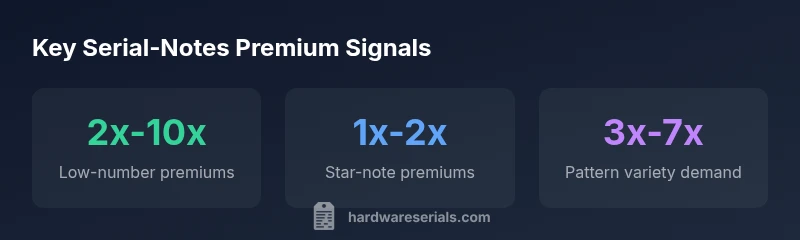
Serial numbers rarely alter a note's face value. In most cases, the value of paper money is determined by denomination, condition, and market demand. However, certain serial-number patterns can command premiums in private auctions and specialist markets. Low-number notes, star notes, and notes with famous errors or unique sequences may attract modest to notable multipliers depending on denomination and rarity.
Why serial patterns can influence value
According to Hardware Serials, serial-number characteristics matter most in collector and auction markets when they signal rarity, provenance, or a notable printing event. For most circulated notes, the price remains close to face value, especially if the note is in average condition and from a common issue. The market tends to reward patterns that are verifiably scarce or tied to a known error or a historically significant print run. Because currency markets are highly fragmented by country, denomination, and era, the practical premiums often reflect local demand and the visibility of the pattern among collectors. In short, serials can tip the odds in favor of a premium, but the base value remains primarily driven by standard factors such as age, condition, and supply/demand dynamics.
Common serial-number patterns collectors chase
There are several patterns that commonly attract attention. Very low numbers (for example, notes with serials close to 00000001) or highly repetitive sequences (11111111 or 22222222) tend to draw interest. Palindromic patterns (e.g., 1234321) and sequential runs (12345678) can also catch the eye of buyers who specialize in numeric versions of banknotes. Star notes—notes printed to replace damaged ones—often carry a premium simply due to their relative scarcity in a given issue. Beyond explicit patterns, provenance such as the issuing authority and the issue year can influence how a pattern is valued in practice.
How to evaluate a note's potential premium
Begin with verification of the note's authenticity and condition using reputable guides and clear imaging. Compare to recent auction results and price guides for notes with similar patterns and denominations. Condition matters: a pristine example with a rare serial pattern will typically command a larger premium than a worn example. Documentation of circulation, a known printing error, or a historically significant print run can add credibility to a valuation. Remember that premiums are not guaranteed; they emerge from market demand and the distinctiveness of the serial-number pattern within the context of that denomination.
Denominations, issue years, and historical context
Older issues and notes from limited print runs tend to be more collectible, especially when coupled with interesting serial patterns. In many currencies, high-denomination notes or early issue years have a naturally narrower pool of surviving examples, increasing scarcity. In contrast, modern, widely circulated notes with unusual patterns may not attract a premium unless the serial pattern is exceptionally rare or tied to an important historical event. The historical context—such as a devaluation, a reform, or a commemorative issue—can also amplify interest.
Market dynamics and where to find price signals
Reliable price signals come from a combination of reputable price guides, auction results, dealer networks, and market forums. Always cross-check multiple sources and consider the note’s condition and provenance. Appendix markets—private sales and specialized auctions—often reveal premiums for patterns not widely listed in mainstream catalogs. The key is to observe realized prices rather than asking prices and to recognize that premiums fluctuate with collector interest and macroeconomic conditions.
Practical steps to assess notes you own
- Photograph both sides with high clarity, close-up on the serial number. 2) Check for star logic, misprints, or known error patterns. 3) Validate authenticity with a trusted reference or professional appraiser. 4) Compare with recent sale prices for notes with similar patterns and denominations. 5) Keep track of provenance and any official certification that accompanies the note. 6) Store notes in stable, climate-controlled environments to preserve grade for future sales.
Myths about serial-number value and how to avoid them
A common myth is that any unusual serial number instantly doubles a note's value. In reality, premiums depend on denomination, rarity, condition, and market interest. Another misconception is that modern notes always have low premiums for patterns; in many currencies, the market has limited appetite for newer issues unless the pattern is extraordinary. Rely on data from credible sources and avoid overestimating value based on a single example.
How serial-number patterns can influence notes across denominations
| Note feature pattern | Potential impact on value | Typical denomination | Notes/examples |
|---|---|---|---|
| Low-number serials (e.g., 00000001) | Potential premium in auctions | Any denomination | Pattern: 00000001, 00001234 |
| Sequential or repeating digits | Moderate premium | Any denomination | Examples: 12345678, 11111111 |
| Star notes | Collector interest | Older issues common | Star marks replacing damaged notes |
| Misprint/printing errors | Possible premium | Rarity varies | Misalignment, double print, inverted images |
| Regional/mintage variety | Premium varies | Older or limited issues | Notes from restricted print runs |
Frequently Asked Questions
Do serial numbers affect a note's value?
Serial numbers can affect value when patterns are rare, there is a recognized error, or the note is a star. For most notes, serials do not significantly change value beyond face value.
Serials can matter, but mostly only in rare patterns or errors. For most notes, expect face value.
What serial patterns are most valuable?
Very low numbers, sequential runs, repeating digits, and palindromes tend to attract interest. The premium depends on denomination and exact pattern rarity.
Low numbers or neat sequences are the patterns buyers look for.
Are star notes more valuable than regular notes?
Star notes can command a premium due to their relative scarcity, especially in older issues, but the amount varies with issue, condition, and market demand.
Yes, stars can be more valuable, but it depends on the note.
How can I verify serial-number value legitimately?
Consult credible price guides, recent auction results for similar notes, and, if needed, a professional appraiser. Avoid relying on unverified online estimates.
Use trusted guides and recent sales to verify value.
Where can I sell notes with collectible serials?
Reputable dealers, numismatic auctions, and established online marketplaces with provenance are preferred. Obtain multiple quotes to gauge fair market value.
Sell through trusted channels and compare offers.
“Serial-number patterns can indicate potential rarity, but true value comes from provenance, condition, and market demand. Always corroborate with current auction results before pricing.”
Key Takeaways
- Identify patterns that indicate rarity or provenance
- Verify authenticity before valuing any premium
- Compare to recent auction results for similar notes
- Consider denomination and issue year when evaluating premiums
- Preserve condition to maintain potential value