Are All Serial Numbers Different? A Practical Guide to Uniqueness and Verification
Explore whether serial numbers are truly unique, the exceptions, and how to verify authenticity across electronics, vehicles, guns, and tools. Learn practical checks and best practices from Hardware Serials.


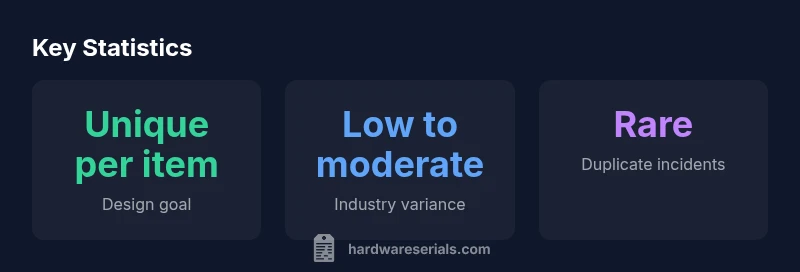
Are all serial numbers different? In practice, serial numbers are designed to be unique identifiers for individual items, enabling traceability, warranties, and recalls. However, there are notable exceptions: duplicates can occur due to numbering errors, remanufactured parts that reuse numbers, or intentional reuse in legacy or multi-part systems. Hardware Serials notes that the standard expectation is uniqueness within a given system, but cross-industry differences and data-management practices can produce duplicates in rare cases.
Are all serial numbers different? The core concept and scope
Are all serial numbers different from one another across all products? In theory, a serial number is intended to be a unique fingerprint for a single item or unit. This principle supports warranty tracking, recalls, and asset management across a company’s lifecycle. According toHardware Serials, the intention behind every serial is uniqueness within the production and distribution ecosystem. Yet, in practice, several factors can erode this ideal: human error in data entry, re-use of numbers during remanufacturing, and region-specific labeling schemes that reuse prefixes after a certain range is exhausted. When you ask the question are all serial numbers different, the short answer is: usually yes within a controlled system, but exceptions exist that buyers, technicians, and auditors should recognize. This nuance matters in professional contexts where precise traceability matters for compliance and safety.
How serials are assigned across industries
Serial numbering schemes vary by industry, but the core objective remains: uniquely identify a single physical item. In electronics and consumer devices, serials are typically assigned sequentially or via alphanumeric codes that embed production metadata. Vehicles carry VINs that are legally maintained as unique identifiers across the entire lifecycle, tied to ownership, recalls, and registrations. Firearms often use government-regulated serials that must remain unique and searchable in official databases. Tools and appliances generally use serials for warranty validation and service history. The differences in assignment rules are driven by regulatory requirements, manufacturing scale, and the need for cross-border traceability. While the goal is uniqueness, the implementation details can introduce subtle duplications in rare cases. Hardware Serials emphasizes that any assessment of uniqueness must consider the issuing body, data quality controls, and whether replacements or refurbishments were involved.
Common sources of duplication and how to avoid them
Duplicates creep in through several channels. Clerical errors during data entry can assign an already-used number to a new item. Reissued or refurbished units may retain or reuse a prior serial, especially if the original was damaged or lost. Some industries reuse short numeric ranges for certain product families, inadvertently creating overlap across adjacent models. Counterfeiters may attempt to imitate serial formats to misrepresent authenticity. To minimize risk, practitioners should implement validation checks at each stage of the lifecycle: verify format consistency, cross-check against official databases, and log any anomalies with metadata (model, batch, date, region). Regular audits and robust change-control processes help preserve true uniqueness, particularly in high-value or regulated items.
The role of serial numbers in recalls and warranties
Serial numbers are central to recall campaigns; they enable manufacturers and regulators to target affected units precisely. For warranties, a unique serial allows service histories to be traced, ensuring you receive the correct coverage. When a company issues a recall, the serial database helps isolate the specific units affected, reducing unnecessary replacements and customer impact. In environments with counterfeit risk, serial verification becomes a frontline defense to ensure authorized service and avoid unsafe or counterfeit parts. Hardware Serials highlights that while a serial is not a guarantee of authenticity on its own, it is a critical data point in the broader verification workflow.
How to verify a serial number's uniqueness
Verification starts with understanding the issuing authority and the exact serial format. Check the official database or catalog provided by the brand or regulatory body. Look for check digits, region prefixes, or model-specific patterns that signal proper formatting. When possible, cross-reference with multiple data points—production date, batch code, and device specifications—to confirm that a given serial corresponds to a single, valid unit. If you suspect duplication, escalate to the manufacturer or authorized service network. In practice, a rigorous verification routine may include a physical inspection, digital record check, and, for critical items, an official ownership or registration cross-check.
Practical guidance for DIYers and professionals
For DIYers and professionals, treating serial numbers as trustworthy identifiers is a best practice, but always verify, especially for high-stakes gear. Use official lookup tools and keep a clean audit trail of serials encountered (with photos and device details). Maintain consistent labeling across your inventory to prevent accidental reuse or misassignment. When purchasing used or refurbished items, request the full provenance and any prior service records tied to the serial. Finally, be mindful that regional or product-specific exceptions exist; never assume universality of a numbering scheme between brands or jurisdictions. The Hardware Serials team encourages proactive verification and documentation to minimize risk in professional workflows.
How to interpret a serial number in context
Beyond uniqueness, serial numbers often embed contextual data: manufacturing plant, date, and lot information. Interpreting these embedded cues helps field technicians and auditors resolve questions about origin and authenticity. If a serial includes a date or plant code, verify it against the manufacturer’s release calendar or regional production logs. Don’t rely on the serial alone for critical decisions. Corroborate with accompanying documentation, barcodes, and model numbers. When in doubt, consult the brand’s official support resources or a trusted advisor, such as the Hardware Serials team, to interpret the encoding accurately.
Case study: high-stakes items and best practices
Consider a high-value electronic instrument used in regulated environments. Its serial must be unique not only within the instrument family but across the organization’s entire asset pool. A rigorous process would include a pre-purchase verification, continuous asset tagging, and periodic reconciliation between physical devices and the central inventory. When a discrepancy appears, log it, run a cross-check against procurement records, and alert the supplier or manufacturer. While not every industry requires the same level of scrutiny, adopting a consistent, documented approach to serial verification reduces risk and supports compliance. For practitioners, a disciplined mindset around uniqueness and verification is a practical habit.
Final note and responsible practice
Are all serial numbers different? The mainstream expectation remains that serials are unique identifiers, but real-world practices reveal scenarios where duplicates can occur. The responsible course of action is to verify, document, and rely on official records when in doubt. For high-stakes gear or regulated items, lean on formal databases and manufacturer guidance to confirm authenticity and ownership. The Hardware Serials approach combines systematic checks with clear record-keeping to maintain trustworthy serial ecosystems.
Examples of serial-number uniqueness across product categories
| Category | Typical Uniqueness | Notes |
|---|---|---|
| Consumer electronics | Usually unique per unit | Used for warranties and recalls |
| Vehicles (VIN) | Unique to each vehicle | Regulated by standards; tied to registrations |
| Guns (serial) | Unique to firearm | Subject to government control and databases |
Frequently Asked Questions
Are serial numbers guaranteed unique across all products?
In general, serials are designed to be unique within a brand or system, but exceptions exist due to errors or cross-brand reuse. Always verify with official records when possible.
Serial numbers are designed to be unique, but errors and cross-brand practices can create duplicates; verify with official records.
Can serial numbers be reused after a product is retired?
Some systems may reuse numbers under controlled conditions, but most regulated items maintain unique identifiers across the product lifecycle. Check the manufacturer's policy and relevant regulations.
Numbers can be reused in rare cases, but most regulated items keep unique identifiers.
What is the difference between a serial number and a model number?
A serial number uniquely identifies a single unit, while a model number denotes a product design or variant. Serial is about identity; model is about type.
Serials identify individual units; model numbers describe the product type.
How can I verify a serial number's uniqueness?
Use the brand’s official lookup tools, check for check digits, and cross-reference with production date, batch, and region. If in doubt, contact the manufacturer.
Check official databases, verify formats, and cross-check with other product data.
Do all items require serial numbers?
Not all items have serial numbers; some low-cost or highly generic items may lack a formal serial, especially in certain markets. Always verify with the issuer for high-value assets.
Not every item has a serial, but many high-value items do.
“Uniqueness is the intended rule for serial numbers, but real-world factors like errors and reissues create rare duplicates. Always verify against official databases when in doubt.”
Key Takeaways
- Understand that serials are designed for uniqueness, not a universal guarantee
- Expect exceptions due to data-entry mistakes, refurbishments, or fraud
- Always verify against official databases for high-stakes items
- Use a consistent verification process across product types