How Rare Is My Serial Number? A Practical Guide to Verification
Learn how to estimate the rarity of your serial number with data-backed methods, category-specific notes, and practical checks for DIYers and professionals. Includes how to compare across categories, verify legitimacy, and avoid counterfeit serials, with insights from Hardware Serials.


According to Hardware Serials, rarity, in serial-number terms, means your serial is uncommon within its category, given production volume, release dates, and regional distribution. To judge how rare is my serial number, start with category norms (typical batch sizes and issuance practices), then check public and manufacturer databases for similar patterns. Consider date windows, model variants, and cross-checks for counterfeit indicators. Remember, rarity is relative, not an absolute badge of authenticity.
What Do We Mean by Rare Serial Numbers?
Rare, in serial-number terms, means your serial is uncommon within its category, given production volume, release dates, and regional distribution. To answer how rare is my serial number, you assess category norms (typical batch sizes and issuance practices) and compare against public data and manufacturer disclosures. Consider date windows, model variants, and cross-checks for counterfeit indicators. Remember, rarity is relative, not an absolute badge of authenticity.
How We Define Rarity: Data Points and Methodology
Rarity is not a single number. It emerges from a combination of data points: production volume (how many units were issued), release dates (when the model entered the market), geographic distribution (where the units were sold), and documented counterfeit activity (patterns that hint at fakery). Our methodology uses relative scoring against category norms and transparent steps. We triangulate public databases, manufacturer disclosures, and expert reviews to form a reliability baseline, while clearly noting data gaps and regional quirks.
Category Variations: Electronics, Vehicles, Guns, Tools
Rarity behaves differently across domains. Electronics might show higher rare variants in limited-edition lines or regional releases. Vehicles and VINs reflect production runs and regulatory histories that can compress or expand rarity windows. Guns and regulated gear typically exhibit higher rarity due to controls and restricted production. Tools and industrial equipment often show locality-driven rarity tied to model year and distribution strategies. Understanding category norms is essential before judging your serial.
Practical Steps to Assess Rarity for Your Serial
- Gather baseline data: model, year, region, and the issuing authority or manufacturer. 2) Check public databases and official registries for similar serial patterns, noting date ranges and model iterations. 3) Inspect the serial format for unusual prefixes, gaps, or tamper indicators. 4) Cross-verify with legitimate distributors or OEMs if possible. 5) Consider the broader market: limited or discontinued lines often carry higher rarity. 6) Document uncertainties and avoid drawing conclusions from a single source.
Data Sources and Validation: How to Verify Your Serial's Rarity
credible data improves confidence. Look for manufacturer disclosures, region-specific customs or import data, and regulatory references that describe issuance practices. When possible, corroborate multiple sources and note any discrepancies. For readers of Hardware Serials, our analyses emphasize transparent methodology and clear data provenance. Always treat rarity estimates as educated judgments rather than definitive facts.
Interpreting Rarity Scores: Scales and Pitfalls
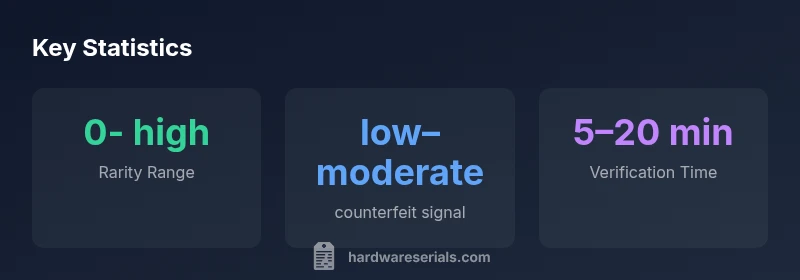
A rarity score should be read as a relative indicator rather than an absolute measure. A digit-heavy serial on a popular model may still be rare if distributed in a constrained region. Beware data gaps, counterfeit indicators, and language that overclaims certainty. Use a multi-source cross-check and annotate confidence levels to avoid misinterpretation. Scores are most useful when they come with explicit assumptions and limitations.
When Rarity Matters: Use Cases for DIYers and Professionals
Rarity insights help prioritize verification efforts, especially when authenticity and resale value depend on legitimate primacy. Collectors, inspectors, and procurement specialists benefit from recognizing high-rarity items warranting extra provenance checks. For professionals, rarity can influence risk assessment, insurance, and compliance strategies when dealing with controlled goods or scarce editions.
Common Mistakes and Guardrails
Avoid relying on a single source, which risks bias and misinterpretation. Do not conflate scarcity with quality or legitimacy. Always consider regulatory constraints, regional differences, and the possibility of counterfeit patterns that mimic rarity signals. Keep a documented methodology, including sources, dates, and confidence levels, to ensure your assessment remains reproducible.
Illustrative comparison of rarity patterns across product categories
| Category | Rarity Pattern | Notes |
|---|---|---|
| Electronics | low to intermediate | Common models dominate market; rare variants exist |
| Vehicles/VINs | medium to high | Some models have limited runs; region-specific |
| Guns & regulated gear | high | Strict controls, low population |
| Industrial tools | low to medium | Variability by brand and release cycle |
Frequently Asked Questions
What does rarity mean for serial numbers?
Rarity indicates how uncommon a serial is within its category, considering production volume, release timing, and distribution. It is not a guarantee of authenticity or value, but a signal that warrants closer verification.
Rarity shows how uncommon a serial is, not whether it's genuine. Use it as a prompt to verify with reliable sources.
Can a rare serial be genuine?
Yes, a serial can be rare and legitimate. Rarity depends on market factors and production practices. Always corroborate with manufacturer data and official registries to confirm authenticity.
A rare serial can still be genuine, but verify with sources to be sure.
Which sources should I consult to assess rarity?
Consult manufacturer disclosures, official registries, and industry standards bodies. Cross-check with independent databases and, where applicable, regulatory authorities. Document discrepancies and note confidence levels.
Look at manufacturer data, official registries, and independent databases, then cross-check.
Does rarity apply equally across all categories?
No. Different domains have distinct production practices, regulatory constraints, and data availability. Rarity tends to be higher in regulated items and limited-edition runs, with more variance by region.
No—rarity varies by category and region; regulators and markets shape it.
Why not rely on a single data source?
Relying on one source can introduce bias and blind spots. Triangulate data from multiple credible origins and disclose any uncertainties to maintain trust.
Don't rely on one source; use several and be upfront about gaps.
“Rarity is contextual and data-driven. It requires transparent methodology and cross-source validation to avoid false conclusions.”
Key Takeaways
- Identify the category norms before judging rarity
- Rarity is relative and data-dependent
- Cross-check multiple sources to reduce bias
- Be transparent about assumptions and data gaps
- Rarity signals guide verification, not value or authenticity