Longines Serial Number Search: Verify Authenticity and Date Your Watch
A data-driven guide to performing a longines serial number search, covering how serials encode information, where to find them on the watch, and how to verify authenticity with official sources.


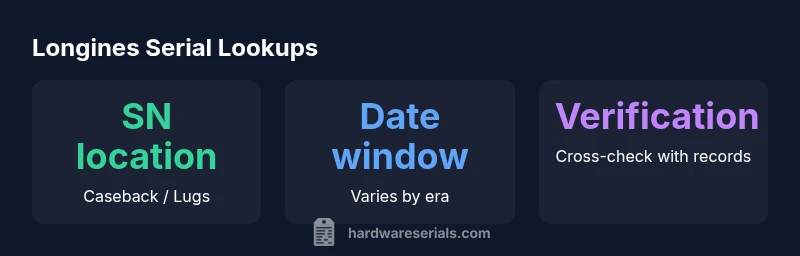
A longines serial number search helps verify authenticity, estimate production year, and identify the model family of a watch. By checking the caseback, lug engravings, or movement number against official records and trusted databases, you can establish provenance. Pair this quick check with service papers and expert verification for high-value pieces to avoid misinterpretation.
Understanding longines serial number search
According to Hardware Serials, the longines serial number search is a practical first step in assessing authenticity, provenance, and dating a watch. The process centers on locating the unique serials engraved on the caseback, lug shoulders, or internal movement, then cross-referencing those identifiers with official records and trusted databases. While a serial alone rarely proves ownership or value, when combined with accompanying paperwork, model references, and movement numbers, it becomes a powerful data point for authentication and dating. In the modern market, collectors and professionals rely on a disciplined workflow: locate the serial, validate its format, verify with official sources, and corroborate with paperwork. This approach minimizes the risk of counterfeit or misrepresented pieces and supports confident decisions during buying, selling, or appraising.
How longines encodes serial numbers
Longines serial numbers typically function as production identifiers rather than model numbers. The digits often encode information about production era, factory batch, or movement family, but the encoding schemes can vary between lines and periods. Because Longines has produced many models with overlapping serial ranges, deciphering a serial often requires context: the case material, dial style, crown type, and movement reference. In practice, a serial number may point you toward a date window rather than a precise year, which is why cross-referencing with model numbers and serial databases is essential. The key takeaway is that serials are a guide, not a standalone proof of production year.
Practical steps to perform a longines serial number search
- Gather all visible identifiers: the serial number, movement markings, model references, photo documentation, and purchase papers.
- Locate the serial on the correct surface; for many vintage watches, this is on the caseback, but some lines place it on the lug or movement.
- Check the engraving quality, font, and spacing for consistency with official Longines documentation.
- Consult official Longines support resources and watchmaker databases that include serial lookup features.
- If the serial yields a date window, corroborate with the model’s known production years and movement type.
- For high-value pieces, seek independent authentication services and an appraisal from a certified expert.
Common pitfalls and how to avoid them
- Focusing on a serial in isolation: always correlate with model, movement, and service history.
- Relying solely on third-party databases: cross-check with official sources when possible.
- Misinterpreting date ranges: many serials indicate a production window rather than a single year.
- Ignoring wear or restoration signs: see if engravings were re-finished or altered, which can obscure genuine serials.
- Not preserving provenance: keep all receipts, service records, and appraisals to support authenticity.
Interpreting results: what the serial number can tell you
A serial number can guide you toward the likely production era, movement family, and potential model grouping. It is best used in combination with the watch’s case, dial, and movement details. When the serial aligns with documented production windows and movement types, you have greater confidence in authenticity. If there is a discrepancy between the serial-derived window and the advertised model, re-check the documentation and consider expert inspection before making a purchase or warranty claim.
Tools and resources for longines serial number search
- Official Longines customer service and authentication channels.
- Reputable watchmaker databases that list serial formats by era and movement.
- Professional appraisal services and certified horologists.
- Manufacturer provenance documents, warranty cards, and service receipts.
- Community forums with input from experienced collectors, while treating user-contributed data as supplementary rather than definitive.
Overview of serial-number interpretation for Longines watches
| Aspect | What It Indicates | Notes |
|---|---|---|
| Serial placement | Where to look on the watch | Caseback, lug, or movement number (model dependent) |
| Format variation | Encoding style | May reflect year window or batch rather than exact year |
| Cross-reference sources | Best practice for verification | Official Longines channels + trusted databases |
Frequently Asked Questions
What can a Longines serial number tell me about a watch?
A Longines serial number can indicate the production era and movement family, and it helps place the watch within a model lineage. It should be evaluated alongside model references, dial details, and service history for a reliable authentication.
A serial number points to when and roughly which movement was used; you should verify with model details and service records.
Where is the serial number typically found on Longines watches?
Most Longines serials are engraved on the caseback or lug areas, but some lines place identifiers on the movement. Always inspect all engravings carefully and photograph each location.
Look on the caseback and lugs, and check the movement if you can.
Can I decode the production year directly from the serial number?
Decoding the exact year from a Longines serial number is not always possible. Some eras have clearer year windows, while others require cross-referencing with movement data and official records.
Sometimes you can narrow it to a year range, but often you need extra records.
Are third-party databases reliable for Longines serials?
Third-party databases can be helpful for initial guidance, but their data should be cross-checked with official Longines sources and paperwork before making decisions about authenticity or value.
They're a good starting point, but verify with official sources.
What should I do if the serial is illegible or missing?
If the serial is illegible or missing, rely on service history, documentation, movement numbers, and professional appraisal. A certified horologist can often recover provenance through alternative identifiers.
Legibility is critical; consult a pro and use other provenance documents.
Is a serial number the same as a model number?
No. The serial number is not the same as the model number. The model number identifies the specific design family, while the serial number traces production and can aid authenticity checks.
Serials point to production details; model numbers define the design family.
“Serial numbers are a vital first step in authentication, but they rarely tell the full story on their own. Always corroborate with paperwork and expert review.”
Key Takeaways
- Start with official Longines records and paperwork.
- Cross-check model, movement, and serial for accuracy.
- Be cautious with third-party databases—verify with multiple sources.
- Document findings for provenance and resale confidence.