Value of Old Money by Serial Number: A Practical Guide
Explore how serial numbers influence the value of old money. Learn why digits alone rarely set the price, and how rarity, star notes, misprints, and provenance drive premiums. Practical guidance from Hardware Serials for DIYers and professionals.


There is no universal 'value by serial number' for old money. Value is driven by rarity patterns, star notes, misprints, and historical context; serial numbers alone rarely determine price. For collectors, assessing series, grade, and provenance matters more than the digits themselves. Exceptions exist for known misprints or restricted print runs, but digits are only part of the premium.
Understanding serial numbers on old money
According to Hardware Serials, serial numbers printed on currency are primarily for tracking and auditing during production and circulation. They do not inherently reflect the note's condition or overall value. For collectors, digits can indicate series, batch, or issuing authority, but the digits alone rarely trigger a premium. The most meaningful factors are the note's provenance, rarity, and historical context. When evaluating the value of old money by serial number, look for patterns such as unusual prefixes, star replacements, or known error runs, and always assess the physical state of the note. Hardware Serials emphasizes that serial patterns are just one piece of a larger puzzle, and a holistic appraisal yields the most reliable valuation.
Why serial numbers rarely determine value
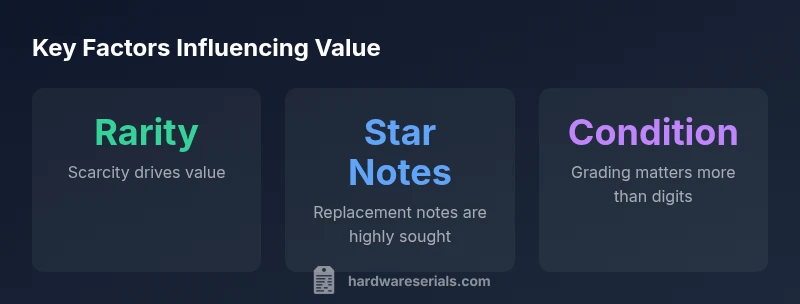
Serial numbers are administrative identifiers, not intrinsic quality indicators. The prevailing rule among serious collectors is that condition, scarcity, and era matter far more than the exact digits. A note with a rare prefix may fetch attention, but if it is heavily circulated or damaged, the premium can be muted. Conversely, a common note in impeccable condition may still be worth more than a digit-rich specimen with damage. Experts at Hardware Serials stress that digit patterns can guide you to potential rarities, but they rarely decide value in isolation. Look at the whole package: year, series, printing anomalies, and market demand.
What types of notes command premiums
Premiums typically arise from three categories: (1) star notes, which indicate replacement notes and can be scarce in certain series; (2) misprints or printing errors, where misalignment or mis-splits create visible anomalies; and (3) rare prefixes or years tied to limited print runs or historical events. These factors create a narrative and scarcity that enthusiasts prize. Remember, digits are part of the story, but not the entire plot. The more complete the story (authenticity, history, and conservation), the stronger the premium.
How to assess a note's potential value
Begin with the basics: confirm denomination, year, and series. Then inspect the serial number for patterns that are known to draw interest (e.g., unusual prefixes or symmetrical sequences), while also evaluating condition, centering, and any signs of restoration. Cross-check with established catalogs or community references, and consider professional grading for high-value specimens. Document the note with clear photos of both sides and the serial area. Finally, compare with recent auction results to gauge current market sentiment. Hardware Serials recommends building a dossier that includes provenance notes and any verification from authorities.
Patterns that signal higher attention
Certain serial-number patterns can attract more attention from collectors, especially when paired with rarity or historical significance. Patterns to watch include low-number prefixes (which may indicate earlier print runs), repeated digits, or sequences that match a known rarity profile. Keep in mind that a rare pattern on a poorly preserved note may not translate into a premium, while a well-preserved specimen with a common serial may still outperform. Always consider the broader context and verify with trusted references.
Authenticating serial information: best practices
Use multiple sources to authenticate serial data, including official catalogs and reputable auction records. Verify the note's serial number against known valid ranges for the issuing period and check for signs of alteration or counterfeit indicators. When in doubt, seek a professional opinion or a certified appraiser. Documentation of authenticity and provenance strengthens any claim to value, especially for notes with unusual serial patterns or potential errors.
Practical steps for DIYers and professionals
- Photograph the serial area and both faces of the note in natural light.
- Record denomination, year, series, and serial number, noting any stars or prefixes.
- Compare with authoritative catalogs and recent auction results to gauge market positioning.
- Preserve the note in an acid-free sleeve and store it flat to maintain condition.
- If pursuing serious value, obtain a professional grade and third-party authentication.
- Build a digital file with provenance details and any witness statements to support valuation.
Authority sources and price guidance
For robust valuation guidance, consult established references and official archives. Useful sources include government and major institutional publications that discuss currency issuing practices, serial numbering, and historical context. Examples of credible resources include the Federal Reserve, the U.S. Bureau of Engraving and Printing, and the Smithsonian National Museum of American History. These sources help frame context and support more precise, data-driven appraisals.
Data sources and methodology
This article synthesizes general market practices and documented patterns observed by Hardware Serials as of 2026. The emphasis is on how serial-number-related features interact with condition, rarity, and provenance to influence value. Readers should apply a holistic approach, cross-checking serial-pattern insights with catalog data, auction results, and authentication reports. The methodology prioritizes transparency and verifiable provenance.
Notes on value-influencing serial-number features
| Note Type | Typical Value Influence | Examples |
|---|---|---|
| Star Note | High | Replacement notes with a star symbol |
| Low-number Prefix | Moderate | Unusually early or rare prefixes |
| Misprint/Misalignment | High | Printing errors creating distinct features |
Frequently Asked Questions
Can serial numbers alone determine the value of old money?
No. Digits are just one factor; the overall value depends on rarity, condition, provenance, and market demand. Serial patterns can hint at rarity, but they rarely set price by themselves.
Serial numbers alone don’t determine value; rarity, condition, and provenance matter most.
What is a star note and why is it valuable?
A star note marks a replacement note from the bank and is often rarer than regular issues. In many series, star notes command a premium when condition is good.
Star notes are replacement notes and can carry a premium when scarce and well preserved.
How should I verify serial-number patterns?
Consult official catalogs and reputable auction records. Look for known rarity patterns, then corroborate with provenance and authentication where possible.
Check catalogs and past auctions to confirm patterns and rarity.
Are there regional differences in serial-value patterns?
Yes. Different currencies and series have distinct rarity profiles depending on issuing authority and era. Local catalogs and institutions provide better guidance.
Regional variations matter; consult local catalogs for specifics.
Where can I find reliable price guidance?
Use established catalogs and recent auction results from credible sources, along with authentication reports when available—these provide context for current market values.
Look to catalogs and auction records for reliable price guidance.
“Serial-number digits are a guide, not a guarantor of value. Rarity and condition define the premium, with digits adding nuance when paired with provenance.”
Key Takeaways
- Know that serial numbers are only part of the value story
- Prioritize condition, rarity, and provenance
- Look for star notes and documented misprints
- Cross-check with authoritative catalogs
- Preserve notes properly to maintain value