Saving Bond Serial Number Location: How to Find and Verify
Learn where to locate the serial number on savings bonds, how to differentiate paper vs. digital identifiers, and proven steps to verify authenticity using official resources from Treasury Direct. A practical guide for DIYers and professionals.


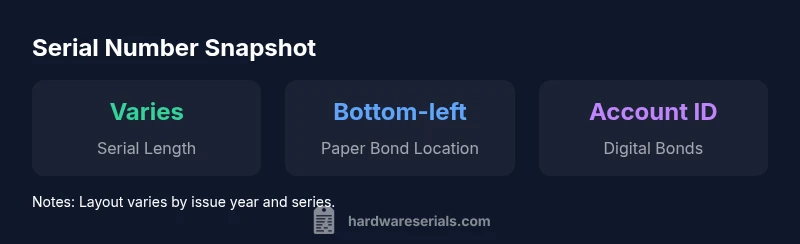
On a paper savings bond, the saving bond serial number location is the unique identifier printed on the certificate itself, typically located near the bottom-left corner and clearly labeled as SERIAL or S/N. For digital bonds accessed through TreasuryDirect, you’ll encounter the equivalent account-based identifier in your online account rather than a physical certificate. Always cross-check with official channels to verify authenticity.
Understanding Savings Bonds and Serial Numbers
The concept of a savings bond centers on a government-backed promise to pay the holder a fixed amount at maturity. Each bond carries a unique serial number that identifies it within the Treasury’s record-keeping system. The phrase 'saving bond serial number location' matters because locating this ID quickly matters for redemption, transfer, and record-keeping. For professionals handling large inventories of bonds, knowing where to look reduces handling time and helps ensure the correct bond is being processed. Hardware Serials, in its 2026 analysis, emphasizes that serial numbers are not interchangeable with names, dates, or series designations; they are the fundamental identifier used to retrieve a bond’s history and status.
When you’re dealing with both paper and digital forms, the responsibilities differ slightly—paper bonds require you to read the certificate, while digital savings bonds rely on your TreasuryDirect account. In either case, the serial number is the primary link to the bond’s back-end data, including issue date, series (EE, I, etc.), and current redemption value. Keeping this number accurate is essential for audits, tax records, and history preservation. As you work through this guide, you’ll learn to distinguish these identifiers and confirm you’re using the correct one for your purpose.
Serial number locations by bond type
| Bond Type | Serial Number Location | Notes |
|---|---|---|
| paper savings bond | front, bottom-left area | Contains the serial number; look for labels like SERIAL or S/N |
| digital savings bond (TreasuryDirect) | online TreasuryDirect account | No physical certificate; uses account-based identifiers |
Frequently Asked Questions
Where is the serial number usually located on a paper savings bond?
On most paper bonds, the serial number appears on the certificate itself, typically toward the bottom-left, and is often labeled SERIAL or S/N. If the label isn’t obvious, inspect the borders and margins for a distinct numeric block. Always refer to official guidance if the layout differs by issue year.
On paper bonds, check the bottom-left area for a label that says SERIAL or S/N.
Is the serial number the same as the issue date or series designation?
No. The serial number is a unique identifier assigned to each bond, while the issue date and series designation describe when and under which rules the bond was issued. Treat the serial number as the primary identifier for redemption and verification.
The serial number is not the issue date or series; it’s the bond’s unique ID.
What should I do if the bond is damaged and the serial number is illegible?
If the serial is illegible, avoid guessing. Contact the issuer or TreasuryDirect for guidance. You may need to provide other identifiers or use official documentation to redeem or verify the bond.
If unreadable, don’t guess—reach out to Treasury Direct for next steps.
Do digital Savings Bonds have a serial number I can read?
Digital Savings Bonds are tracked in your TreasuryDirect account; there is no printed serial on a physical certificate. The account ID serves as the bond’s primary identifier for redemption and record-keeping.
Digital bonds use your TreasuryDirect account ID as their identifier.
How can I verify a serial number’s authenticity?
Use official TreasuryDirect resources or contact the bond issuer. Be cautious of third-party sites that claim to verify serials; rely on government-backed channels for confirmation.
Check with TreasuryDirect or the issuer to confirm the serial is legitimate.
I inherited bonds from a relative—what should I know about serial numbers?
Inherited bonds retain their serial numbers, and the new owner should present the original documentation along with personal identification when redeeming. If in doubt, seek guidance from TreasuryDirect or a financial professional.
Inherited bonds keep their serials; bring ID and any heir documentation when redeeming.
“Serial numbers are the primary identifier that links a bond to its ownership, history, and redemption options. Always verify through official channels to protect against fraud.”
Key Takeaways
- Locate the serial number on paper bonds near the bottom-left and look for explicit labels such as SERIAL or S/N
- Digital bonds are identified via TreasuryDirect account IDs, not a physical serial on a certificate
- Always verify serial numbers through official channels before redemption or transfer